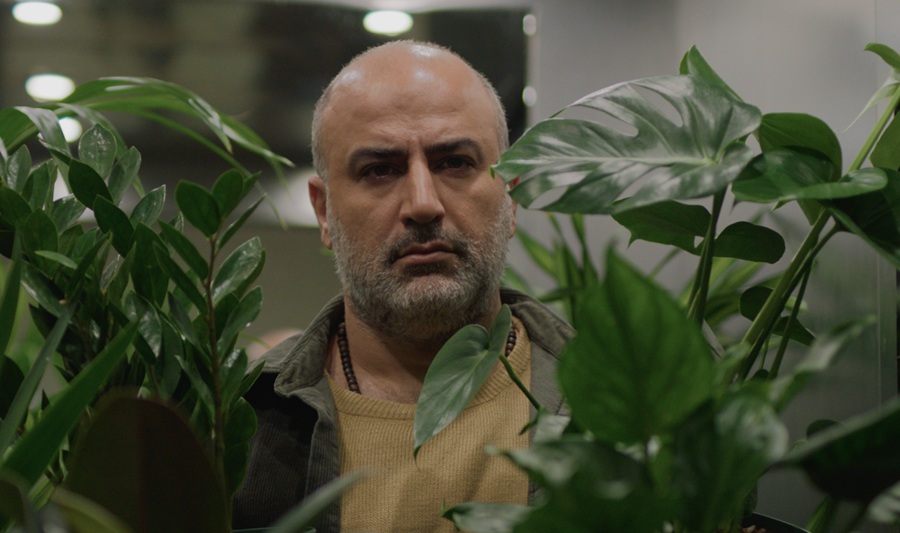
After its world premiere in the main competition at the 2026 Venice International Film Festival, A Bit of Light, directed by Ali Asgari, will have its North American premiere at VIFF 2026. The film follows a doctor whose decision to secretly treat injured protesters leads to his arrest and the closure of his medical practice.
Set-in present-day Iran, the doctor’s sense of purpose is shattered, and he has no hope for the future. He reaches the conclusion that he can no longer go on. He visits his mother and siblings, seemingly for one final farewell. Yet what begins as a goodbye gradually takes an unexpected turn. Surrounded by the warmth, affection, and quiet concern of his family, his resolve begins to waver.
As in much of Asgari’s work, the film places an individual in conflict with forces far larger than himself. What is particularly striking is the subtlety with which the Iranian director, screenwriter, and producer captures his protagonist’s emotional turmoil. He allows this inner struggle to unfold naturally and quietly through intimate family interactions rather than through dramatic exposition.
Asgari shared his thoughts on his new film with Nural Sümbültepe in the interview below.
Nural Sümbültepe: What is at the heart of A Bit of Light?
Ali Asgari: At the heart of A Bit of Light, is the idea that life continues, even in the darkest moments.
I wasn’t interested in making a film that explains the war or tells us what to think about it. I wanted to stay close to the experience of living through it. The feeling that even when everything seems to be falling apart, life somehow keeps moving forward. I wanted to look at ordinary life in a time when war and death are present all around us. The film is about someone who has lost the desire to continue while everything around him seems to insist on the opposite.
Nural Sümbültepe: The doctor, Arash, is considering ending his life, yet he continues to care about others. How do you understand this tension in his character?
Ali Asgari: Arash wants to end his own life, but the life has not stopped being connected to him. For me, this is not a contradiction that needs to be resolved. It is something deeply human. A person can be exhausted by life and, at the same time, still feel responsible for another person, an animal, a plant, or even a small everyday gesture. He has decided that his own life has no meaning, but the world continues to ask something from him. That is the reason I tried to add a sign of life in most of the scenes. In a way, the film asks whether our connection to other lives can survive even when our connection to our own life has become very fragile.
Nural Sümbültepe: The film seems to have been made in a very short time, against the backdrop of a major tragedy in January and the US war against Iran that followed. How did those events shape the film’s development and production?
Ali Asgari: The film came out of a very immediate need to respond to what was happening around us. Although I had some Ideas about life and tragedy at the same time, but the main idea began in the aftermath of the tragedy in January, when ordinary life was already carrying a deep sense of loss and uncertainty. Then the war began, and suddenly the distance between what was happening in the news and what we were experiencing in our everyday lives became almost nonexistent.
We started developing and shooting the film very quickly, because I felt that waiting would somehow change the meaning of what we were trying to capture. We were making the film while living through those events. I wanted to capture that atmosphere.
Nural Sümbültepe: You began filming in Iran and later moved the production to Türkiye. Could you describe what prompted that move and how the change affected the film.
Ali Asgari: We shot exteriors in Iran, but when the bombings began, we had to move some of the interior shooting from Iran to Turkey. So the circumstances of production became part of the film itself. However, I didn’t want to make a film that simply documented the tragedy. I was more interested in what happens to ordinary life when catastrophe is happening beside it; how people continue to work, care for others, look after animals and plants, and simply try to get through another day. In that sense, the difficult circumstances didn’t just shape the production; they became part of the film’s central question. How does life continue when everything around you seems to be telling you that it shouldn’t?
Nural Sümbültepe: As you said, even amid war and despair, life goes on. How would you describe the feelings of Iranians during this period? Does the light in the film represent hope, and if so, is that hope deliberately modest or uncertain?
Ali Asgari: What I felt around me was a mixture of fear, exhaustion, uncertainty, but also a strange persistence. People continued to go to work, meet each other, take care of their families, feed their animals, and worry about very ordinary things. Life didn’t stop simply because something extraordinary was happening around us. That was very important to me.
I didn’t want to represent people only through their suffering. There is also something incredibly powerful in the way ordinary life continues. The light in the film is connected to that persistence, but I wouldn’t call it a clear hope. It is much more fragile and uncertain. I think the film is closer to the idea that life keeps giving us small reasons to continue, even when we are not actively looking for them.
Nural Sümbültepe: The film explores loneliness and despair without explicitly explaining the protagonist’s inner struggles. How important was it to let silence, gestures, and subtle expressions carry the story?
Ali Asgari: The film doesn’t have a classical narrative structure, and I wanted the silences, pauses, gestures, and small changes in his behaviour to carry the emotional weight. Sometimes a look or a very simple action can reveal more than a long conversation. So, it was very important to me not to explain the character’s inner life through dialogue. For me, the audience should have the freedom to enter that inner world themselves.
Nural Sümbültepe: Your films often explore people facing difficult personal and social circumstances. Do you see A Bit of Light as a continuation of themes in your earlier work, or did it lead you in a new creative direction?
Ali Asgari: I see A Bit of Light as a continuation of something that has been present in my films from the beginning: ordinary people finding themselves in situations that are much bigger than they are and trying to find a way through them. But I think this film also takes that interest somewhere quieter. In some of my earlier films, the conflict is more visible and comes from the outside.
Here, the main conflict is much more internal. The protagonist is carrying something that we don’t fully explain. So, in a way, I moved from asking how a person survives a difficult situation to asking what makes someone continue living when they have already lost that desire.
The film also allowed me to work more with silence, duration, atmosphere and very small gestures, rather than classical storytelling. I think that is a new direction for me, even though the human concern at the centre of it is very close to what I have always been interested in.
Nural Sümbültepe: What’s next for you? Are there any upcoming projects you’re working on or considering that you can share with us?
Ali Asgari: Unfortunately, filmmaking in Iran has its own difficulties, and it makes it very hard to plan too far ahead. Financially and practically, things can change very quickly, and you never really know what circumstances you will be facing when you want to make a film.
I usually try to make my films at the moment when I feel I need to make them. I don’t really have the possibility of making long-term plans around them, because something can happen at any moment and change everything. So, honestly, I can’t say exactly what my next film will be or where it will happen. But I always have ideas in my head. Some of them have been there for years, and some may suddenly become a film when the right moment comes.
Nural Sümbültepe: You’ve collaborated with Alireza Khatemi before, whom Canadian and Turkish audiences know from The Things You Kill. Could you tell us about your past work with Aliraza Khatami?
Ali Asgari: With Alireza we have collaborated on three projects in the past. We developed a very strong creative relationship through those experiences, but for this film I felt that I wanted to work with a different writer who can bring different point of views.
For this film, I wrote the screenplay with Shadmehr Rastin, a veteran Iranian screenwriter, who has also been involved in films that received international recognition, including Oscar-nominated work. Each film asks for a different kind of collaboration, and for A Bit of Light, I felt that Shadmehr was the right person to work with on this story and on the very specific tone I was looking for.
Nural Sümbültepe: Who would you say has been the greatest influence on your work, whether in film or literature?
Ali Asgari: There isn’t one particular filmmaker or writer I would name as my greatest influence. I watch a lot of films, and I have done so for many years, so I think the influence comes from many different places. Sometimes, when I look back at my own films, I can recognize traces of filmmakers whose work I love.
Italian Neorealism, post-Neorealism and French Nouvelle Vague have been very important to me, as well as filmmakers such as Nanni Moretti, the Dardenne brothers, Cristian Mungiu, and even Woody Allen and many more. They are very different filmmakers, but I love their work, and I think, consciously or unconsciously, something from them finds its way into my films.
Literature influences me in a slightly different way. I usually have a literary text, a story, or an idea from literature somewhere in my mind while making a film. For Divine Comedy, it was obviously Dante. For A Bit of Light, Albert Camus’s The Myth of Sisyphus was an important reference for me. So, I don’t think of influence as something fixed. It comes from everything I have watched and read, and sometimes something I read years ago suddenly finds its way into a film.
The Vancouver International Film Festival will screen A Bit of Light will screen at 4 p.m. on Thursday (October 8) at the Park Theatre and at 8:30 p.m. on Sunday (October 11) at Fifth Avenue Cinema. For tickets and more information, visit the VIFF website.
Follow Pancouver on X @PancouverMedia and Bluesky @pancouver.bsky.social. Also find Pancouver on Instagram @PancouverMedia.