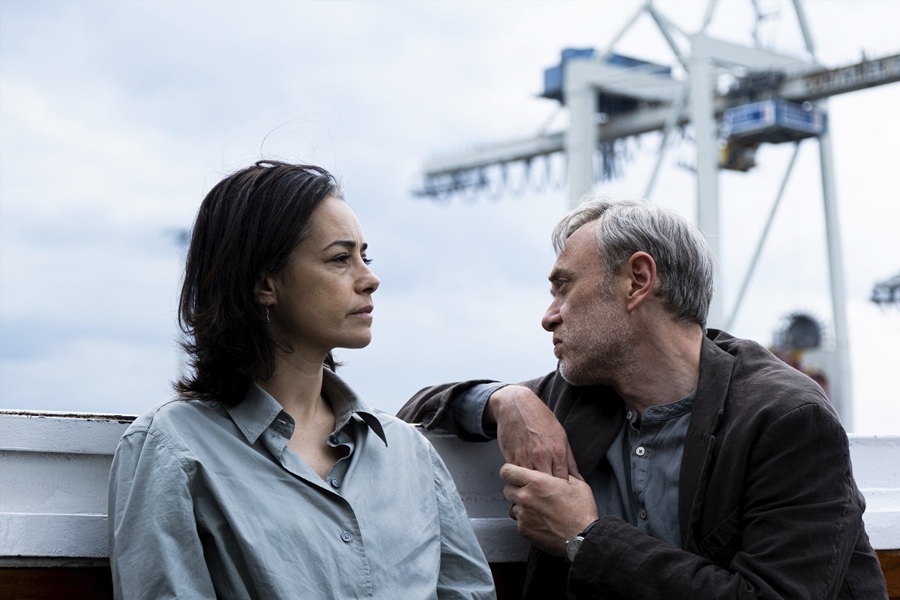
When a few people gather and discuss politics in Türkiye, an outsider will sometimes jokingly ask, “Are you saving the world?” This line, used in Yellow Letters, reflects the essence and tone of the film. At one point, the teenage daughter asks her parents who both work for the state theatre, “You’re just putting on a play—you think you are saving the world?” the father responds with sincere conviction, articulating the film’s main idea: “Yes.”
Can art save the world? Yes, maybe, when it’s left free.
In February 2026, the world of cinema was stirred by Yellow Letters, directed by İlker Çatak, which premiered at the Berlin International Film Festival (Berlinale), one of the world’s largest festivals. It went on to win the Golden Bear award. Considering Berlinale’s political stance (or lack thereof) in Germany’s increasingly right-leaning political climate, the awarding of the top prize to Yellow Letters strikes me as an ironic coincidence. The film critically examines precisely the relationship between art and authoritarian power.
Following Berlinale’s silence on the massacre in Gaza and the festival jury president’s comments that filmmakers should stay away from politics (in relation to Gaza), figures like Arundhati Roy withdrew from the festival in protest. Kaouther Ben Hania, director of The Voice of Hind Rajab, also refused to accept her award.
What happened at the festival, combined with this film’s subject matter, has further inflamed heated debates about the rising right-wing political tendencies and authoritarian governments not only in the Middle East but also in the West.
The Vancouver International Film Festival will present Yellow Letters at the Park Theatre on October 2 and 10 and at the Lindsay Family Stage on Granville Island on October 3.

Yellow Letters tells a story set in Turkiye but was filmed in Germany. In the film, Berlin represents Ankara and Hamburg represents Istanbul. This initially appears to be a practical production decision, but as the film progresses, it becomes clear that it’s a conscious aesthetic choice made to emphasize the universality of the subject, which is the right-wing rise in the world, particularly in the West.
Although many assume that the film was shot in Germany because it wouldn’t have been permitted in Turkiye, Özgü Namal, one of the lead actors, clarified at a news conference that filming in Germany was not a necessity, but a deliberate choice.
The film begins on the opening night of a political play written and directed by Aziz (Tansu Biçer), a university lecturer and a playwright for the state theatre. His wife Derya (Özgü Namal), a renowned actress, stars in the lead role in the play. As the play ends and the applause still reverberates through the theatre, a seemingly insignificant incident unfolds backstage.
Derya refuses a photo request from a government official who has spent much of the performance on his phone and paying little attention to the play. Derya’s minor act of defiance triggers a chain of events that will irrevocably alter the lives of the couple and their teenage daughter. From this point on, everything expands like ripples in the water spreading to other family members and friends alike. Despite its success, the play is canceled. Aziz is removed from his university post and along with colleagues perceived as critical of the establishment and sympathetic to the opposition. Derya is also forced to resign.
Even the sanctuary of their own home is stripped away as they are subjected to mounting pressure and intimidation. They are made uncomfortable in the home where they live. Their careers and artistic identities come under attack and they suffer financial hardship and emotional and psychological stress.
The practices we observe in the state theatre, such as authoritarian management, pressure, and the purging of experienced artists, are not far from what happened in real life in Türkiye in the last few years. These same events also bring to mind the closure of the Kennedy Center amid demands associated with Trump’s agenda.
Finding themselves unemployed and without an income, the family finds a solution in moving from Berlin-Ankara to Hamburg-Istanbul, to live with the grandmother (İpek Bilgin). This decision uproots their teenage daughter Ezgi (Leyla Smyrna Cabas) from her school environment. Although Ezgi loves her grandmother, she clashes with her. The grandmother, once a feminist and intellectual shattered by the defeat of the ’80s coup, has retreated into a more traditional and pragmatic existence spending her days watching Turkish soap operas.
Through the grandmother, İlker Çatak could be exploring whether the same cycle of repression, disillusionment, and retreat is beginning to repeat itself in a new generation. The teenage girl is caught between her grandmother’s earlier feminist self and her later, more traditional persona. In this space Ezgi struggles to define an identity of her own.
Ezgi is depicted as a typical representative of the “TikTok” generation, respectful of her parents yet politically distanced from their idealism, shaped by a media culture of rapid, visual, and constantly shifting content.
Most of the characters are familiar. Derya’s small-business owning conservative brother (Aydın Işık) represents another facet of society. His close ties with government officials around the mosque—together with his reluctance to criticize the state—place him in stark contrast to Aziz and Derya’s idealistic stance.
The film’s three generations (the disillusioned feminist grandmother of the ’80s, the conservative brother, and the social-media addicted teenage girl) received much criticism as one-dimensional and superficial stereotypes. However, I think Çatak wants us to focus not so much on the depth of these characters, but what they represent within a broader political landscape. Their apparent simplicity can be read as deliberate. Each embodies a different response to political pressure, disillusionment, conformity, or resistance. What we’re watching, then, is not merely a single family but a portrait of a society, an entire country, or even several countries grappling with similar tensions between individual freedom and political power
One of the film’s most striking scenes takes place at an airport security checkpoint. At first glance, the characters forced undressing appear to be merely security procedure but the scene carries a deeper symbolic meaning. When Derya or Aziz are stripped of their clothes, they are exposed, their reputations destroyed, and they are torn from the identities that define them. The human body, male or female, becomes yet another territory over which the state can assert power and control.
The choice of an airport for the setting is also significant. Airports are spaces of movement, borders, belonging, and surveillance, where one’s right to leave, to enter or pass through is subject to scrutiny. Here Aziz or Derya reduced from citizens with professions and identities to vulnerable bodies.
One of the film’s other memorable moments comes during Aziz’s trial, when we see the date “1933” in the courtroom. By invoking this date, the film draws a disturbing historical parallel between the political pressures depicted in the story and one of the darkest chapters of European history. The film thus establishes a disturbing parallel between today’s political pressures and the bleakest period in Germany.
The reference suggests that authoritarianism does not emerge overnight, but can take shape through the gradual erosion of artistic freedom, individual rights, and institutional independence.
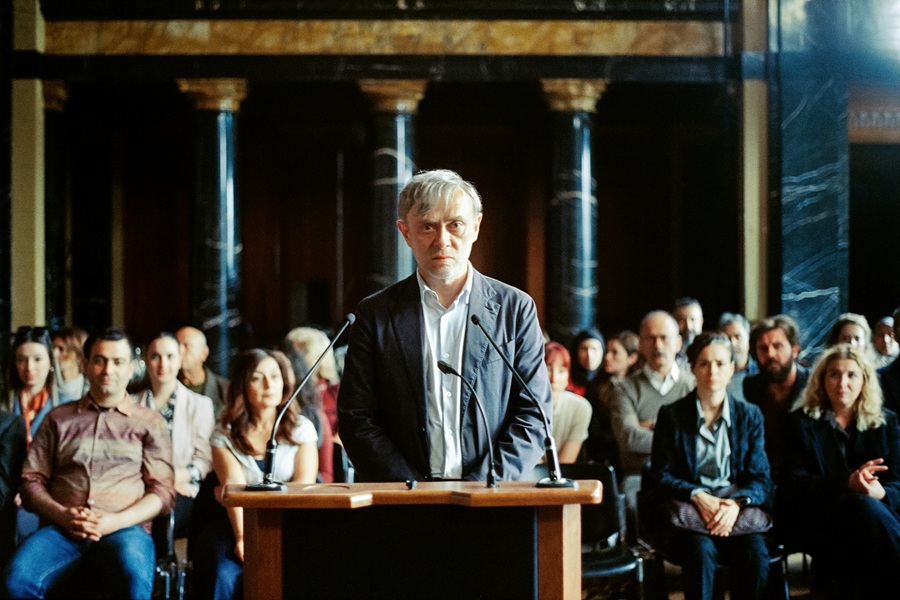
The film references Samuel Beckett. When a student asks, “What are we doing, professor?” Aziz responds, “We’re waiting”; to the question “For what?” he says, “We’re waiting for Godot.” With this political metaphor, like the characters in Beckett’s play, they appear trapped in the political impasse they feel while waiting for justice and change.
A distinctly Brechtian influence runs throughout the film. The transitions between Aziz’s play and the characters’ daily lives recall Brecht’s epic theater, particularly the “alienation effect” (Verfremdungseffekt), which allows us to focus not on personal dramas and events, but on the collective and political systems that brought the characters to this point. German streets, architecture, and the courtroom signage “Everything in the name of the people” (Alles im Namen der Völker) reinforce the sense of estrangement. Germany becomes more than a backdrop; it functions as a deliberate reminder of Europe’s own history with authoritarianism.
Through these visual and theatrical devices, the film suggests that authoritarian tendencies are not confined to a particular geography or political system. The danger is not necessarily somewhere far away; as the director, Catak puts it, it may be “in our own backyard”. And what he means, I think, is Germany.
The film is not as abstract as Kafka’s The Trial, but it carries Kafkaesque traces. Aziz is declared a “terrorist” for criticizing the government and is buried in existential helplessness, dragged through an opaque legal system and suffocating bureaucracy. Footage secretly recorded by one of his students and used as evidence against him in court is reminiscent of the surveillance of “Big Brother” in Orwell’s 1984 and people informing on each other to please the system.
To emphasize this atmosphere of oppression, cinematographer Kaufmann tried to create a sense of confinement, from the choice of cities to interior spaces like apartment buildings and offices. Çatak’s editing, and Marvin Miller’s music for dramatic scene, created with strings reminiscent of Vivaldi’s Winter, sometimes frozen, sometimes dark and full of dramatic crescendos, are also highly effective.
To better understand Yellow Letters, it’s useful to watch Çatak’s first film, The Teachers’ Lounge. In both films, universal concepts such as ethics, conscience, and the struggle for survival are addressed through small communities like schools and families with dialogue-heavy narratives. What begins on a micro scale gradually opens onto a much larger picture. Through the experiences of individuals who strive to act ethically and fairly, the film reveals how people can be progressively squeezed and constrained by institutional and political systems.
Yellow Letters will be remembered not only as a powerful cinematic work that won recognition at Berlinale, but also as an important political warning directed at today’s Türkiye, Europe, and even the USA. It offers a sobering meditation on whether can remain independent, courageous, and truthful under authoritarian politics and on what happens when that freedom is gradually taken away.
The Vancouver International Film Festival will present Yellow Letters at 3:30 p.m. on Friday (October 2) and 6:15 p.m. on October 10 at the Park Theatre. The film will also be screened at 9:30 p.m. on Saturday (October 3) at the Lindsay Family Stage at Granville Island. For tickets and more information, visit the VIFF website.
Nural Sümbültepe is a B.C. teacher. Follow Pancouver on Instagram @PancouverMedia, on X @PancouverMedia, and on Bluesky @pancouver.bsky.social.