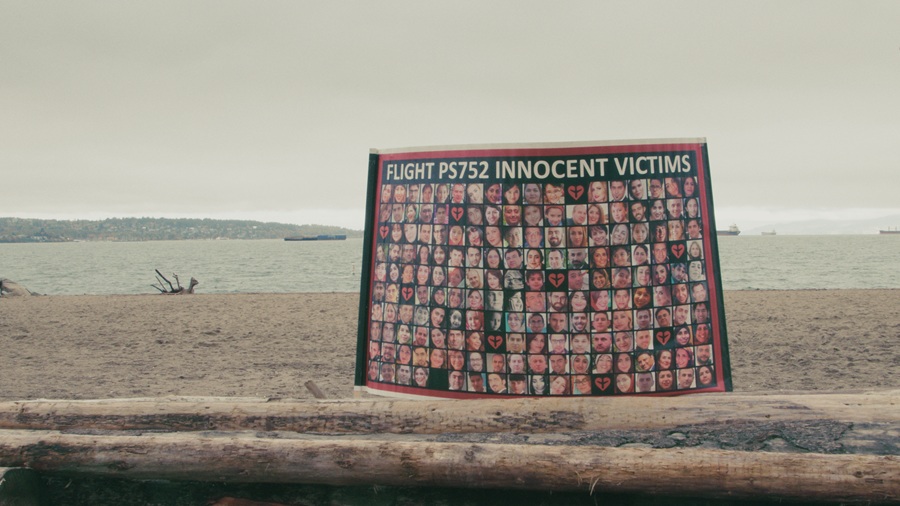
On January 8, 2020, Flight PS752 was shot down by the Islamic Revolutionary Guard Corps (IRGC) shortly after taking off in Tehran, killing all 176 people on board, including dozens of Iranian Canadians. For many families in Canada, the disaster became not only an unimaginable personal loss but also the beginning of a long and difficult search for truth and accountability. The Flight follows Canadian families as they navigate the aftermath, while also documenting their efforts to seek justice alongside lawyers and other families affected by the tragedy.
Rather than focusing solely on the crash itself, The Flight turns its attention to what came after—the years of grief, unanswered questions, and persistent efforts to hold those responsible accountable. The film offers an intimate look at the Iranian Canadian community’s struggle to keep the victims’ stories alive while demanding answers from the Iranian authorities. Moving between deeply personal moments and the broader political and legal battle, it captures how private grief can evolve into collective action.
The Vancouver International Film Festival will present the world premiere of The Flight at 8:15 p.m. on Thursday (October 8) at SFU Woodward’s. There will be a second screening this National Film Board of Canada–produced film at 3:45 p.m. on Sunday (October 11) at the Fifth Avenue Cinema. Kurdish Canadian director Soran Mardookhi will answer questions from the audience at both screenings.
Powerful, devastating, and deeply compassionate, The Flight is ultimately a film about remembrance, resilience, and the determination. Nural Sümbültepe spoke with the director in Vancouver.
Nural Sümbültepe: What made you want to make this film? Why did you feel this story needed to be told through the Iranian Canadian perspective?
Soran Mardookhi: Well, for me, this story wasn’t just about Iran or Canada. It’s about justice and how grief turns into a collective action. This was not the first crime by the Islamic Republic of Iran (IRI). They have been in power more than 40 years. We’ve seen crimes even bigger than this one. People who live in Iran know the regime very well, and they know what they are capable of.
They come into power in 1979. It was exactly the day I was born. They started bombing my hometown first because, in Kurdistan, we had said “No” to this regime. This film for me was not just a news report. Two of my close friends were on that flight. The regime denied that they had shot down the plane for three days. They lied to everyone; to their own people, and to the world, basically. The IRI said it was a technical failure.
After three days, [Justin] Trudeau said the intelligence from multiple sources have enough evidence that the plane was shot down by an Iranian missile. That was when the regime went back and said, “Oh, yeah, that was us, but it was a human error.” Lies after lies. We, especially people in Middle East, can see through them.
I didn’t want to make a film about only loss. What surprised me most was what families of the victims did after the downing of Flight PS752. As I said before, we witness so many tragedies, crimes. We hear it in the news and the news disappears. But the families of the victims on the flight came together and used their loss and grief as a fuel to fight for justice. I wanted to make this activism the main focus for the film.
Nural Sümbültepe: That was my next question. Particularly in Canada, the families transformed their grief into a campaign for accountability and justice. As we see in your film, the families have also pursued accountability through international legal mechanisms, including submitting information to the International Criminal Court (ICC). Unlike the ICJ, which handles disputes between states, the ICC focuses on individual criminal responsibility. These are complex legal processes that can take many years.
Soran Mardookhi: ICJ and ICC are big courts. This is going to be a very long process. International Court of Justice (ICJ) is between countries. Canada, Sweden, Ukraine, and the United Kingdom jointly referred the case against Iran to the International Court of Justice in July 2023.
Some lawyers from International Criminal Court (ICC) represented the families in Canada. That is still ongoing. It will probably take two or three more years. The case is open for ICC. This is not between countries. Individuals can directly sue through ICC, but it is still ongoing.
Nural Sümbültepe: I remember the aftermath of the tragedy. I was driving from work, and I heard a powerful poem, an elegy on CBC by an Iranian woman. I had to pull over because my tears were blurring the road. Then two months later, we had the COVID-19 pandemic. That must have added another layer of loss and isolation for the victims.
How did the proximity of these two events influence the families in the way they mourned? Was that when you decided to, to make this film or was it after COVID?
Soran Mardookhi: I decided to make the film when I heard the news. I didn’t think it was going to be an easy journey for me. I did wait for a year. I didn’t know where the film was going to go. I wanted the families of the deceased to show me the direction.
What the families wanted to do was very important. They are amazing. The families educated themselves; they hired experts, they collected all that evidence, which the Islamic Republic tried to destroy. They built relationships with several institutions, with governments in Canada, in the U.K., Ukraine.
When COVID happened, it was very hard for the families to get together and meet each other. But they did it. They had meetings in the parks, in the parking lots, distancing themselves…but they just kept going with no hesitation. They fought very hard to get where they are right now.

Nural Sümbültepe: It’s quite impressive what they achieved even without a final resolution. They had to take matters into their hands such as hiring independent experts because they couldn’t rely on governments to pursue that.
Soran Mardookhi: We all know, when a government commits a crime, they use all the sources: money, power to change their narrative. You cannot also rely on other governments to follow up or ask for justice, either. What was important in this case—the families did not accept that narrative. They had their own narrative, and they forced Canada, and other countries, to listen to their narratives. They had a lot to do.
Nural Sümbültepe: In Turkish, we say, “Fire burns where it falls,” meaning the people who are mostly affected by this tragedy are the loved ones of the people who died. They will be the ones pursuing justice. What about the Canadian government?
Soran Mardookhi: Well, obviously, when it is fresh news, everybody wants to do something. But there is a lot happening in the world. News gets forgotten. But the families started an association. We must give a lot of credit to that association, because if it wasn’t for that, nobody would even actually remember Flight PS752, especially during COVID.
Nural Sümbültepe: How did you seek consent and how did you get the families of victims to trust you? How did you approach difficult conversations?
Soran Mardookhi: Building trust is not something that happens overnight. For the first year, I talked to many families, not only the people in the film. I talked to so many of them, and without any cameras. It was just casual talk. I was very clear about what kind of movie I wanted to make. I told them what my focus and direction was going to be. I communicated this with my producers too.
I was very ready. everything was clear for me, for the producers. But what I didn’t direct [was] the families on the set. I let them direct me. We kept rolling. Many times, they forgot the camera was even there. I really appreciated that trust that developed. I had so many powerful, emotional moments.
I had to take it out in the editing room. I kept the scenes that helped the families tell their story, but some of those interviews—conversations—were hard to hear. Very powerful, and, emotional. I cut some of the emotional scenes. I didn’t want to take advantage of all those trust they gave me.
There was one thing that I always asked myself: which direction should I go? And they basically showed me the direction and where this film has to go.
There are also a lot of political and legal issues around this case. There are processes and procedures. Those are also part of their story. But I stayed with the families and let them do the talking and let them tell the audience how they live with the pain, and what they are going through.

Nural Sümbültepe: One of the family members, a mother of the victim, says, “There’s nothing in Iran but pain and trouble.” Also, another father says and as you also said, “the Islamic regime has been killing civilians for 46 years.” Another Iranian director at VIFF this year, Ali Asgari, the director of A Bit of Light said in one of his interviews that “people in Iran no longer have high hopes for the future. They wait for good news that never comes.” But he says that he does believe in small specks of hope.
What do you think about what he said? What do you think about hope?
Soran Mardookhi: I cannot speak on behalf of people of Iran. Personally, I think there is always some kind of hope. It’s different what this hope means. What are we expecting to see for the future of the world, not just in Iran or the Middle East but the whole world? Look at history. There were always lots of dark moments in history. Change is coming. When you see the changes, you see the hope as well.
Nural Sümbültepe: Do you feel change is coming? For Iran?
Soran Mardookhi: Definitely. I’m just not sure if it’s good or bad, but change is coming not only in Iran. Everywhere. I cannot tell you if the changes would be for the better or the worse. We’re hoping for the better one.
Nural Sümbültepe: With the “Woman, Life, Freedom” movement and protests and the recent killing of protesters, it’s one tragedy after another. It’s good to have hope even if it is small. What was the most challenging part of making the film? Accessing information, dealing with conflicting accounts, editing?
Soran Mardookhi: The most challenging part was listening to the pain people have, especially when you are talking to a mom, who lost her kids. Even when they are laughing you see the grief. You witness how grief becomes part of their life, and how they live with it.
It’s not easy, of course, but at the same time, watching how those people have so much energy and hope even though they go through unimaginable grief and pain. Talking to them gives me more energy and some sort of hope for a better future. This crime changed everybody’s lives, but they continue to live with the grief.
It was harder in the editing room watching all the footage from the plane. I couldn’t include some of the archival footage in the film. No human being should do that such a thing.

Nural Sümbültepe: What I found really hard was when IRI tried to destroy a tree planted the families want to have as a memorial. They weren’t allowed to have a memorial. They allowed the tree but they tried to kill it and there was surveillance around the tree.
Soran Mardookhi: Yes, that’s typical, and very sad—arresting and harassing the families who are mourning for their loved ones.
Nural Sümbültepe: What do you hope the audience, particularly people who are not familiar with the tragedy of Flight PS752, to take away from your film?
Soran Mardookhi: Well, I want the audience to understand the power of individuals when it comes to fighting for justice. This is the focus of the film. If individuals act in groups, of course, they can be more powerful. Also, I don’t want them to think this film is only about this particular flight and tragedy. It’s about the justice. It’s international and universal.
Nural Sümbültepe: It’s about universal human rights.
Soran Mardookhi: Yes, It’s about human rights. It doesn’t matter where, what country or city or wherever. I’m hoping that the audience will leave with some questions. How can you fight injustice if it happened in your community?
Nural Sümbültepe: Some families wanted to build schools in Iranian Kurdistan to honour their loved ones.
Soran Mardookhi: They did, yes. For example, in Kermanshah in Kurdistan, they have done much more than that. Unfortunately, I had to cut out a lot of things.
Nural Sümbültepe: In a way, you have also created a memorial film for the families, a lasting tribute to their loved ones, if nothing else. Thank you.
The Vancouver International Film Festival will present the world premiere of The Flight at 8:15 p.m. on Thursday (October 8) at SFU Woodward’s. There will be a second screening this National Film Board of Canada–produced film at 3:45 p.m. on Sunday (October 11) at the Fifth Avenue Cinema. Kurdish Canadian director Soran Mardookhi will answer questions from the audience at both screenings. For tickets and more information, visit the VIFF website.