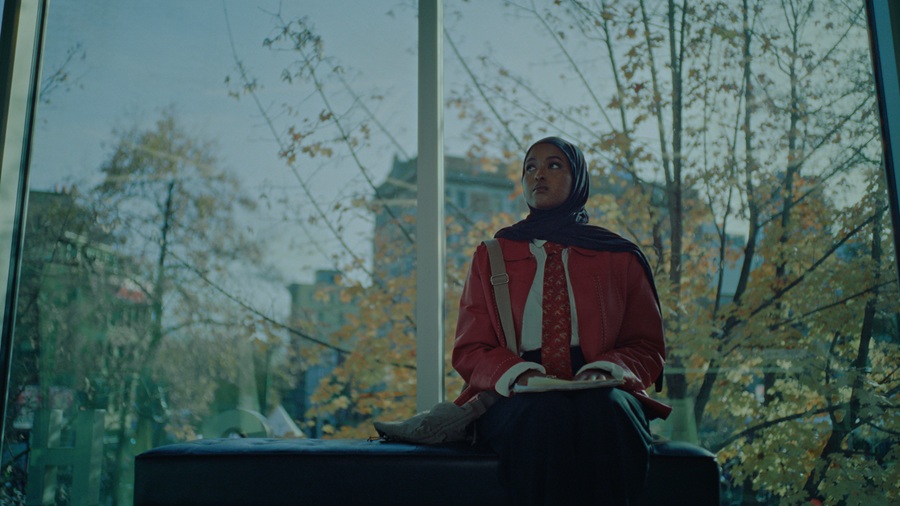
Some of U.S. president Donald Trump’s most racist remarks have been directed against the Somali diaspora. These comments are so reprehensible that they are not going to be republished here. Yet the garbage coming out of Trump’s mouth in the past year makes B.C. director and screenwriter Ilhan Adullahi’s new feature film, Lifeline, timelier than ever because it shatters so many stereotypes about her Somali North American community.
“When I wrote this in 2014, there wasn’t specifically anti-Somali hatred,” Abdullahi tells Pancouver over Zoom. “It was just anti-refugee sentiments. And you always think things are going to get better.”
In those days, she was working as a refugee settlement youth worker in Surrey and Vancouver. It bothered her that the media and feature films would repeat so many tropes about refugees that had nothing in common with the youths she was assisting.
“At the time, I was like, ‘I really want to make some kind of film that centres the community here in Vancouver and Surrey,” Abdullahi says. “So I wrote the script then.”
Mostly filmed in Vancouver, Abdullahi’s debut feature revolves around a charismatic female Somali youth worker named Ibtisam (Muna Abdulahi). She’s assigned to assist a teenage Somali basketball star, Hassan (Hanad Abdi), charged with a serious crime.
Lifeline will have its world premiere at the Vancouver International Film Festival on Thursday (October 8) and Saturday (October 10).

Lifeline challenges assumptions about angry young males
Abdullahi was born in Italy to Somali parents, and she created Ibtisam as a fun-loving, style-conscious, hijab-wearing Muslim.
“Let’s show something very different, where we have this character who’s always wearing bright colours, who’s very cheerful and awkward,” the filmmaker states.
In a subplot, Lifeline reveals intergenerational rifts between Ibtisam and her Somali immigrant mother even as Ibtisam maintains a smooth veneer in public.
“A lot of women in my community in particular, but I think just a lot of women as well, carry so much,” Abdullahi states. “They are expected when they leave the house to just put on a performance.”
Abdullahi points out that there are also many assumptions about angry young males in trouble with the law. So she created Hassan as a well-rounded teenager who loves music, volunteering, spending time with friends, and has his own style.
“So for Hassan’s character, what I wanted to show is that there is this charming kid underneath.”

“Lifeline” short expanded into a feature
The two lead characters have different socioeconomic backgrounds, illustrating the diversity of the Somali diaspora in North America. Hassan’s world starts out a bit darker, whereas Ibtisam is surrounded by brighter colours at home.
“Even though they come from the same ethnic background—the same community—it’s the different realities that people live,” Abdullahi states.
She initially wrote and co-directed an eight-minute short, also called “Lifeline”, which was released in 2024. It starred Abdi, a Somali American, as Hassan, just as in the feature film. In the short, Abdullahi playing the youth worker.
Abdullahi had the female lead character in her head for many years. But it wasn’t until she watched Season 2 of The Mole on Netflix that she became aware of Muna Abdulahi, who’s of Somali ancestry. Muna was one of the contestants on this reality show and she was full of charisma.
“My sister and I were watching it,” Abdullahi recalls. “I’m like, ‘Who is this woman?’”
The two women eventually ran into one another at the Mosquers Film Festival in Edmonton, where Muna was a spoken-word performer.
“She watched my short film and she came to talk to me about the story and how she wants to get into acting… The moment she auditioned, she brought it.”
Abdullahi then cast Muna as Ibtisam for the feature-length version. The film includes several humorous moments and here again, Abdullahi counters the usual ways that asylum seekers are depicted on-screen.
Yet Lifeline is a compelling film as Ibtisam unravels how Hassan ended up in so much trouble. Abdullahi, now an SFU PhD student in health sciences, emphasizes that her film is not inspired by true events.
Community sticks together
Some of the dialogue is in the North Somali dialect. But as the writer and director, Abdullahi opted not to delve into tribal and regional differences within the Somali diaspora.
“I had so many versions of the script that actually did touch upon that,” she acknowledges. “When the brother meets Ibtisam for the first time, we had a whole thing talking about tribalism.”
But in the end, Abdullahi decided to focus on the two central characters’ dynamics.
As the interview draws to a close, Pancouver asks if there is anything particular to the Somali community that she wanted to show in Lifeline.
“Yes, I think one thing is we always show up for each other, no matter what happens,” Abdullahi replies. “There have been so many cases that I’ve seen—whether it’s somebody getting deported because of their refugee status or whether they’re experiencing family reunification issues.
“With things like that, people will always show up,” she adds. “Regardless of where you come from or what your background is, people will always show up. And we saw that happening in Minneapolis with the ICE raids—and everybody collectively coming together.”
The Vancouver International Film Festival will present Lifeline at 7 p.m. on Thursday (October 8) and 4:30 p.m. on Saturday (October 10) at International Village. For more information, visit the VIFF website.
Follow Pancouver on X @PancouverMedia and Bluesky @pancouver.bsky.social. The publication is also on Instagram @PancouverMedia.