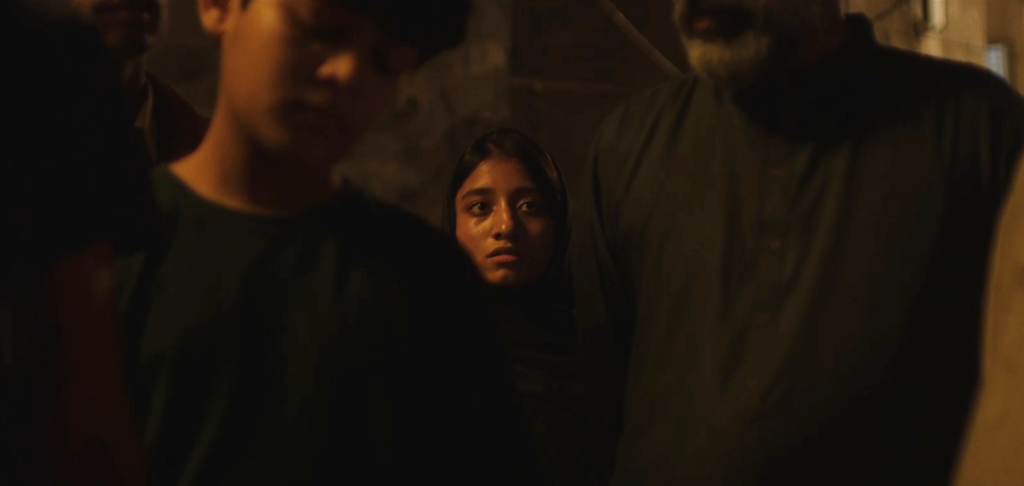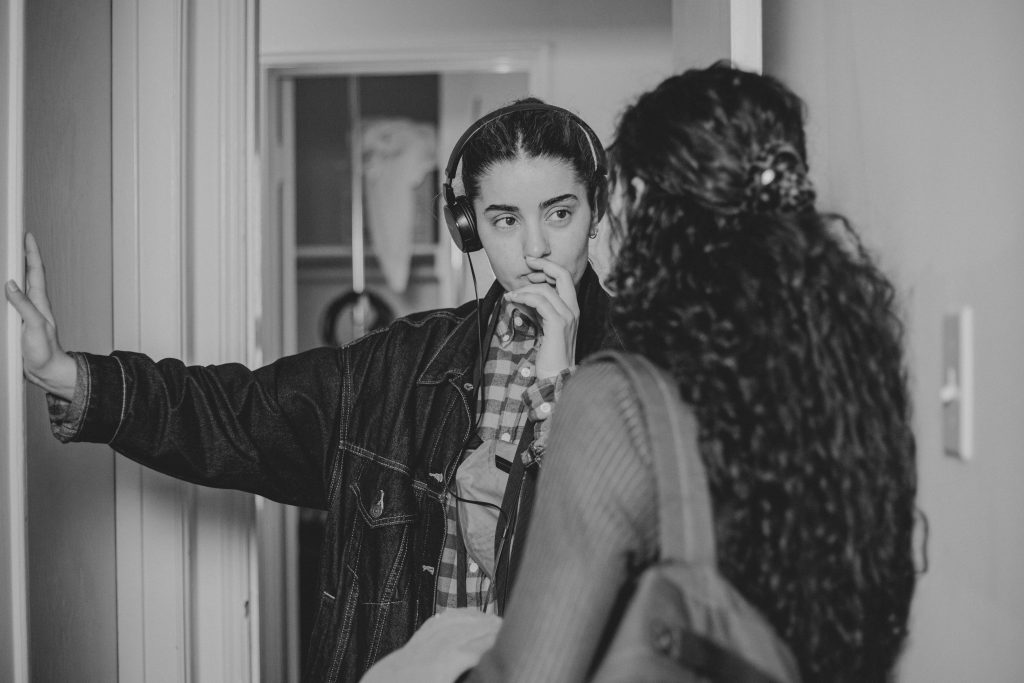
Vancouver filmmaker Sepideh Yadegar drew on her own experience as an international student in writing and directing One Must Wash Eyes. It tells the story of Sahar, an international student from Iran, whose life is turned upside down after she is photographed at a Women, Life, Freedom protest in front of the Vancouver Art Gallery.
“I would say the movie is about people who don’t make the headlines and whose lives are shaped by politics, borders, and financial uncertainty every day,” Yadegar tells Pancouver over Zoom.
She is thrilled that One Must Wash Eyes will have its Vancouver premiere on opening night of GEMFest 2025. One of just three international film festivals for women and gender-diverse people in Canada, it runs from March 5 to 9 at the VIFF Centre.
“I wanted to focus on international students because their struggles are usually invisible,” Yadegar says. “We don’t see them.”
Yadegar moved from Iran to Canada in 2011 with a goal of working in medicine. But after taking a film course, she realized that she could create her own stories. Yadegar went on to earn a bachelor’s degree in film, video, and media integration at Emily Carr University of Art + Design.
She started making short films, including “From…”, “Asal”, and “Uprooted”. In her first feature film, One Must Wash Eyes, Yadegar’s lead character responds to visa limitations, legal restrictions, and economic uncertainty in Canada as her home country is in tumult.

Yadegar highlights economic realities
Yadegar reveals that she began writing the screenplay in 2020, originally setting the story in 2012. But after the 2022 death of Mahsa Amini in the custody of Iran’s morality police, she made some adjustments. According to Yadegar, she changed two scenes and updated the setting to 2022.
“International students exist in a very unique and vulnerable position, caught between political and economic realities of both their homeland and their host country,” Yadegar states. “When international sanctions were imposed on Iran, for example, the value of the dollar spiked. So, a lot of international students from Iran were stranded.
“They couldn’t work because of their visa limitations, so they couldn’t support themselves,” she continues. “And their families were faced with costs two times or three times of what they originally planned for.”
Tehran-born and Toronto-based actor, singer, and songwriter Pegah Ghafoori plays Sahar. Yadegar makes full use close-up shots and handheld camera images to convey what her lead character is experiencing.
“I wanted to be fluid and constantly on the move to represent the inner state of Sahar’s life, which is never stable and static,” the director explains.
She credits composer Armine Bouzaher and singer Saba Zameni for reinforcing the mood with beautiful music. In one dreamy scene, Yadegar is seen dancing in a red dress, reflecting the hopes of Sahar for a brighter future.
As Sahar navigates through a multitude of challenges, she crosses paths with three men each representing different perspectives. Ahmad (Gus Tayari) reflects old-school immigrant thinking by keeping his head down, following the rules, and not challenging authority.
“His actions are out of fear and self-preservation,” Yadegar says.

Seeing the world differently
Sahar’s friend Matt (Sean Depner), on the other hand, is unintentionally reckless. And his actions don’t appear to have severe consequences on him. Moreover, this demonstrates a certain privilege that Sahar doesn’t enjoy. The third male character, Majid (Navid Charkhi), lives his life in between those extremes.
The title of Yadegar’s film comes from a verse by 20th-century Iranian poet Sohrab Sepehri.
“One must look at the world differently,” Yadegar says. “And I think the movie tries to embody this.”
Some of the most emotional scenes involve phone calls between Sahar and her mother in Iran, played by Mitra Lohrasb. At times, there’s real joy, as well as deep love. Yadegar, as a former international student, says that she could relate to these interactions.
“It felt very authentic,” Yadegar says. “That was my reality. And unfortunately, a lot of immigrants’ reality is constantly connecting with our loved ones through a screen—never truly with them—and trying to bridge the gap of the distance…
“For anyone who is separated from their family, technology is both a lifeline and a limitation,” she notes. “We’re constantly relying on the Internet speed or stability and the time differences. And you can add all the other circumstances to that.”
The Gender Equity in Media Society will screen Sepideh Yadegar’s One Must Wash Eyes at 6 p.m. on March 5 to open GEMFest 2025. The festival runs at the VIFF Centre from March 5 to 9. For tickets and more information, visit the website.
Follow Pancouver on X @PancouverMedia and Bluesky @pancouver.bsky.social. Pancouver is also on Instagram @PancouverMedia. In addition, follow Charlie Smith on Bluesky @charliesmithvcr.bsky.social.