Obsession with Taiwan tops China’s convoluted grab for global power
(This piece is much longer than most articles on media websites.)
Donald Trump has collected some of America’s biggest anti-China hawks for his proposed Cabinet in the second coming of his presidency. Yet, he will struggle to contain China given the United States’ own set of mounting problems: the wars in Ukraine and the Middle East; immigration; the record levels of government debt and budget deficit, both out-of-control and still rising; the nation’s faltering infrastructure; and escalating security threats from domestic terror groups; and external forces. Assuming that the 47th president doesn’t end up in jail, he will be more focused on fortifying the U.S. and reducing its exposure to the world’s problems than take on another external challenge.
Fortunately for Trump, the threat from the People’s Republic of China (PRC) is being blunted by an improbable “ally” operating at the highest level inside Beijing.
Xi Jinping has made a career of being an unlikely winner during his long climb to become the PRC’s supreme leader. He is now the most powerful leader in the country’s 75-year history, surpassing even founder Mao Zedong. If Xi stays the course and the conditions permit, he could land his biggest and most far-fetched role yet as the man who stopped China’s rise. He would be doing Trump a favour without being asked.
In surviving China’s cannibalistic politics, Xi played to his two biggest assets, his birthright and reputation, to exploit the CCP’s weak system of governance.
He was already well-known and had a certain level of privilege as the son of Xi Zhongxun, a legendary revolutionary who served and suffered under Mao for decades. Xi Jinping used his birthright to gain the power and status that he believes is his entitlement as a member of China’s super elite. At the same time, he kept humble, and was not known to flaunt his privilege in a way or degree that would have threatened his career. Where there were scandals, he successfully relegated them to the realm of gossip and hearsay. In Chinese politics, birthright is a double-edged sword with those of elite lineage particularly prized for takedown.
Xi’s main asset was perhaps his carefully cultivated reputation as being the least likely to make waves. He avoided offending the powerful while quietly nurturing a network of key allies on his way up. He positioned himself as a loyal, competent, and obedient servant of the party while hiding his ambitious streak and radical ideological leanings. By staying above the constant factional bloodletting, he ended up in the most unlikely position as nobody’s enemy.
When China’s most powerful job of general secretary of the ruling Chinese Communist Party (CCP) became available, Xi was the default compromise candidate among the squabbling party elders. Everyone felt safe, or thought that they were safe, when they gave him the keys to the kingdom in November 2012.
One of them was a former mentor, Hu Jintao, who as Xi’s immediate predecessor was seated next to him at the CCP’s 20th National Congress in October 2022. At the closing ceremony of the six-day gathering, the 79-year-old elder statesman was unexpectedly pulled out and escorted from his seat by two men in front of a shocked live audience of more than 2,200 party delegates. The likely orchestrated humiliation of the previous CCP general secretary and president of China was quickly broadcast uncensored to the world. Xi remained seated, barely acknowledging Hu who tried to resist his “minders”. Xi’s display of seeming contempt conveyed his position of power amid reports that he would no longer tolerate the shadow politics of past presidents, especially that of his immediate predecessor who still had supporters inside the party.
The making of Trump’s helper
Hu Jintao’s forced exit at the party’s 20th National Congress was a fitting finale to the theatre that Xi Jinping had scripted for his total power grab.
The veteran China watcher Willy Wo-Lap Lam was prescient in his call as early as 2015 that Xi was plotting to remain in charge beyond his expected two terms in office ending in 2023. This was confirmed in March 2018 when the legislature, the National People’s Congress (NPC), amended the constitution to remove the term limits on the country’s presidency. By manoeuvring the NPC into that decision, Xi had broken the fragile post-Mao agreement that the president should serve only two five-year terms.
Deng Xiaoping, modern China’s reformer who began pulling the country out of its Maoist nightmare from 1978, had helped write the rules to prevent the centralization of powers by a future Mao copycat. Deng, like millions of Chinese who had suffered under Mao’s murderous rule, recognized the damage a dictator could inflict on China.
But Deng’s rules were not firmly institutionalized and failed at the first test when a Mao copycat did emerge to bend the party, the government, the military, and the nation to his will.
According to Yu Jie of Chatham House, the party’s National Congress, which meets every five years, “not only selects China’s leadership team but acts as a signpost indicating the direction the country will be heading in the near future, with implications for decades to come.”
Instead, it rubber-stamped Xi’s demands to complete his promotion to full dictator. The delegates at the October 2022 gathering amended the CCP’s constitution to cement his core status and the central role of his political thought within the party, elected Xi loyalists to monopolize the elite Politburo Standing Committee (PSC), and removed rivals to ensure he would rule without challenge. Premier Li Keqiang, a past Xi rival and constant counterweight, was forced to retire as he was not given the term extension. The more liberal Wang Yang and Hu Chunhua, each with a significant factional following, were ousted from the seven-member PSC to make way for Xi’s clones. Hu, also a potential rival of Xi and aligned to Hu Jintao, wasn’t even among the 24 members elected to the lower ranking Politburo. Months later, Li, 68, was gone for good after he reportedly died of a heart attack.
Lam was damning in his assessment of “China’s new Emperor” for packing his latest Cabinet with “unalloyed supporters” to serve his third five-year term.
Their “expertise are in areas such as ideology, propaganda and ‘party construction” whose role was to consolidate Xi’s “conservative, quasi-Maoist policies”, Lam wrote.
In late 2022, Xi had reached a new peak unscaled by any ruler in the long history of Chinese politics. He had control over 1.4 billion people, the world’s second largest economy, its largest standing military, and a global surveillance reach comprising a network of spies supported by the best monitoring technology available. Xi had dedicated his life to acquiring those powers for the avowed purpose of turning China into the utopian Communist state supposedly envisioned by Karl Marx, Mao, and Confucius. Under Xi, China would be “rejuvenated” to become the world’s leading superpower that would go on to reshape the crumbling U.S-led international order for the good of all humanity.
The dictator’s paradox
Two years on, China is showing few signs of rejuvenation. Instead, the supreme leader is revealing his nerves in the face of the country’s mounting problems.
In raising unrealistic expectations about his new powers, he is under pressure to perform miracles like wipe out “corruption” in Chinese politics, nurture paradigm-shifting innovation and entrepreneurism in an authoritarian environment, motivate an increasingly demoralized workforce, and create “win-win” outcomes out of China’s difficult relationships with a host of countries in Asia, the Middle East, and Europe. In promoting Chinese ascendancy, he has fanned both Western and Asian fears about the China Threat and made Beijing a bigger target for the incoming Trump administration.
The paradox of Xi’s peak supremacy is that he has made China more vulnerable to infighting, turmoil, and decline.
On the domestic front, he has amassed a long list of enemies who would be willing to work with foreigners to take him down. By overriding Deng’s political reforms, he has created the conditions for strife when his succession inevitably comes into question.
Xi faces a host of immediate challenges largely of his own making. He is unable to reverse the damage inflicted on the economy by some of his arbitrary and nationalistic policies. There is growing international distrust of China amid rising tensions with the West and neighbouring countries in Asia, and Beijing’s dubious neutrality in the wars in Ukraine and the Middle East. Within the party and the military, Xi has lost the fight to cover up their continuing power struggles, which means he is still facing open resistance. China’s youth are losing hope in their country’s future while businesspeople and bureaucrats are increasingly afraid of taking risk.
In November, Xi told Singapore’s visiting senior minister Lee Hsien Loong that he remains confident in China’s economic prospects “in the long run”. His comment drew attention to his silence about the immediate term which makes for grim reading. The Chinese economy faces years of slow growth, according to the World Bank and the International Monetary Fund (IMF). China is groaning under a heavy debt overload from its overleveraged real estate sector, a population that is ageing and in decline at the same time, and the uncertainty surrounding its much-touted tech sector. The Wall Street Journal estimates that China’s households have lost a total of US$18 trillion in the country’s property meltdown since 2021.
Lee, described by Xi as an old and good friend of China, said the hard part out loud. The former prime minister of Singapore told his host that China must “revive the vibrancy, the confidence, the optimism, the innovation and entrepreneurship which have created breakthroughs, unicorns, and tremendous sense of dynamism and transformation, which have carried them all the way nearly 50 years since 1978, since they started reform and opening up”.
Lee had delivered a not-too-subtle rebuke with a reminder that China’s success was built largely by Xi’s predecessors.
Despite Xi’s brave front, Beijing is deeply worried about the economy. The regime recently launched a 10-trillion-yuan package to deal with local government debt while the central bank has announced major stimulus measures in an attempt to stave off a persistent deflationary threat.
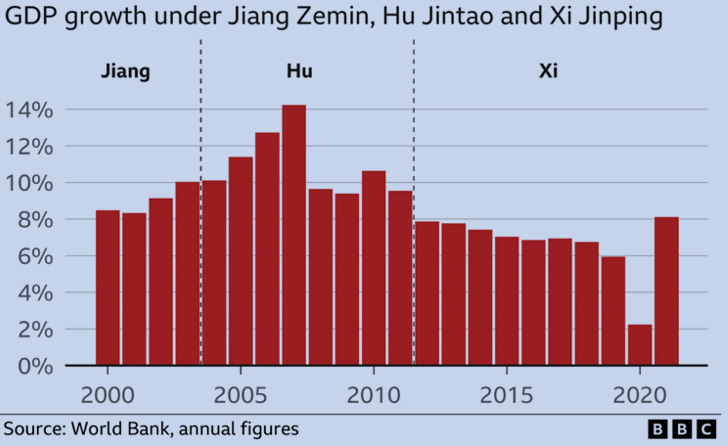
Whatever Xi is attempting, the Chinese economy will not return to the golden pre-COVID era when it often grew by eight to 10 percent annually. While still expanding at a faster rate than the global average, the economy is falling behind the country’s rising social demands and Beijing’s expanding security and military expenditures.
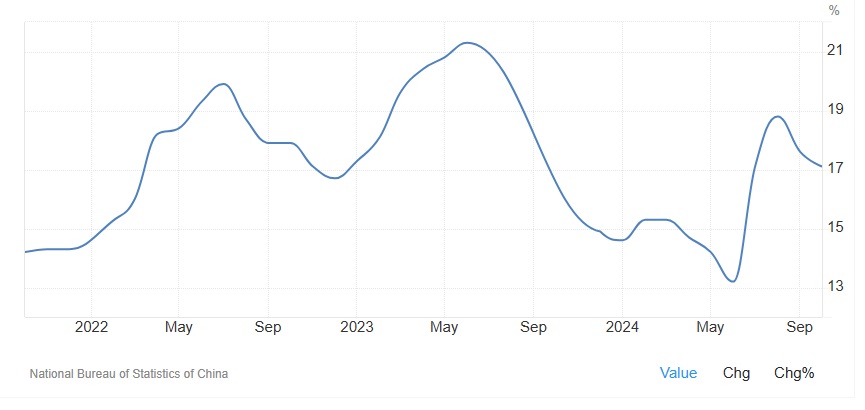
Millions of educated young people are “lying flat” in silent protest at their dwindling life prospects. Youth unemployment, mostly among university and high-school graduates, has been holding firmly at dangerously high rates of 15 percent to 18 percent over the past two years. The 10 million Chinese youth who graduate from universities and colleges every year face a bleak future as Xi has hobbled the real estate, technology, and education sectors that traditionally created some of the country’s most coveted jobs. For the first time in decades, a generation of Chinese youth is experiencing a decline in living standards leading many to give up on traditional career and marriage goals. If Xi is unable to reverse the trend, he could face the prospect of social unrest from the young and educated in the coming years.
Equally concerning is the plight of some 400 million “invisible” blue-collar workers, or about 29 percent of the country’s total population, who have long suffered from the lack of job security and social support. Despite its much acclaimed economic miracle of the past decades, China still has a sizeable underclass of working poor.
The mental and emotional health of China’s urban population of more than 900 million is another source of worry. Many are still suffering from the human rights abuses and trauma of Beijing’s draconian measures imposed on them during the arbitrary COVID lockdowns of 2020 to 2022. The damage could be a contributing factor to the recent outbreaks of mass fatal public attacks by severely repressed and depressed people. What else lurks in the collective psyche of a people so brutalized by Beijing’s COVID policies may never be known as the regime has refused to even acknowledge their effects.
A small group of Chinese is dealing with the country’s decline by migrating, legally and otherwise. Many are gambling with their lives and those of their families by paying an enormous fortune to trek the death routes of Panama and Mexico to illegally enter the United States and the Balkans for Europe. Middle-class Chinese families joining poor South Americans as economic refugees has become quite the phenomenon over the past two years.
China’s perennial scourge of capital flight, led by the wealthy and skilled, is gaining momentum again since Xi’s promotion to ruler for life. Foreign companies, once the biggest defenders of international engagement with Beijing, have joined in the exodus at a time when China needs their investment to shore up economic confidence.
The IMF has pointed to a new worrying trend: the sharp decline in foreign direct investment into China, hovering at a record low of less than 0.5 percent to the GDP in recent years.
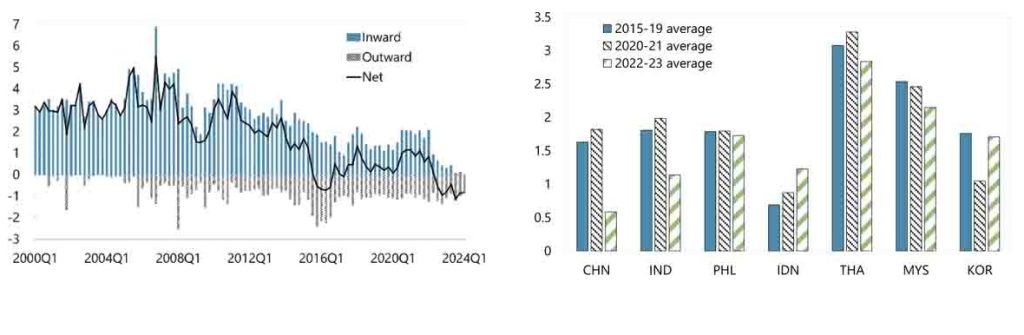
In a special report in August 2024, the IMF blamed “an increase in geopolitical risk and economic policy uncertainty” for scaring off foreign capital. The IMF left no doubt that it holds Beijing responsible.
At its height, FDI accounted for 6.5 percent of China’s GDP in 2006-2007 when foreign businesses were extremely bullish about the country’s prospects. Then, China was at the peak of its economic and political liberalisation process.
Going the opposite direction, China’s spending on domestic security and the military has risen at a faster rate than the economy. Geopolitical tensions between China and its immediate neighbours in Asia and the West along with fears of domestic unrest and espionage will continue to fuel security-related spending. Officially, China’s military budget will rise by 7.2 percent to a record RMB1.665 trillion or US$233 billion in 2024, although the actual spending is probably more than double the published figure.
“It marks the third year since COVID-19 hit that the budget has grown by above 7%,” said the International Institute for Strategic Studies (IISS). “Adjusted for purchasing power parity, the core 2024 defence budget would come to US$439 billion, while total military expenditure would reach US$574 billion.”
It is no coincidence that China enjoyed its biggest economic expansion between 1980 and 2012 when it had good relations with much of the world, especially the West. With no involvement in external conflict, China could afford to focus on its economy, which grew at an annual rate of 12.6 percent over that 32-year period. Since Xi took charge in 2013, China’s economy has grown at a still impressive but slower annual rate of 7.2 percent between 2013 and 2022, according to World Bank data. Those rates are expected to fall significantly in the coming years. While COVID was a major factor in the recent slowdown, Beijing’s crackdown on its real estate, technology, and education sectors, along with rising trade tensions with the West and security issues with its Asian neighbours have dented investor confidence in the Chinese economy.
Xi Jinping’s Chinese dream
A key part of Xi’s Chinese Dream is tied to China building friendly ties with the outside world.
Yet, Xi is overseeing the darkest phase in China’s foreign relations since Mao’s rule from 1949 to 1976. Mao’s disastrous experiments on the economy from 1958 to 1962 caused the death of at least 30 million Chinese people through starvation, disease, and torture. China’s failed attempt to ‘leap’ ahead of the West made Mao paranoid, leading him to launch the Cultural Revolution from 1966 to 1976 to reassert control over the country. His Red Guards terrorized the Chinese people while the CCP stepped up its export of armed revolution to other countries that became a part of Mao’s policy and legacy.
Unsurprisingly, Mao’s foreign adventure failed, leaving behind a bitter legacy of anti-China sentiments in parts of Asia and the West that have endured till today.
Xi is faring better but is still far from winning over world opinion. His Chinese Dream is being undermined by the contradiction between China’s declared wish to be everyone’s friend and its increasingly aggressive drive for hegemony. Xi’s Global Development Initiative (GDI), Global Security Initiative (GSI), and Global Civilization Initiative (GCI) have the nominal support of most developing countries, which are largely driven by China’s offer of potential economic gains and resentment against the U.S.-led international order. Russia is a firm supporter due to its dependence on China to sustain President Vladimir Putin’s war in Ukraine. China can also rely on a small group of staunchly anti-Western countries that includes Iran, South Africa, Venezuela and Cuba. The rest of the Global South is a mixed bag as their support for Beijing is tied to Chinese aid, investment, and economic opportunities. If China tightens up its purse strings, many will likely vanish as fair-weather friends.
Significantly, India shares Western suspicion of China as the Global South’s two heavyweights battle each other for influence on the world stage. Southeast Asian countries are on the Chinese bandwagon partly for the economic ride, but Indonesia, Vietnam, Malaysia, the Philippines, and Singapore retain strong ties with the West and India as they too fear Beijing’s intentions. China’s worsening territorial disputes with its neighbours, especially its thuggish attempts to dominate the South China Sea, contradict Xi’s promise to forge “win-win” relations with other countries.
This image was just displayed at Vietnam’s annual South China Sea conference, which I’m attending right now. 😄👏 pic.twitter.com/McRLy8MPPv
— Derek J. Grossman (@DerekJGrossman) October 24, 2024
The Belt and Road Initiative
Xi’s most ambitious foray at winning win global influence has lost its way since its launch in 2013 to develop an economic corridor to connect Asia, the Middle East and Europe. Xi unveiled his signature Belt and Road Initiative (BRI) vision to great expectations that China would use its infrastructure expertise and enormous foreign exchange reserves to build a global “community of common destiny” and bring prosperity to every corner of the world.
Instead, BRI projects have been accused of saddling participating countries with heavy debt and corrupt practices while human rights, socio-cultural, and labour abuse, and environmental problems have occurred under the watchful eyes of the Chinese government.
The U.S. Council of Foreign Relations said the BRI is struggling as a result of “poor risk management and a lack of attention to detail and cohesion from the Chinese state-owned enterprises and banks, private companies, and local governments involved.”
For now, China remains a partner of choice for many developing countries who complain that they are being ignored by the West and international development agencies.
In a landmark study of 129 countries involved in the BRI, AidData found that “79% of leaders surveyed viewed Beijing as actively supporting their countries’ development, and 38% selected the PRC as their infrastructure partner of choice, outstripping other major powers.”
“Three-quarters of leaders reported that the PRC had increased the number and size of projects in their country since 2012. The majority reported an uptick in Chinese laborers, suppliers, and firms to implement these projects.”
Despite AidData’s less pessimistic tone compared with its previous assessment in 2021, the BRI remains a troubled undertaking for China and many of the participating countries that have borrowed heavily from Beijing.
“Total outstanding debt—including principal but excluding interest—from borrowers in the developing world to China is at least US$1.1 trillion,” the 2023 report said.
“Beijing is navigating an unfamiliar and uncomfortable role—as the world’s largest official debt collector.”
It is not clear who will be the biggest loser: China or its debtors who will struggle to pay back. Due to its inexperience in this role, China is likely to take a financial hit as 80 percent of “its overseas lending portfolio in the developing world is currently supporting countries in financial distress.”
For all its generous spending to buy goodwill, China has taken serious reputational damage, with its approval rating among developing countries falling from 56 percent in 2019 to 40 percent in 2021, said AidData.
“The terms and conditions of BRI financing were often shielded from public view through strict nondisclosure agreements, which in turn set off alarm bells with institutions like the World Bank and the International Monetary Fund,” observed Mark Green, the president and CEO of the Wilson Center.
A think tank linked to the Chinese government has acknowledged BRI’s problems.
“Several investments in the Belt and Road Initiative have had to be stopped, mothballed or cancelled due to financial (e.g., difficulties in financing or servicing debt) and operational reasons (e.g. due to travel restrictions or problems in supply chains),” said a study published by the Fanhai International School of Finance (FISF) at Fudan University in Shanghai, China.
Author Christoph Nedophil Wang found that more than half the BRI’s announced coal-fired power plants have been mothballed.
“In order to avoid reputational, social and environmental risks arising from stopped, mothballed or cancelled projects, plans should be developed and implemented by financial institutions including insurance companies, developers, local governments and relevant Chinese authorities that compensate any losses to workers and companies up to a specific extent,” he recommended without going into details.
Wang also called for the remediation of “nature around mothballed and particularly stopped projects. This also helps avoid having skeleton constructions serve as a reminder of unfinished projects.”
The US$62-billion China Pakistan Economic Corridor in Balochistan province is the BRI’s biggest and most ambitious project. It has also become a showpiece in Chinese mismanagement and a long-term drain on China’s financial and political capital. The financial viability of CPEC’s various projects is in doubt while local militia groups opposed to Chinese investment in western Pakistan have been terrorizing and killing Chinese workers.
“After US$55.2 billion in aid and credit for new highways, power projects, and rescue loans, CPEC has struggled to generate sustained economic benefits amidst a deteriorating security situation marred by poor governance,” wrote Hong Zhang and Ammar A. Malik.
Relations between the two countries have plunged with China openly venting anger at Pakistan for failing to stop the terror attacks.
The BRI has also hit a roadblock in the Middle East and Europe in the aftermath of the wars involving Israel and Ukraine. Israel has lost faith in China for seemingly siding with Palestine, Hamas, and Hezbollah while the Arab world is frustrated by Beijing’s failure to show any leadership since the start of the conflict on October 7, 2023 when Hamas attacked Israel.
European countries are deeply divided on their China policies but seem in agreement that Beijing cannot be trusted. China’s supposedly neutral stance on Russia’s invasion of Ukraine is viewed as deceitful given that Beijing has increased its support for Moscow since the war began on February 24, 2022. On December 6, 2023, Italy announced that it would not renew the 2019 memorandum of understanding (MOU) that had made it the first and only country in the G7 to participate in the BRI.
Who are China’s friends, really?
Shortly after he officially took power in 2013, Xi raised expectations that he would be the new flagbearer for globalization, free trade, and, in his own words, the builder of a global “community of common destiny”. Instead, he has proved to be probably the most divisive world leader, surpassing even Donald Trump. Since 2017, China has decisively pivoted away from the West, forcing many countries to choose between aligning with it or the U.S.
China has positioned itself as the new leader of the developing world (Global South) to break the stranglehold of the U.S. and its Western allies on global power. Yet despite spending heavily on influence-building around the world, China has not win over the Global South. Influential members India, Brazil, Nigeria, and Indonesia along with most of Asia harbour varying degrees of resentment against the West but they are also wary of China’s unpredictability, nationalistic behaviour, and propensity to be a bully. Even in Africa and the Arab world, where memories of Western colonial exploitation are fresh and deep, China’s popularity is far from guaranteed and universal. China’s dream to replace the U.S. dollar with an alternative currency to break Washington’s grip on the international trade system continues to wash up against the hard reality of economics.
China’s staunchest allies to change the world include Russia, North Korea, Iran, South Africa, Cuba, Venezuela, Yemen, and what was recently Syria.
The China-Russia link is the spine of the new anti-Western front, but it is fragile and laden with historical baggage, including centuries of conflict between the two countries. That link currently relies heavily on the recent personal relationship between Xi and his Russian counterpart, President Vladmir Putin. It is not known if they genuinely trust each other, especially considering how Xi’s idol, Mao, regarded Russia as the biggest villain and beneficiary of foreign plunder of China during its Century of Humiliation from 1839 to 1949. Mao’s bitter fallout with the Russian leadership from the 1950s led to the world’s two largest Communist states fighting a border war in March 1969 that could have led to the use of nuclear weapons. Ironically, the deadly clash on Damansky Island in the Russian Far East (or Zhenbao Island when it was owned by the Chinese) contributed to China’s eventual divorce from Soviet communism. China would complete its defection to the West a decade later with the establishment of diplomatic ties with the U.S. on January 1, 1979.
Mao’s unresolved anger against Russia remains widely shared by most Chinese who retain bitter memories of Imperial Russia committing genocide and seizing large sections of old China in the 19th century. If Xi were to truly fulfill his mission to rejuvenate China, he would have to take back the resource-rich Russian Far East, Siberia, and Sakhalin that used to be Chinese property. Here’s my analysis of Xi’s strategy towards Russia written a month after Putin launched his invasion of Ukraine in 2022.
Putin is fully aware of the latent threat of Chinese grudges, having seen how Beijing regularly whips up anti-Japanese sentiments over Imperial Japan’s war crimes in China during the Second World War. Russia, by contrast, has never been held to account for committing far worse atrocities and plunder against China. Putin is also mindful of Xi’s mastery at concealing his true feelings and strategic intent. The former KGB spymaster struck first by pulling off a coup of his own when he recruited North Korea to fight his war in Ukraine. The deal was sealed last June when Putin made his first visit to Pyongyang in 24 years to sign a landmark mutual defence agreement with North Korean leader Kim Jong-un.
The “breakthrough document”, as described by Putin himself, overhauled Russia’s policy on North Korea with a new agreement that stipulates that one would come to the defence of the other during conflict. This clause was invoked almost immediately when Kim sent thousands of his soldiers to fight Ukraine in October. The agreement also set the foundation for Moscow’s long-term strategy to begin military and technical cooperation with Pyongyang that could be read as a challenge to Beijing’s influence.
The speed and extent of the Putin-Kim embrace alarmed not just the world, but also Xi who was likely caught out by the intimacy that had developed between his two closest allies. Both desperately dependent on China for political and economic support, the new deal will give Moscow and Pyongyang some breathing space from Beijing’s suffocating embrace.
As geopolitical consultant Samuel Ramani noted, North Korea has sharpened the divergent views between Russia and China over security issues in the Indo-Pacific region.
“The Sino-Russian cleavage over North Korea’s nuclear weapons program is especially pronounced.”
China blames “external stakeholders” for North Korea’s nuclear sabre-rattling yet worries that Pyongyang’s actions might motivate the U.S. to deploy additional strategic nuclear-capable assets to the region.
“Russia has no such qualms about North Korea’s nuclear program. The Communist Party of the Russian Federation (CPRF), which has an ultranationalist ideological bent, has supported North Korea’s right to pursue a nuclear deterrent for years,” Ramani wrote.
The fall of the Assad regime in Syria on December 8 was another major setback for Xi as he ended his first two years as dictator-in-chief on a depressing note.
Xi had personally invested in President Bashar al-Assad’s longevity in Syria as a foundational piece in China’s struggle for a coherent Middle East strategy. In September 2023, Xi invited Assad to Beijing where they signed a China-Syria strategic partnership.
Although the agreement has been derided for lacking substance, Xi did boldly promise China’s support for Syria “in opposing foreign interference, rejecting unilateralism and bullying, and safeguarding national independence, sovereignty and territorial integrity.”
He also pledged to help Syria “in conducting reconstruction, enhancing counter-terrorism capacity building, and promoting a political settlement of the Syrian issue following the ‘Syrian-led, Syrian-owned’ principle.”
As with his lofty slogans to the world, Xi’s promises to Assad have turned out to be empty. China watched passively as the Assad regime collapsed within weeks of a joint assault by opposition forces. Forget about “safeguarding national independence, sovereignty and territorial integrity,” Xi could not even offer asylum to Assad and his family who fled to Moscow, not Beijing. The “strategic partnership” will serve as a reminder of China’s hollowness in supporting its allies in their time of need.
But more than Beijing’s diplomatic reputation is now at risk. Assad had helped keep Islamic extremist forces from taking the fight to China’s restive western region of Xinjiang. For years, the Assad regime employed brutal tactics and repression to stop a disparate group of extremist forces from exporting revolution to the region and beyond. The most powerful group to emerge in post-Assad Syria is the Islamist group Hayat Tahrir al-Sham (HTS) led by Abu Mohammed al-Jolani. For years, the U.S. had a US$10 million bounty prize on Jolani who fought alongside al-Qaeda and the Islamic State (ISIS). On December 20, the U.S. State Department announced it would lift the bounty after holding a “very productive” meeting with Jolani in Damascus, even though the terrorist label on HTS remains.
One of the HTS’s victorious allies, the Turkistan Islamic Party (TIP), has vowed to now turn to fighting China over its ill-treatment of the Uyghur Muslim population who are indigenous to Xinjiang. Formerly known as the East Turkestan Islamic Movement (ETIM), the group has been designated by the U.N., China, the European Union, and Britain as a terror organization. As TIP steps up its military campaign for Xinjiang’s separation, Xi will have another challenge to add to his growing list for 2025. But he will not find any sympathy from the U.S. which removed the terrorist label from ETIM in 2020.
Trump’s China Challenge
Trump will encounter a very different China from the one he dealt with at the start of his first term in 2017. Xi is far less confident in 2025 than he was eight year ago as he struggles with the souring of his Chinese Dream that is now in full swing.
Not that Trump will have an easy time himself with his own and America’s problems.
But he will have a few advantages over the supreme leader. The U.S. economy is in far stronger shape than China’s. The world is once again looking to the U.S. for direction, having seen through Xi’s empty slogans. Contrary to predictions about its demise, the US dollar has grown stronger on investor demand to reach a near two-year high against the rest of the world’s currencies.
While Xi has assumed the entire burden of government in his role as the “Chairman of Everything”, Trump can still count on America’s institutions along with the country’s network of international allies. Xi is increasingly suspicious of his own hand-picked officials, witness the endless purges in China’s military establishment. The poor state of Chinese governance that allowed him to so easily climb up the hierarchy, amass powers, jail his critics and rivals, and change the country’s laws at will is now his enemy.
Trump will face an increasingly anxious Xi if the Chinese economy continues to flounder and Beijing is unable to regains credibility on the world stage. Like Mao, Xi could be tempted to take out his failings on both his people and neighbouring countries, with Taiwan particularly vulnerable.
Trump will have his work cut out regarding China. He did the hard part of turning mainstream America against Xi’s China during his first term. For his second term, he must strike a balance to allow China to continue down its path of decline while ensuring that it doesn’t result in a collapse leading to political instability and possibly a war over Taiwan or anywhere in Asia.
Most importantly, Trump must rein in America’s war hawks and their defence contractors who are eager for a new theatre of conflict in Asia. A U.S.-China war would be catastrophic for all.
The second part of this commentary will focus on Taiwan and how the island republic has creatively dealt with its increasing diplomatic isolation resulting from China’s undeclared act of war.
Ng Weng Hoong is a Vancouver journalist focused on China and Chinese issues. This article originally appeared on his Substack account, where you will find a list of 100 footnotes for the links. Follow Pancouver on X @PancouverMedia and on Instagram @PancouverMedia.