
Choreographer, dancer, and sound designer Sophie Dow is happy to explain why her latest stage project is called Agrimony. She tells Pancouver over Zoom that agrimony is a yellow flower native to North America and Europe. Many cultures have relied on it for healing, including in Ancient Greece and the Middle Ages.
“In plant medicine, when you mix it as a tincture, it’s a heart and lung remedy,” Dow says.
Dow has a background in traditional Thai massage, BreathWave, and cranial-sacral therapy. So, she has a keen interest in healing techniques. That’s in addition to being an artistic associate of O.Dela Arts, Chimera Project Dance Theatre, and Compagnie V’ni Dasi/Louis Riel Metis Dancers.
The dance artist notes that in its flower form, agrimony is looked upon an “energetic remedy”. There’s a belief that it helps dissolve masks that people develop over time in response to trauma and other experiences.
“So, this show is very much based around that,” Dow reveals.
The Vancouver resident has teamed up with composer Laura Reznek, who will perform nine songs on-stage from her 2021 album Agrimony. As a result, this show incorporates elements of a live concert with contemporary dance performance. It was six years in the making.
“We’re challenging ourselves, first of all, to really look at all these masks you wear,” Dow says. “What mask do I put on to get out of bed? What mask do I put on to ride the SkyTrain every day, and what mask should I put on to run a rehearsal?”

Agrimony dancers don masks
The Dance Centre will present the West Coast premiere of Agrimony at the Scotiabank Dance Theatre on September 20 and 21. It’s part of the Dance Centre’s 2024-25 Global Dance Connection Series.
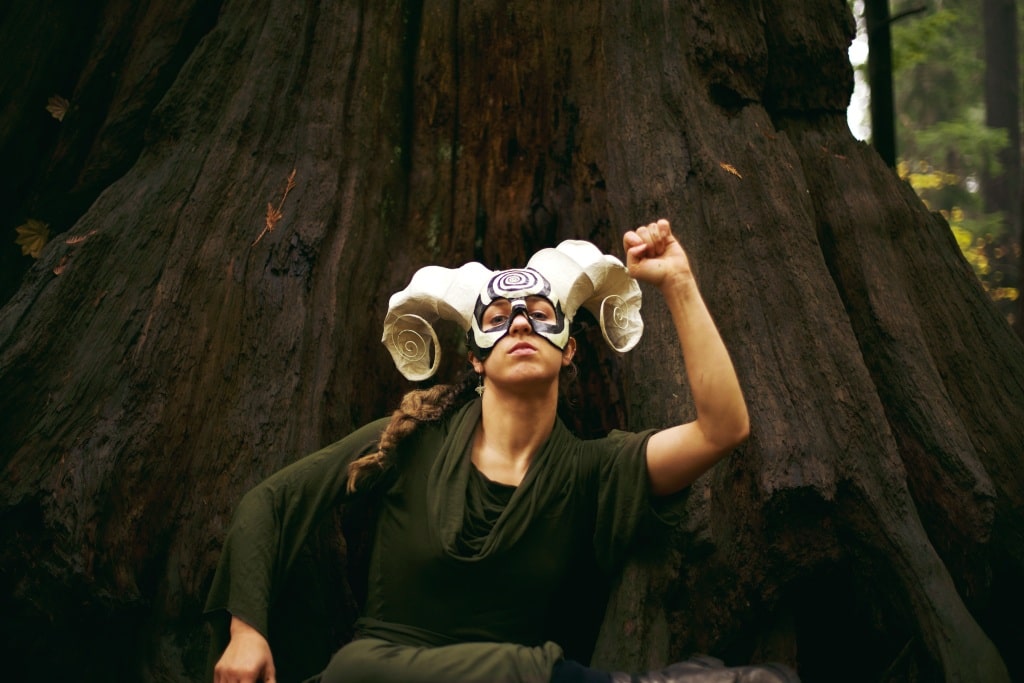
In Agrimony, four dancers—Dow, Amanda Testini, Tavia Christina, and Mohammed Rashead—will wear masks representing a rabbit, owl, coyote, and spiral-horned creature.
“The rabbit and the owl were woven into that because we were really looking at fear,” Dow states.
The choreographer discloses that the owl is like an overseer. However, it’s also capable of swooping in, creating terror for its prey.

According to Dow, the rabbit represents a response to fear. But it is also a scary character in the show, almost like a Donnie Darko ghost. Meanwhile, the coyote was added over the past year.
“In my tradition, the coyote is a trickster, so there’s that element of trickery,” says the Treaty 1-born Dow, who has Michif/Assiniboine and French/Ukrainian heritage.
Dow says that Agrimony offers an opportunity for the artists to reflect on the world that her generation is experiencing. Then, in a moment of self-reflection, she asks what latches inhibit her from being authentic as possible with everyone she relates to.
“I’m really curious, and interested to see how the deep work of that—of how we’re doing it with ourselves—is going to ripple out as a visual and an audible experience for audiences,” Dow states.
Dow emphasizes that she and the other dance interpreters are not trying to convince anyone of anything. They’re not proselytizing; rather, they are merely expressing their feelings.
Studio collaboration set show in motion
Dow, also a former resident of Winnipeg and Toronto, traces the origins of Agrimony to a small dance film that she made with director Vitantonio Spinelli in 2018. They asked Reznek to provide music. It ended up being one of the songs on Agrimony. And the music video sowed the seeds for the entire show.
The turning point for the entire show came in February 2020 when Dow had a residency with the National Ballet of Canada. COVID-19 was starting to spread.
“Then, there was a day when there were no dancers left in the studio except me,” Dow says.
She didn’t want to waste her studio time, so she invited Reznek in to provide some music.
“She just started playing the album front to back, and I just started dancing, like for six or seven hours straight,” Dow recalls. “We realized, at that point, it was something larger than both of us. And we had to basically take her album, weave it into a narrative, and tell that story with dance.”
One of the songs, “Green Linoleum”, addresses the complete rapture of childhood reminiscences and how adults lose touch with those feelings as they grow up. Another song, “Rattling Chains”, is very much about conquering fears, Dow states.
In case anyone is wondering, Dow describes Reznek’s album Agrimony as a “masterpiece”.
At the upcoming performances at Scotiabank Theatre, there will be four other musicians performing: Jonah Ocean, Roisin Adams, J Daniel Baxter, and Chris Marriott.
Event details
The Dance Centre will present Sophie Dow + Laura Reznek in Agrimony at the Scotiabank Dance Centre. The first show is at 8 p.m. on September 20 followed by a 2 p.m. show on September 21. For more information and tickets, visit the Dance Centre website. Follow Pancouver on X @PancouverMedia and on Instagram @PancouverMedia.




