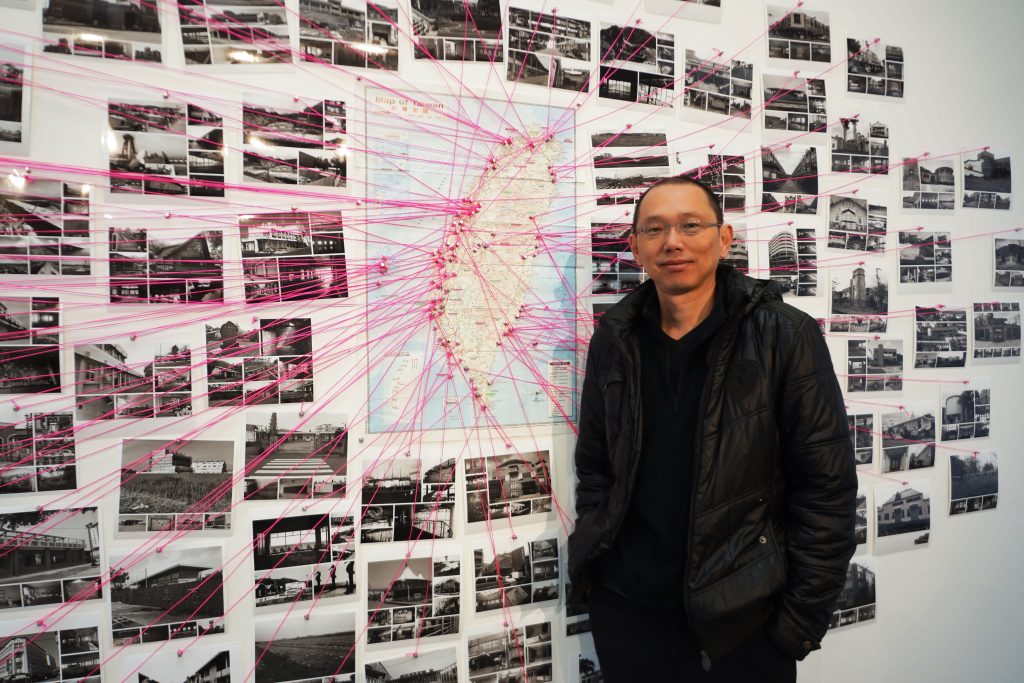
In 2010, a professor named Yao Jui-Chung did something highly unusual. The Taipei-based educator and artist gave his students at Taiwan Normal University a choice. They could either listen to his lectures or investigate abandoned public projects.
There was certainly appeal in listening to his lectures. After all, Yao was among the first artists who rose to prominence following the lifting of martial law in Taiwan in 1987. Moreover. he represented Taiwan at the Venice Biennale in 1997.
In addition, Yao co-founded a theatre collective in 1992. He served as art director on Edward Yang’s 1994 film A Confucian Confusion. Perhaps most importantly, Yao made a name for himself by photographing abandoned temples, monuments, and public buildings around the island nation.
However, his students decided to take him up on his offer to examine forsaken edifices and structures rather than hear his lectures.

Members of the Lost Society Document, which included students from Taiwan Normal University and the Taipei National University of the Arts, actually found 800 underutilized publicly financed facilities. The result was a 684-page book documenting 147 so-called “mosquito halls”.
Starting in the 1970s, the government built many sports facilities, convention centres, and schools. But then, officials allowed too many of them to rot. In some cases, they deteriorated into mosquito-breeding sites, which had a deleterious effect on public health.
The research project had an effect. Yao and the students’ investigations led the government to take action, promising to revive some buildings and destroy others.

Yao engaged in social activism
An upcoming exhibition beginning May 30 at the Museum of Vancouver will feature 150 black-and-white photographs arising from the project. Entitled Mirage: Disused Public Property in Taiwan, it’s being shown in North America for the first time. The museum is promoting the exhibition as “Photography as Social Activism and a Critique of Urban Development Policies”.
“In this age of transparency, covering up only causes more harm,” Yao says in a Museum of Vancouver news release. “The mission of this project is to examine the condition of public space usage from the perspective of the peoples. The whole world is facing the same problem, but Taiwan is willing to face it, deal with it, and let go, which can set an example for the international community.”

The Mirage exhibition will also include Sandy Lo’s documentary, A Rainbow Over the Ruins, showing footage of Lost Society Document’s work. Furthermore, there will be short films created by students enrolled in UBC’s Asian Canadian Migration studies program and the UBC School of Architecture and Landscape Architecture.
According to the Museum of Vancouver, the students’ films “will provide a local perspective on the themes of placemaking and urban decay in Vancouver”.

For more information on Mirage: Disused Public Property in Taiwan, visit the Museum of Vancouver website. Follow Pancouver on Instagram @PancouverMedia.