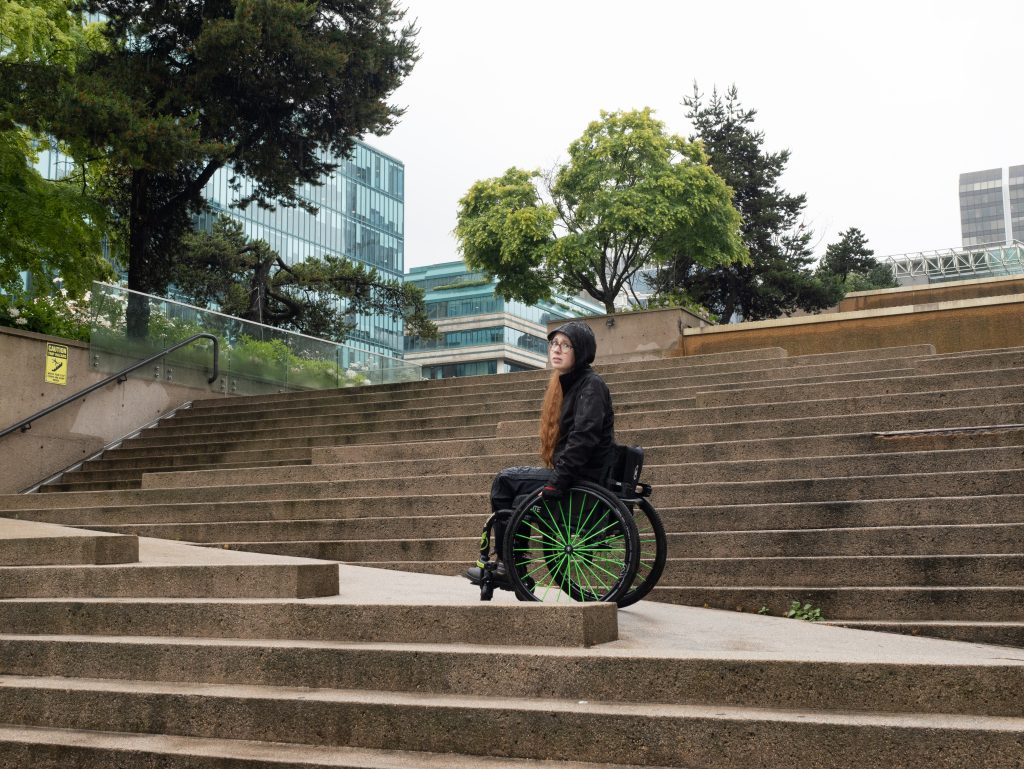
When Pancouver reaches Adam Grant Warren by phone, he has a lot on his mind. The co-artistic director of Realwheels Theatre is ostensibly on the line to discuss the release of a radio play called Disability Tour Bus. The lead character, Shiloh (Cadence Ruth Quibell) is a wheelchair user who works as a guide for “Funcouver Bus Tours”. On their first day on the job, Shiloh discovers that the city is often inaccessible for people with disabilities.
“The original intention was to have it take place on a city tour bus,” Warren reveals.
Audience members were going to be onboard with performers as the bus travelled through the city. But that plan was nixed by the pandemic. As a result, the script by Amy Amantea and Rena Cohen underwent significant revisions.
“Eventually, we got to a place where it was developed and now has been released as an audio play,” Warren says.
However, in the midst of discussing the play, Warren drops something newsworthy. After 21 years of being known as Realwheels, he says that the theatre company has just embarked on a rebranding process.
“We don’t know what the new name will be yet,” Warren says. “Obviously, it’s going to be down to the leadership and the board.”
In the meantime, Realwheels Theatre has engaged a community-based rebranding company for assistance.
“We intend to reach out to our audience base and…people who’ve worked with us before to help us come to the name that we will carry in the future,” he adds.
Warren discloses this shortly before he’s about to go to Vancouver City Hall to advocate for the Firehall Arts Centre. It’s seeking $7 million from the city’s capital funding envelope to upgrade its Cordova Street theatre to make it far more accessible.

Realwheels Theatre founded in 2003
Warren, a wheelchair user, is a leader not only in inclusive theatre, but also as an artistic associate with the inclusive All Bodies Dance Project. In addition, he’s a filmmaker, performer, playwright, and screenwriter.
The origins of Realwheels date back to 1990 when a theatre student, James Sanders, suffered a spinal cord injury. As a quadriplegic, he completed his theatre education at Simon Fraser University in 1998.
Five years later, Sanders co-founded Realwheels with a friend, Bob Frazer, with the goal of changing perceptions about people with disabilities. The company’s first production was SkyDive.
In 2014, Saunders left the company and was succeeded by Cohen, the co-playwright and director of Disability Tour Bus. She played a pivotal role in the launch of Realwheels Acting Academy before announcing her intention to resign in 2020. Warren joined Realwheels in 2023 and he works alongside managing co-artistic director Shawn Macdonald and company producer Jordyn Wood.
Part of the reason for the pending name change is expanding awareness of the dimensions of disability. When Realwheels began, there was a great deal of focus on people who used mobility aids.
“I so appreciate where Realwheels has emerged from and the desire that emerged out of it,” Warren emphasizes. “But the lens on disability is much broader. And it’s not defined by wheelchair users or mobility aid anymore.”
To cite one example, there’s growing appreciation for including people on the autism spectrum in theatre-making. Moreover, the co-playwright of Disability Tour Bus, Amantea, has been legally blind for 16 years. She also performs the role of a blind character named Tess in the production.

Intersecting conditions create compelling storylines
Earlier this year, Amantea shared her experiences as a blind person, along with photographs she took, in Through My Lens at the Hold On Let Go festival.
That came just over a month after Pi Theatre presented Deafy, written and performed by Edmonton-based Deaf actor, playwright Chris Dodd.
Warren points out that intersecting conditions and intersecting identities can create intriguing storylines. One such example is when Shiloh meets Tess in Disability Tour Bus.
“The play raises some questions and notions around the experience of a blind person on transit,” Warren acknowledges. “But it also explores the tension between differing disability experiences.”
He adds that that through the script-writing process, Disability Tour Bus became a more human-centred radio play.
“There’s a pretty classic love story that is sort of the underpinning of the whole show,” Warren says. “I like to think it became less of a series of lessons on what’s wrong with Vancouver and more of a story about some people who are looking for a way through things—and a way toward the next phases in their lives.”
Realwheels Theatre is presenting Disability Tour Bus as a radio play podcast on its website. Follow Pancouver on X @PancouverMedia and on Instagram @PancouverMedia.