
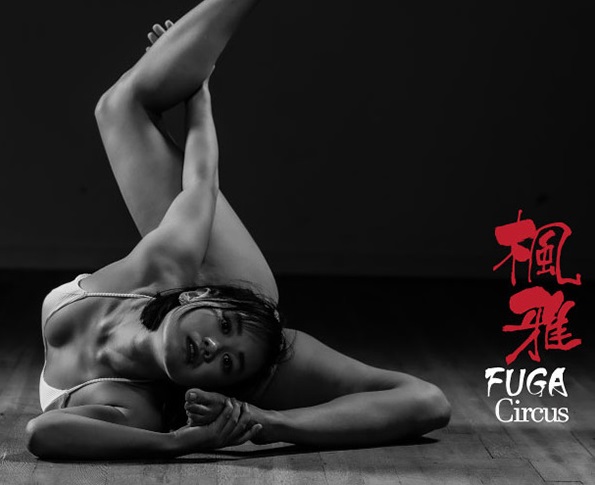
This year’s Powell Street Festival will feature a blending of centuries-old Japanese circus traditions with modern performance. Fuga Circus was founded by two Japanese Canadians based in Vancouver: contortionist and circus artist Kasha Konaka and Yuki the Juggler. They will show off their remarkable talents to the sounds of taiko and handpan drumming at 4 p.m. on Sunday (August 4) at the Firehall Arts Centre.
All events are free at the Powell Street Festival.
According to Konaka’s website, she was the head coach of Britannia Gymnastics Club from 2016 to 2018. She has also choreographed many floor routines. In recent years, she’s made a name for herself by bending and twisting her body in ways that have astonished audiences across North America.
Kanaka also performs aerial dance with hoops and nets.
Below, you can see a video that she posted on YouTube in 2021.
Meanwhile, Yuki is a well-known juggler and co-owner of Cause & Effect Circus. He’s a two-time winner of the Canspin Canadian Juggler of the Year Award. He also won first place at East Japan Juggling Jam Session 2013.
Yuki uses a variety of props in his energetic performances, including bowling pins, balls, and rings. Below, you can see a video of his work.
Fuga Circus draws on kyokugei
Tradition is important to Kanaga and Yuki. Fuga Circus draws on kyokugei, a traditional form of Japanese acrobatics originally performed in dedication to the gods and Buddha. Moreover, Yuki has incorporated kasamawashi into some of his performances. In the video above, he puts mari balls on top of a spinning umbrella.
The 48th annual Powell Street Festival takes place at several locations on Saturday (August 3) and Sunday (August 4) in the Paueru Gai (Powell Street) district. It was home to a thriving Japanese Canadian neighbourhood from the late 19th century until 1942.
However, the Second World War and rampant anti-Asian racism shattered the community. Following Imperial Japan’s attack on Pearl Harbor on December 7, 1941, then prime minister Mackenzie King’s government decided to incarcerate approximately 22,000 Japanese Canadians living in B.C. The government confiscated their homes, businesses, fishing boats, and other possessions and sent them to live in camps away from the West Coast or to work as farm labourers in other provinces. They weren’t allowed to return to within 100 miles of the West Coast until 1949.
The Powell Street Festival was created in 1977 to rekindle pride among Japanese Canadians and showcase their artistic works. As a result, a growing number of Canadians look upon Paueru Gai as the ancestral home of Japanese Canadians.
Throughout its history, the Powell Street Festival Society has worked collaboratively with community groups in the Downtown Eastside, including Indigenous organizations, to ensure local folks are given employment opportunities. In addition, the society has repeatedly and publicly supported their efforts to create a more humane and caring society.
Event details
The Powell Street Festival presents Fuga Circus at 4 p.m. on Sunday (August 4) at the Firehall Arts Centre. For more information on the Powell Street Festival, visit the website. Follow Pancouver on X @PancouverMedia and on Instagram @PancouverMedia.




