Pancouver primarily focuses on underrepresented artists. However, it also publishes a column by David Suzuki to advance education about critical issues, including this one about nature-first cities. Without a habitable Earth, there will be no arts and culture.
For too long we’ve clung to the Western concept of nature as something outside cities—far away and disconnected from most people’s daily lives.
Yet people need to spend time in nature because it improves physical and mental health. Without nature in their daily lives, people suffer more from depression and disease, reduced productivity and shorter lives. Children face the cognitive and behavioural consequences of living apart from natural surroundings. Without ecosystems to disperse, store and clean water, cities are saddled with crumbling pipes and sewers that municipal governments can’t afford to maintain and repair. Nature also provides clean air and water and healthy food. Urbanites removed from nature’s distress signals are slow to notice a planet in crisis.
So how do we invite nature into a city without pushing people out of the way?
It starts with the premise that both nature and people belong in cities, as intertwined co-creators of the urban landscape. Nature belongs where we are, and we belong in nature. From that premise flows an invitation that enhances cities, restores our connection with nature and rebuilds our relationships with each other.
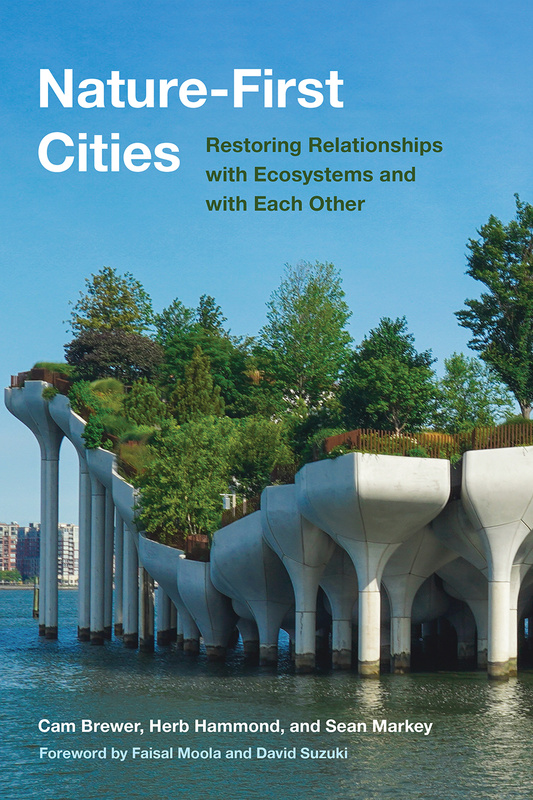
I recently had the honour of co-authoring the foreword to a new book, Nature-First Cities: Restoring Relationships with Ecosystems and with Each Other. It promotes “nature-directed stewardship” in urban areas. This concept was developed by renowned ecological planner Herb Hammond and co-authors Cam Brewer and Sean Markey to address the non-urban challenge of protecting ecosystems and the rural communities that depend on them in the face of relentless resource extraction.
Restoring ecological integrity to cities
As an alternative to activities such as clearcut logging, nature-directed stewardship focuses on what to protect: ecological integrity, biological diversity, healthy watershed ecosystems, community employment and diverse, stable communities—not on what to use (commercially valuable timber). It shows that by prioritizing ecosystem protection, long-term economic and natural stability follow.
Nature-directed stewardship has not yet been fully applied to urban areas. In Nature-First Cities, Hammond and his co-authors outline a comprehensive rationale for why we should pursue it. It includes a detailed methodology, supported with case studies from Vancouver and Vancouver Island, with international comparisons.
Restoration is neither a quick fix nor a primarily human endeavour. Returning ecological integrity to degraded ecosystems in urban areas, or anywhere, is a slow process. Humans can help to reactivate natural processes and sometimes catalyze positive change, but recovery is up to nature. Of course, the more ubiquitous the urban development, the fewer the opportunities for restoration. New developments offer more ecological restoration options, whereas older, established cities impose constraints on restoration of their more thoroughly degraded ecological conditions. In either case, nature-directed stewardship can help.
Accompanying the commitment to restoration is a commitment to stop doing the things that create the need for it to begin with. To achieve this obvious but often ignored goal, new designs and developments must protect ecological integrity, occur within ecological limits and fit people into ecosystems.
Nature-directed stewardship in cities starts by understanding the natural character of the ecosystems that existed before the cities. This is contrasted with existing conditions, and the gap in ecological integrity between the two is the restoration target.
Strengthening networks
Nature-directed stewardship aims to re-establish natural ecosystem character (composition, structure and function) over an entire watershed.
Instead of creating a network of primarily existing ecological integrity—as would be the case when applying nature-directed stewardship in forests, grasslands and other landscapes — in urban areas it starts with establishing a network where restoration activities will lead to future ecological integrity.
As these components emerge, the shape of a restoration network appears. Linking the components at multiple spatial scales will establish and strengthen a restoration network across the watershed. With enough time and effort, this will mature into a protected network of ecosystems with ecological integrity, from small sites to the focal watershed within which the city is located.
I love cities and I love nature. But we need to reconcile the two by dispelling the lie that humans are separate from nature. The practical outcome is restoration of an urban environment that reinforces our place in nature.
Nature belongs in cities. For this reason, we need to redesign cities so they include biodiversity and intact ecosystems. More importantly, we need a fundamental shift in our relationship with urban green spaces, one that recognizes we are part of nature.
David Suzuki is a scientist, broadcaster, author and co-founder of the David Suzuki Foundation. Learn more at davidsuzuki.org. Follow Pancouver on X @PancouverMedia and on Instagram @PancouverMedia.