
Trans-disciplinary performance artist and writer Ray Young (they/them) deeply appreciates safe spaces where people can express themselves fully. In fact, the Nottingham-based director of OUT has made it their mission to create room for artists and audience members who feel marginalized due to intersecting identities.
As a neurodivergent and queer artist of Afro-Caribbean ancestry, Young understands what that feels like. And their joyful and defiant OUT, which will be performed at the PuSh International Performing Arts Festival, is one way to strike back at homophobia and transphobia.
“I can’t be the spokesperson for everyone and every identity because mine is a really specific experience,” Young acknowledges in a Zoom interview with Pancouver. “I hope that in some ways, when people see the work…then maybe there is something that chimes with them. Similarly, there might be things that they haven’t experienced in quite the same way that I have.”
OUT emerged several years ago from a discussion with a friend who was a frequent churchgoer in his childhood and youth. Young and dancer Dwayne Antony talked about the difficulty of having conversations around cultural identities, sexuality, and gender. That ultimately led to a show rooted in a conversation between two bodies, accompanied by music they had grown up with.
Young and Antony initially presented it as a work-in-progress at a festival in Glasgow. With a smile, Young notes that this was far from where they grew up in the Midlands of England.
“It wasn’t until we put it in front of an audience with queer people that we realized the power of the work itself,” Young says.
After generating rave reviews in 2017, the two performers chose not to continue working together on OUT. Young then started collaborating with another movement artist, Malik Nashad Sharpe, expanding upon OUT‘s Caribbean diasporic themes. Young’s father’s family is Jamaican and mother’s family is from St. Vincent, so it felt right.
Watch the trailer for OUT.
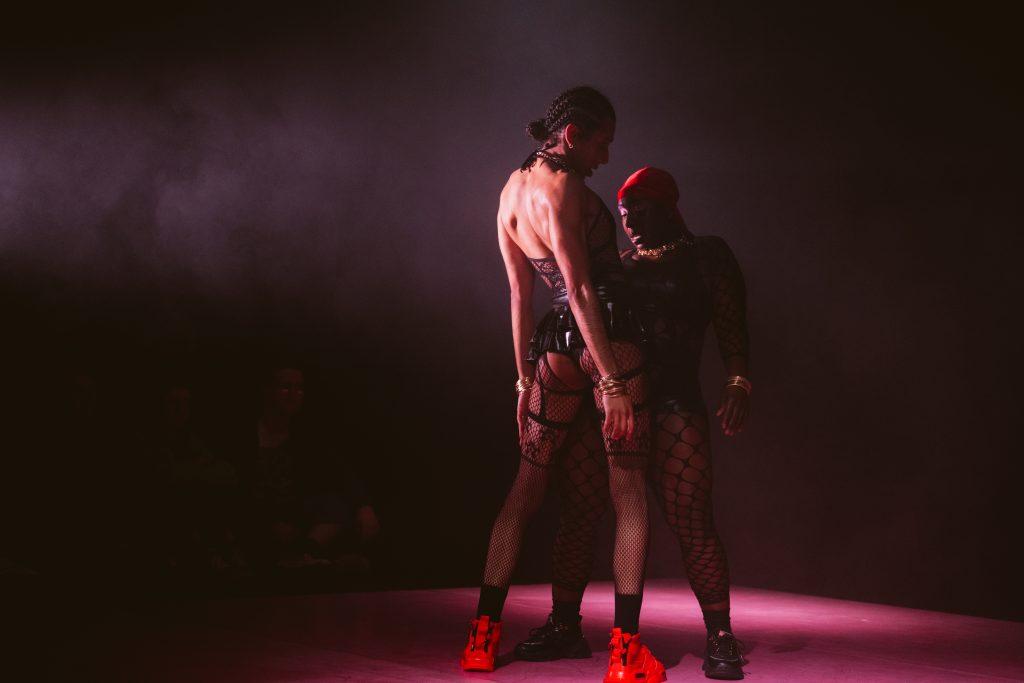
OUT embraces voguing at PuSh fest
In the latest iteration of OUT, Young helms Azara Meghie and Bambi Jordan Phillips in a show that embraces voguing, dancehall music, and Black liberation. And it still rebels through movement against homophobia and transphobia.
Young gave a great deal of consideration to making this deeply personal work resonate with new performers. It required sharing personal histories to allow Meghie and Phillips to root themselves in the piece in a manner that felt authentic to them.
“I’ve taken myself out of the work and I have a more directorial role,” Young states. “It’s a different skill.”
According to the National Museum of African American History & Culture, Black and Latino LGBTQ communities developed voguing in Harlem. Drag artists would engage in friendly competitions and tell stories through exaggerated hand gestures and high-fashion poses. The term came from the famous fashion magazine Vogue.
In recent years, voguing has made a comeback. And Young feels drawn to it because allows for “performative femininity” rooted in strength. That stands in contrast to being “soft and mushy” in accordance with feminine stereotypes.
“There was one way that you were supposed to show up as a person that was assigned female at birth,” Young states. “And so, this gets me an opportunity…to push the boundaries of that.”
Young advises that OUT enables gender-diverse and nonbinary audience members to show up differently than they might for other performances. “You know once you walk into that space that it’s inherently for you.”
To reinforce this point, the director reveals that OUT includes the flamboyantly androgynous Sylvester’s 1982 dance song “Do You Wanna Funk”.
“It’s really, really, really joyful, harking back to the people that have paved a way for us to be and live in the world now,” Young declares.
The upcoming PuSh festival performances coincide with a growing and sometimes violent right-wing backlash against the trans community in many countries. Young cannot comprehend why people face such intense persecution for wanting to live authentically in their own bodies.
“I feel it should be nobody’s business apart from the people whose bodies it is,” the director insists. “And I don’t understand why everyone has such an aversion to it. It doesn’t affect them.”
Neurodivergence as a superpower
Yet Young also recognizes that dancehall and rave cultures still offer queer folks a sense of freedom to express themselves fully.
“Without those spaces— without having that type of community—they may not be the people that they are today,” Young observes. “You might be masking because of your neurodiversity. You might be masking because of your sexual identity. Things like that. Or gender.”
Young only discovered their own neurodivergence in recent years. Prior to being diagnosed, the OUT director chalked up their alternate way of interpreting the world as “Ray-isms” specific to them.
“As much as you think that it’s such a relief to know, there’s also a sadness in that—a real sadness around being misunderstood,” Young says. “For many of us, you want that understanding to come from the world at large.”
Now, however, Young views neurodivergence as “a bit of a superpower” when it comes to problem solving and feeling what others might be experiencing. Because it’s an invisible condition, Young maintains that neurodiverse people must learn how to advocate for themselves.
Sometimes, the director adds, people who are neurodiverse will feel like they are a problem. In reality, they’re simply living in a world designed for neurotypical folks. As a result, Young advises neurodiverse artists to figure out what they need to succeed. And if others are not willing to accommodate them, they’re not worth working with.
“Sometimes, there are reasonable adjustments that can be made that mean everybody has a fair shot at some things,” Young emphasizes. “Sometimes, there’s resistance to that. So, that is one of the things I am always championing in my work and with the work I do with artists.”
Event details
The PuSh International Performing Arts Festival will present OUT with the frank theatre co. at Performance Works on Granville Island at 9 p.m. on February 8. There will be a second performance at the same location at 5 p.m. on February 9 with a post-show talkback. OUT will be presented in partnership with Toronto-based Buddies in Bad Times Theatre and in association with U.K.-based Here + Now. For tickets and more information, visit the PuSh festival website.
Follow Pancouver on X @PancouverMedia and on Instagram @PancouverMedia. Follow Charlie Smith on Bluesky @charliesmithvcr.bsky.social.




