
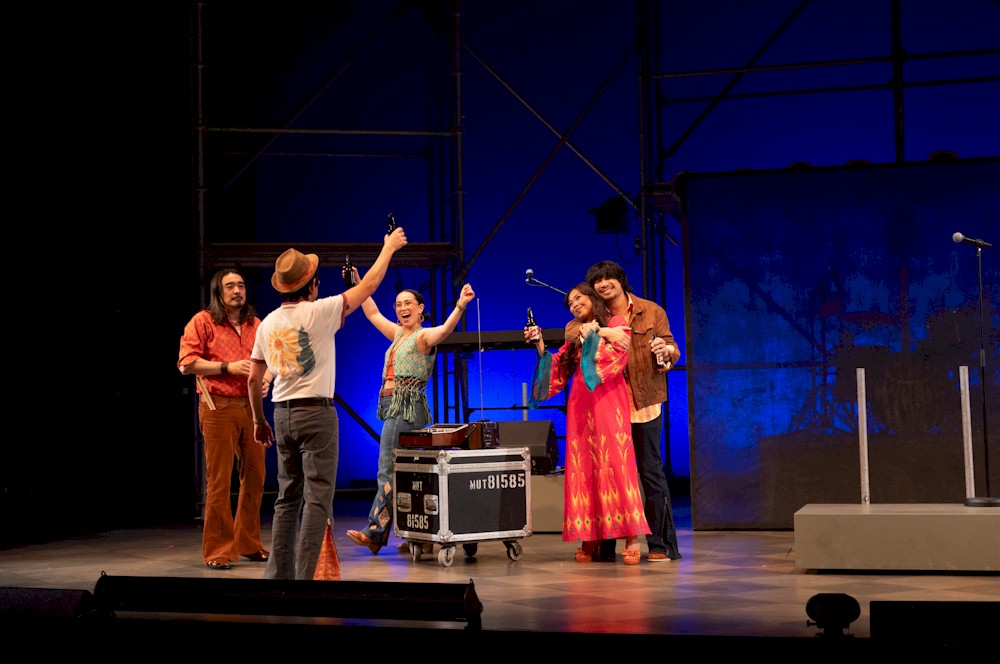
Vancouver writers have already written smart reviews about the Arts Club Theatre Company’s Canadian premiere of Cambodian Rock Band. Two examples include Angie Rico’s “Cambodian Rock Band sings to help heal wounds of a grim past” and Colin Thomas’s “Cambodian Rock Band: Yes and No”. In this article, I will do something different by drawing lessons for Canadians from this show.
Cambodian Rock Band revolves around the sometimes irritable Chum (Raugi Yu), who has returned to Cambodia in 2008 after fleeing the genocidal Khmer Rouge regime in the late 1970s. Chum drops in unannounced on his smart American-born daughter Neary (Kimberly-Ann Truong), who is in Phnom Penh prosecuting Duch (Nicco Lorenzo Garcia), a sinister war criminal.
At the outset, Chum engages in comic banter with Neary as she tries to conceal that her boyfriend, Ted (Jay Leonard Juatco), lives with her.
The play jumps back and forth between 2008 and the 1970s, when Chum was the bassist in a Cambodian rock band called the Cyclos. In these sections, Truong plays a second role as the ebullient, powerhouse lead singer, Sothea. Along with keyboardist Pou (Kayla Sakura Charchuk), drummer Rom (Jung King), and rock-star guitarist Leng (also played by Juatco), they’re recording an album in Phnom Penh as the Khmer Rouge advances. At times, the show becomes a rock concert, much to the delight of the Stanley Industrial Alliance audience.
U.S. playwright Lauren Yee’s manuscript ostensibly deals with atrocities that occurred in the 1970s. Yet as I watched this rollicking and at times tear-jerking show (due to the brilliant Raugi Yu), my mind sometimes wandered to the present. Especially as I witnessed the impact of the normalcy bias on members of the Cyclos.
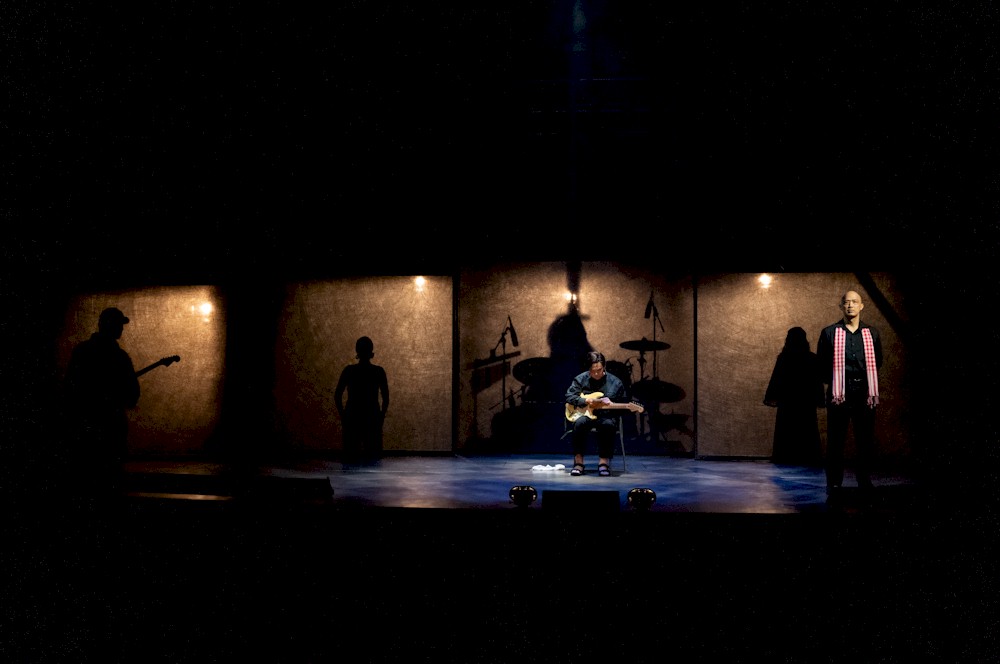
Cambodian parallels to the present
One central question emerges in the first act: how will they respond to the danger of Pol Pot, who was a well-known figure in Cambodia dating back to the 1960s? As leader of the Khmer Rouge, he aimed to ban all foreign influences, including music as well as mail and money. Pol Pot and his minions also had a tendency to murder anyone with material possessions or who was suspected of embracing western ideas. It was all part of an irrational crusade to “purify” society.
The normalcy bias suggests that the band might be underestimating the danger. They’re having fun recording music and they had endured strife-ridden times before. It’s tempting to believe that things will return to normal. After all, music has always been central to Cambodian culture.
There may be parallels in what Canadians are facing with the election of the authoritarian Donald Trump as president of the United States. Rather than preparing for the possibility of a U.S. invasion of Canada—which is one distinct possibility, according to Yale University historian Timothy Snyder—Canadians tend to think that once sanity prevails, the status quo will return. Then, we can resume cross-border shopping.
But we, too, risk falling prey to the normalcy bias, particularly if Trump means what he says about retribution. Clearly, he is not a normal president. He may be clinically insane with his talk of erasing the border and declarations that Canada is not a real country.
These are not normal times
“War with Canada is what Trump seems to have in mind,” Snyder writes on his Substack page. “Fentanyl is not the only the big lie. That Canada does not really exist is the other.”
Nor is the western alliance–wrecking J.D. Vance a normal vice president. White House deputy chief of staff Stephen Miller and Secretary of Defense Pete Hegseth are zealots.
In fact, the Trump administration is populated with others like them who want to shred the rule of law, impeach judges, traumatize public servants, threaten law firms over diversity policies, financially hobble universities, and kneecap the media. They erase the separation of powers embedded in the U.S. Constitution while rejecting the scientific consensus on global heating.
These Trump folks may not be close to the level of Pol Pot–style atrocities, at least not yet. But there are resemblances in the Trump administration’s contempt for the truth and eagerness to violate norms of civilized behaviour. Trump’s team has allowed the deaths of starving children by suddenly shutting down USAID. They also left Ukrainians even more vulnerable to Russian aggression by cutting off intelligence sharing.
On its website, a behavioural design think tank called The Decision Lab says that humans “tend to base our actions on how often we see and experience things ourselves (inductive thinking)”.
“In other words, even though we might know that there’s a risk of a negative situation occurring, we choose not to take the threat seriously because we’ve never seen or experienced it before,” The Decision Lab adds. “In this way, the normalcy bias builds up in our minds over time; as more and more normal events happen to us, our tendency to underestimate threats and the likelihood of disaster increases.”
Beyond solid acting, Jivesh Parasram’s slick direction, magnificent projections, outstanding historical insights, and Juatco’s superb guitar work, this is the lesson of Cambodian Rock Band. The tragedy that shattered Cambodian society in the late 1970s can happen anywhere, including in North America. And the risk increases for all of us if we fail to heed the warning signs due to the normalcy bias.
Event details
The Arts Club Theatre Company is presenting Cambodian Rock Band by arrangement with Concord Theatricals on behalf of Samuel French, Inc. The show is at the Stanley Industrial Alliance Stage (2750 Granville Street) until April 6. For tickets, showtimes, and more information, visit the Arts Club website.
Follow Pancouver on X @PancouverMedia and Bluesky @pancouver.bsky.social. Pancouver is also on Instagram @PancouverMedia. In addition, follow Charlie Smith on Bluesky @charliesmithvcr.bsky.social.




