Sudan, Remember Us ominously opens with an image of Arabic graffiti on a wall in a windswept area of Khartoum. It states: “The heroes’ blood is my blood.”
As the camera pans a desolate neighbourhood, viewers hear a voice-over of a phone conversation between French-Tunisian-Moroccan filmmaker Hind Meddeb and a young woman named Maha. Maha, a resident of Khartoum, is caught between the army’s bombing campaign and the Rapid Support Forces militia who terrorize and murder city dwellers.
“Here in France, there’s not much talk about the war in Sudan,” states Meddeb, a seasoned journalist.
“War destroys absolutely every aspect of our lives,” Maha replies.
It’s a jarring juxtaposition of realities.
Through Maha, Shajane, Muzamil, Khatab, and other young adults in Khartoum, Meddeb (Tunisia Clash) humanizes a horrific conflict that has mostly gone under the radar screen of the international media. The DOXA Documentary Film Festival will present the B.C. premiere on Thursday (May 8).
Sudan, Remember Us doesn’t explain why the country’s capital city has been left in ruins this year. That’s a complicated story rooted in a fight over gold, the collapse of civilian leadership, previous atrocities, mercenaries, and a power struggle between two armed factions following the overthrow of long-time dictator Omar al-Bashir in 2019.
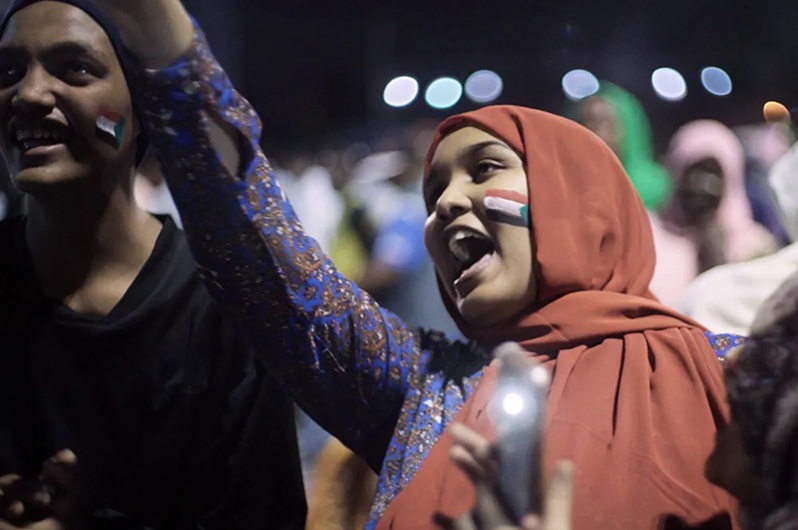
However, Meddeb’s 2024 documentary eloquently captures the effect of civil war on the city’s young poets and artists. Following their successful 2019 uprising, these young freedom lovers believed that Sudan was about to embark on a new era of democracy. Meddeb was in Khartoum at the time, documenting them dancing in the street. Through exceptional cinematography, their euphoria is also palpable in placards and signs that speak about Sudan freeing itself from tribalism and embracing religious pluralism.
Hints of future horrors in Sudan
In some of the film’s most touching moments, Meddeb interviews young, articulate Sudanese women in 2019 anticipating far greater gender equality. Instead, a subsequent civil war brought mass starvation, sexual violence, kidnapping, and fires. Approximately 12.7 million people have been displaced internally and internationally since April of 2023.
Sudan, Remember Us is not filled with images of explicit bloodshed and famine. Rather, Meddeb maintains her focus on young adults in Khartoum, once so full of optimism. They remain defiant following the collapse of civilian rule in late 2021. The director hints at horrors to come with scenes of gunfire and explosions.
It’s a disturbing reality check for anyone who feels that the West is somehow immune to a similar breakdown of civil society. After all, these music-loving Sudanese urban dwellers aren’t all that different from young people in cities around the world. They share similar values and dreams. Moreover, if it can happen in Sudan—due to the bloodthirsty desires of greedy political demagogues—what’s to stop it from occurring here?
After seeing Sudan, Remember Us, it’s easier to feel a visceral connection to this sprawling, northeast African country. Meddeb’s crowning achievement is to build empathy for some very likable residents of Khartoum. It’s an important step in waking up the world to the crisis of millions who’ve had to flee their homeland.
Watch the trailer for Sudan, Remember Us.
Event details
The DOXA Documentary Film Festival will present the B.C. premiere of Sudan, Remember Us at 7 p.m. on Thursday (May 8) at the VIFF Centre. Following the screening, producer Sol Guy, Vancouver-based Sudanese activist Duha Awad, University Canada West lecturer Hala Mousa, and Sudanese-Canadian singer and artist Hatem Hanafi will participate in a panel discussion. For tickets and more information, visit the DOXA festival website.
Follow Pancouver on X @PancouverMedia and Bluesky @pancouver.bsky.social. Also find Pancouver on Instagram @PancouverMedia. Follow Charlie Smith on Bluesky @charliesmithvcr.bsky.social.