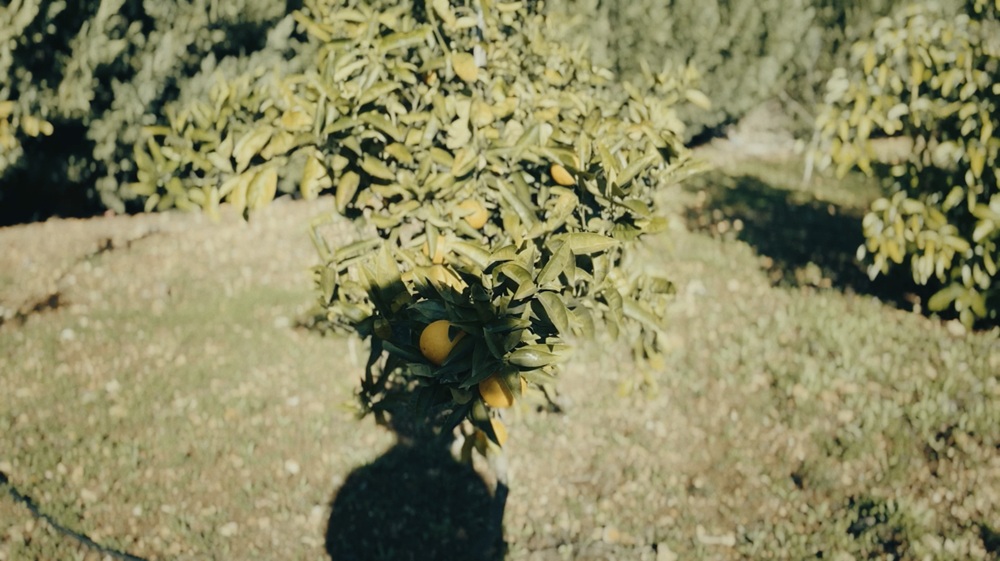
A recurring dream inspired Ghinwa Yassine to travel more than 10,000 kilometres to create her newest film. Ever since Lebanese-born anti-disciplinary artist moved to Vancouver, she has been having visions of her grandfather in her sleep. She tells Pancouver that in these dreams, she sees him working the soil around the same tree in his hometown of Aadchit in southern Lebanon.
“I got a bit obsessed with it and wanted to go and film where he used to put his gardening tools,” Yassine says over Zoom.
Yassine was raised in Beirut, but she and other family members spent plenty of time at her grandfather’s home. Her father even gave her and her sisters a plot of land that belonged to her granddad. But when war broke out in 2023, Yassine was prevented from returning to southern Lebanon to reconstruct images from her dreams.
“It was really not safe to go anymore to the village,” Yassine recalls. “Then, my aunt let a family of refugees from another village use the house.”
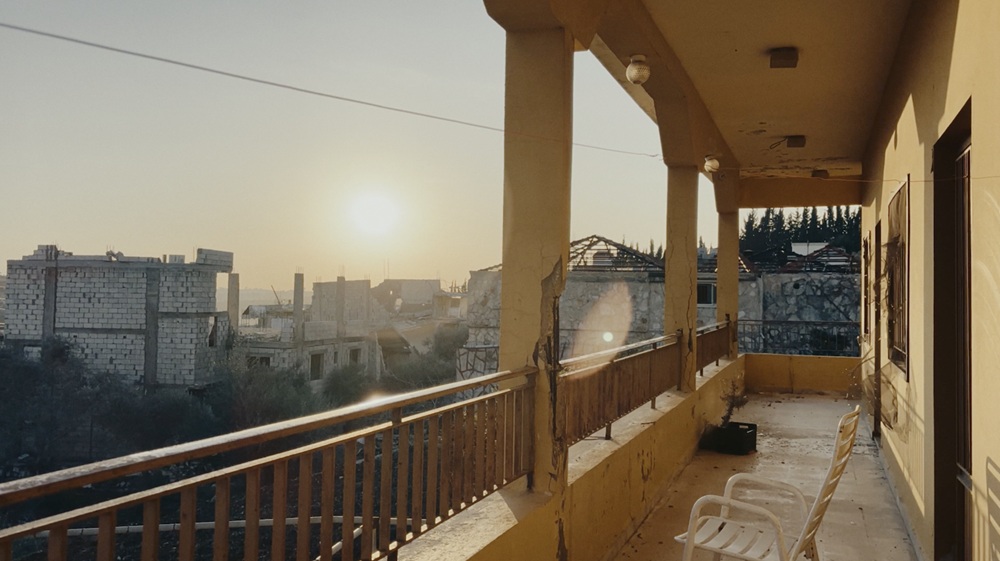
That caused the artist to re-evaluate her project. She questioned whether she could justify a film centred around identity and nostalgia when people were sheltering in the yellow house to avoid Israeli bombs.
Thus when a ceasefire was declared between Israel and Hezbollah, Yassine travelled to Aadchit with a revised plan. She decided instead to focus on loss and renewal in her 18-minute film, “A Dream Pointing to Aadchit”. And she chose to do this by capturing her ancestral village through a “non-anthropocentric gaze”.
“A Dream Pointing to Aadchit” premieres in Beirut
Her film reveals that her grandfather’s house sustained damage from an Israeli bomb, but the land remained intact, ready for replanting.
“I feel like I was trying to find the hope in the resilience of the land,” Yassine states. “There was definitely a sense of relief—I can still access my land.”
She admits that she shed a few tears as she processed what she was witnessing in Aadchit. From sequences filmed from a moving vehicle, she shows several buildings reduced to rubble.
“Because I was behind the camera, I was a bit detached when it came to the destruction,” she acknowledges.
“A Dream Pointing to Aadchit” premiered at the Beirut Shorts International Film Festival, where it was honoured as the Best Land, Peace & Justice Film award. Yassine says that because this project was for her family and others affected by the war, this might have been the most important recognition of her artistic career.
“For an artist working in the diaspora, a lot of times I worry about showing my work in Lebanon,” she states. “I don’t know how it’s going to be perceived.”
On her website, Yassine describes her film as “an anti-documentary that shifts the question from ‘What does it mean to own land?’ to ‘What does it mean for land to be owned?’ ”
“When my grandfather’s house was hit, I saw that the land itself, rich and ready to be planted again, and oblivious to the meaning of identity, was where my embodied memories lived,” Yassine writes. “Avoiding monumentalizing violence, or sentimentalizing loss, this work offers a space for witnessing and reflection.”
Holding on to land
She describes “A Dream Pointing to Aadchit” as her first “film” in the classical sense of the word. She captured images on her phone.
“I was really listening to what the story needed,” Yassine says. “It did not need my previous idea of shooting with a cinematographer.”
Yassine has previously included video in installation work, such as with the multimedia KickQueen about 2019 protests in Lebanon. She has also recorded experimental performances on video, including in her autobiographical solo project A Woman Appears A Woman Disappears.
In “A Dream Pointing to Aadchit”, the filmmaker intersperses phone conversations with relatives alongside imagery of the landscape.
“I offered the land to my uncle to use,” her aunt says in one call. “You should see it now. It’s all green.”
In another call, Yassine asks a sister why her father always said that the land belonged to the girls.
“Because in Islam, a boy gets double a girl’s inheritance, so he wanted to give us equal parts,” the sister replies. “So dad turned out to be a feminist. He’s fair. He believes in justice in everything.”
Yassine says that she never really wanted to take anything from her family or anyone else. While she lacks attachment to material possessions, she put her foot down when her dad suggested selling the family’s plot of land.
“With distance, what remains is the essence of what makes us who we are—what made us—and it was my connection to the land,” Yassine declares. “You lose it and you get some money that will sustain you for a year or two, but then the land is gone.”
Watch the trailer (above) for the award-winning “A Dream Pointing to Aadchit”.
To learn more about Ghinwa Yassine’s artistic practice, visit her website. Find her on Instagram @arts.embodiment. Follow Pancouver on X @PancouverMedia and Instagram @PancouverMedia.