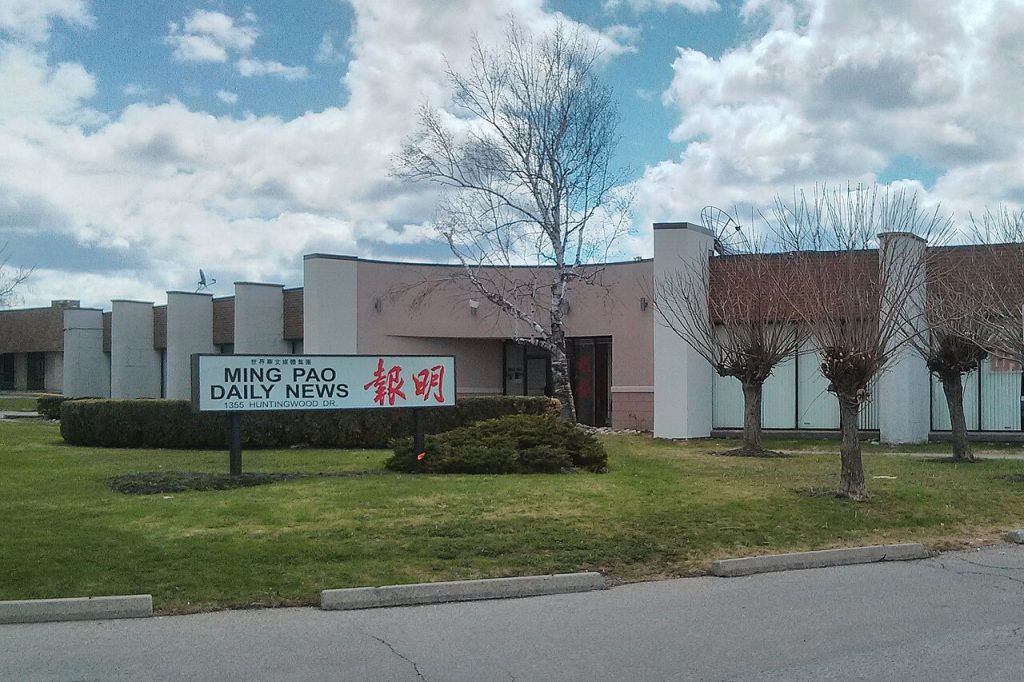
Metro Vancouver is about to lose another important Chinese-language media outlet. Ming Pao Daily News will terminate 60 employees at its Vancouver and Toronto publications. That’s according to a letter from Ming Pao Newspapers (Canada) to the B.C. Labour Ministry, which was obtained by the Canadian Press.
Canadian Press journalist Nono Shen reported that Ming Pao will print its final newspapers in Canada on January 17; workers will be terminated effective January 31.
Hong Kong-based Ming Pao Enterprise Corporation Ltd. owns Ming Pao Daily News.
Ming Pao has been publishing in Toronto and Vancouver since 1993. In Vancouver, senior reporter Victoria Chang has been with the paper since 1997. Others who’ve worked there over the years include former long-time reporter and managing editor Susanna Ng, progressive journalist Eric Chan, former CBC journalist Winston Szeto, and former city hall reporter and columnist Catherine Chan.
Ng, Chang, Eric Chan, Ivy Ng, Eva Cheng, and Amanda Sun shared a Jack Webster Foundation Award in 2018 for their Ming Pao Daily News series “Hongkongers in Canada – on the 20th anniversary of Hong Kong’s handover”.
Via email, Susanna Ng described news of the closure of Ming Pao as “deeply personal”. She pointed out that the paper won numerous Webster Awards as it chronicled the largest wave of Hong Kong immigration to Canada since the mid-1980s.
According to her, the Western Canadian edition of Ming Pao at its peak employed more than 140 staff, including around 15 reporters and translators and more than a dozen editors. It also operated its own printing press.
“But its importance went well beyond its scale,” Ng asserted. “The paper was not only a voice for Hong Kong immigrants; it also became a forum for self-examination. It asked what kind of Canadians we wanted to become.”

Ming Pao served as a bridge
Ng maintained that the paper was a “platform for integration” in addition to being a source of information. She noted that in the 1990s, the paper hosted lively debates about identity and belonging. In this respect, it served as a bridge for the community.
“I was proud to be part of these conversations, and they shaped my own understanding of citizenship,” Ng declared. “Working at Ming Pao made me a better Canadian.”
Ng expressed the hope that the full archive of Ming Pao Canada will be preserved and made accessible to future generations. Currently, UBC Library hosts the digitized version of Ming Pao‘s community section, but not complete daily editions.
“As a researcher in Chinese Canadian history now, I am deeply thankful that the nearly complete run of The Chinese Times from 1915 to 1992 has been digitized by UBC and SFU,” Ng stated. “That archive has been essential to understanding the lives of earlier generations of Chinese Canadians.”
Richmond-Bridgeport MLA Teresa Wat worked as a city editor at Ming Pao in 1996 before she was hired by as a communications official for the B.C. government. Over X, she expressed sadness that Ming Pao Daily News will cease daily publication.
“Ming Pao was more than a newspaper,” Wat tweeted. “Thank you for your lasting contributions to the Chinese Canadian community. An era ends but the memories endure.”
I’m saddened to learn that Ming Pao Daily News will cease daily publication in Canada, including Vancouver, at the end of this month.
I worked at Ming Pao in 1996 as City Editor, leading a team of 10 reporters during a time of urgency and journalistic pride.
Ming Pao was more… pic.twitter.com/u5KswJTjJt— Teresa Wat (@Teresa_Wat) January 13, 2026
Ming Pao cites “financial reasons” for closures
The shutdown comes less than a month after the federal broadcast regulator granted an application by Fairchild Radio (Vancouver FM) to revoke its broadcasting licence for its AM 1470 radio station, effective March 5. The Canadian Radio-television and Telecommunications Commission ruling allows Fairchild to transfer 33 hours of Chinese-language programming to its FM station on weekday mornings and afternoons.
The migration of private-sector advertising from print and broadcast to digital has hobbled many media outlets. Google and Meta attract approximately 80 percent of online advertising revenue in Canada, leaving relatively little for Canadian-owned media outlets.
In its letter to the B.C. Ministry of Labour, Ming Pao Newspapers (Canada) cited “financial reasons” for the permanent closure of its Canadian operations, according to Canadian Press.
In 2024, the City of Vancouver paid $28,651 to Ming Pao Daily News, according to the city’s annual statement of financial information. In contrast, Postmedia Network Inc. received $109,630 from the City of Vancouver. Provincial spending numbers are not so easily obtained because media buys go through advertising agencies.
Ming Pao Newspapers (Canada) is just one of several Canadian media companies under financial pressure.
Corus Entertainment owns 15 conventional television stations, 25 specialty television services, and 36 radio stations across Canada. It also owns the Global network, yet its share price is a mere $0.04. Corus Entertainment’s market value is just $7.84 million—less than the value of a mansion in Vancouver’s Shaughnessy neighbourhood.
In 2025, Corus reported a $321.8-million net loss on revenues of $1.12 billion. The adjusted net loss attributable to shareholders was $73.5 million.
Meanwhile, Canada’s largest newspaper company, Postmedia, reported an after-tax net loss of $77.3 million in 2025 on revenues of $431.5 million.
This article was amended on January 14 to include Susanna Ng’s comments. Follow Pancouver on X @PancouverMedia and Bluesky @pancouver.bsky.social. The publication is also on Instagram @PancouverMedia.