
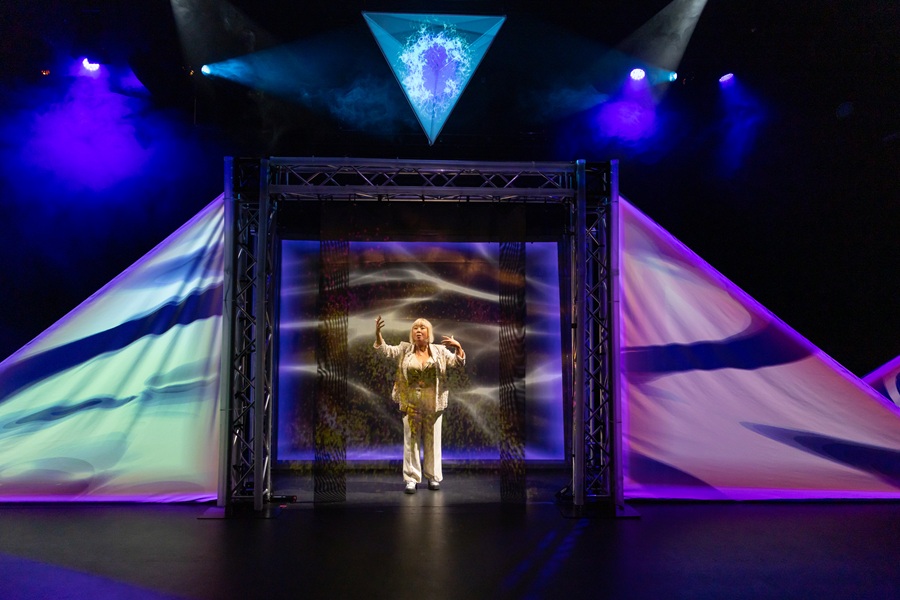
Hazel Venzon embarked on a truly original artistic mission with her upcoming solo show at the PuSh International Performing Arts Festival. The veteran Winnipeg writer, director, and actor decided to collaborate with longtime collaborator Darren O’Donnell in addressing questions commonly asked of the Filipino diaspora.
These questions range from “Why are Filipinos so nice?” to “Why is there such a diasporic spread of Filipinos to so many countries?”
“The show is framed by learning, essentially, how to be Filipino,” Venzon tells Pancouver over Zoom from her home in Winnipeg.
As a second-generation Filipina, Venzon never had a need to escape her country in order to build a new life. But the Studio 58 and University of Manitoba School of Fine Art graduate understands why so many Filipinos are working abroad. Her mother immigrated from the northern Philippine island of Luzon more than 50 years ago, finding employment as a seamstress. Her father is from the southern Philippine island of Mindanao.
In Everything Has Disappeared, Venzon helps audience members imagine what the world would be like if there were no Filipino people. Festivalgoers can also consider what their lives would be like without any Filipinos working on cruise and container ships or in care homes, factories, and other workplaces.
“It’s a cheeky way to say, ‘You know, without us, you’re fucked,’ ” Venzon quips. “The whole conceit of this now is that I play a host and a guide to walk people through on how to essentially learn the ways in which we care for people through kapwa.”
Watch the trailer (above) for Everything Has Disappeared.
Venzon elevates public appreciation for kapwa
In the 1970s, the father of Filipino psychology, Virgilio Enriquez, advanced the concept of Sikolohiyang Pilipino. It aims to understand the Filipino psyche through Filipino culture and language, which is infused with Indigenous history. The Philippines endured more than 330 years of Spanish colonization. That was followed by decades of U.S. hegemony and Japanese conquest.
For far too long, Enriquez felt that western psychology wasn’t up to the task of understanding Filipinos. Central to Enriquez’s approach was the notion of kapwa, which recognizes that Filipinos share their inner self with others.
“This Filipino linguistic unity of the self and the other is unique and unlike in most modern languages,” Enriquez declared at the time. “Why? Because implied in such inclusiveness is the moral obligation to treat one another as equal fellow human beings. If we can do this—even starting in our own family or our circle of friends—we are on the way to practice peace.”
One of Venzon’s larger goals with this show is to elevate public appreciation for kapwa. And she likes employing humour as a tool. At times, she even takes on the role of a mentalist.
“We teamed up with a magician named Erik Mana from Toronto, who had his own magic show in the Philippines,” Venzon discloses. “He taught me how to do some sleight-of-hand and mentalism—and this work ends up in the production. So, it started to become a much more interactive piece.”
As a result, she promises that Everything Has Disappeared is unlike anything theatre audiences will ever experience. But she warns that it will require bravery on the part of the audience—and not the type of bravery that entails simply climbing up on-stage as a participant. Rather, she is describing the courage of confronting what lurks inside the chambers of our soul.
“We literally play with your mind, your body, and the idea of your own self,” Venzon declares.

Co-writers consulted with academics
Venzon is executive artistic producer and co-founder of UNIT Productions. Her co-writer Darren O’Donnell is artistic and research director of Mammalian Diving Reflex. The show’s origins date back to O’Donnell witnessing a huge gathering of Filipinos in Hong Kong nearly a decade ago.
On Sundays, migrant Filipino domestic workers all have the day off. Prior to more recent Chinese government crackdowns, they sometimes held public protests.
According to Venzon, O’Donnell asked if she knew about one particular occupation that he saw. She replied that this was news to her. That led O’Donnell to wonder what would happen if none of the Filipino migrant labourers returned to work.
“I went, ‘Well, things will break down. It’s like when bees disappear from the ecosystem,’ ” Venzon recalls saying.
Next, they asked themselves what that would look like on the ground. In search of answers, they contacted Geraldine Pratt, UBC’s Canada Research Chair in Care Economies and Global Labour.
“I had worked with her on a different project, so we had this connection,” Venzon says. “She sat with us and through that, thought the question was pretty robust.”
In the ensuing years, Venzon and O’Donnell consulted with other academics.
“When I was in the Philippines for something, I met with a bunch of other scholars and human geographers,” Venzon says. “And we asked the question: what would happen if we all disappeared?”
That helped the co-writers of Everything Has Disappeared identify specific choke points in the global economy.
“So, we focus on that in the show and we basically spell it out,” Venzon reveals.
The PuSh International Performing Arts Festival will present Everything Has Disappeared with the Cultch and Live Biennale at the York Theatre (639 Commercial Drive) from Thursday (January 29) to Sunday (February 1). Unit Productions and Mammalian Diving Reflex are co-producing the show in collaboration with The Chop Canada. For tickets and more information, visit the PuSh festival website.
Follow Pancouver on X @PancouverMedia and Instagram @PancouverMedia.




