By Rita Wong
Showing at the International Village Cineplex Odeon until Thursday, February 5.
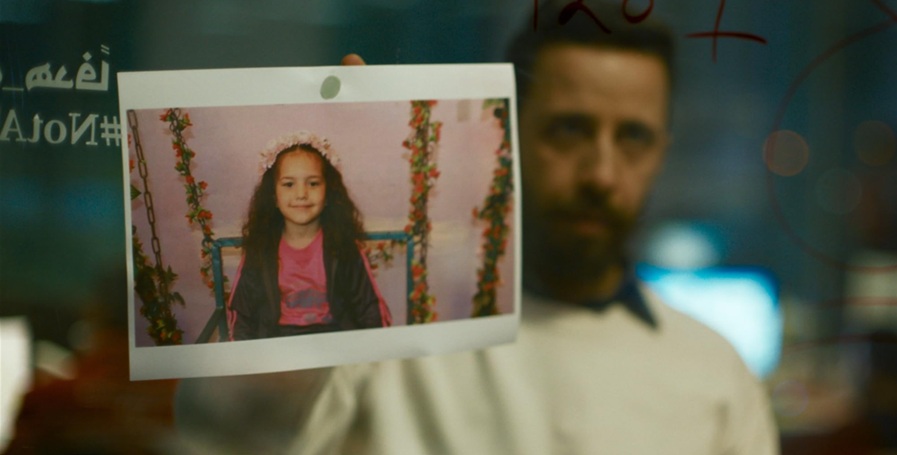
Hind Rajab loved the ocean. A five-year-old girl, Hind’s last hours of life in January 2024 were spent trapped in a car with the corpses of her uncle, aunt, and four cousins, who had been killed by the Israeli military. Terrified and surrounded by tanks, Hind’s calls for help reached the Palestinian Red Crescent Society staff, who overcame bureaucratic hurdles and sent paramedics to rescue her. Despite receiving an approved route for the ambulance to proceed, the rescue workers, Yusuf al-Zeino and Ahmed al-Madhoun, were also killed by the Israeli military.
The Voice of Hind Rajab is a gripping film that takes us through the last hours of Hind’s short life from the perspective of the people who responded to her call for help.
By now, many millions of people around the world know this heart-breaking story, one of countless atrocities and war crimes committed by Israel’s army. Yet the film is riveting in its re-enactment of Hind’s last hours of life. It is a necessary refusal to look away from the brutal dehumanization and state-driven genocide of Palestinian people.
In witnessing Hind’s humanity, we are placed in a similar position to the Red Crescent staff, doing whatever they can, yet thwarted by fascist military violence trying to exterminate a people. We learn that we have much more in common with Hind and the people who tried to rescue her than we do with those who murdered her.
In this moment, as we see a widening disregard for life by fascists killing without constraint in Palestine, spreading to places like Minnesota, we also see steadfast mass resistance to the violence. This film is part of that resistance, well worth seeing for its commitment to life.
Though the film does not name Hind’s murderers, the Hind Rajab Foundation has filed a war crime complaint against Lieut.-Col. Beni Aharon, the commander of the battalion that killed her. The International Criminal Court has not rendered a verdict yet regarding this.
I see why the film received a 23-minute standing ovation when it premiered at the Venice Film Festival. Though the horrors of war are vividly faced, a child’s humanity remains intact, and her spirit proves stronger than the weapons and brutes that would snuff her out. The film is a testament to what it means to be human in the face of war, and well worth seeing anytime, but particularly in the times that we are now facing.
Rita Wong is a poet-scholar who attends to the relationships between water justice, ecology, and decolonization. Follow Pancouver on Bluesky @pancouver.bsky.social and Instagram @PancouverMedia.