An award-winning documentarian insists that the City of Vancouver has done a disservice by changing the name on panel memorializing the expulsion of the Komagata Maru from Vancouver’s harbour in 1914. In a commentary on Scroll.in, Ali Kazimi stated that the information panel in Harbour Green Park “now carries rewritten text that presents the ship primarily as the Guru Nanak Jahaz, with the name Komagata Maru visually and textually subordinated”.
“This may appear to be an act of historical redress,” wrote Kazimi, a York University professor of cinema and arts. “But it narrows a broader history of racial exclusion and introduces a present-day political claim into the documentary record without fully reckoning with the consequences.”
The city unveiled the change to coincide with the 112th anniversary of the arrival of the ship in Vancouver’s harbour.
Kazimi is one of Canada’s leading scholars on the Komagata Maru. His 2004 documentary, Continuous Journey, focused on the context surrounding the federal government’s decision expel the ship along with more than 350 passengers.
A Sikh businessman, Gurdit Singh, chartered the Komagata Maru. However, officials refused to allow the boat to dock because of a government ban on immigrants who had not made a continuous journey to Canada. The ship had stopped for provisions in Hong Kong on its way from British-ruled India to Vancouver.
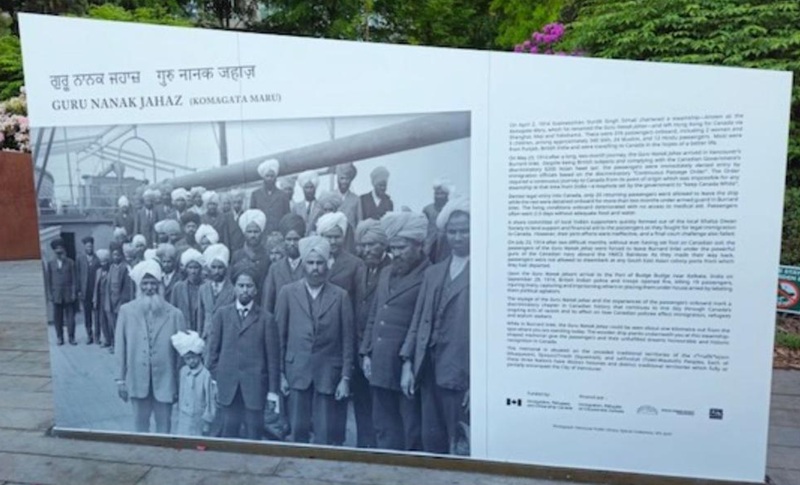
Komagata Maru was ship’s legal name
Three dozen passengers were either Muslim or Hindu. The continuous journey regulation applied to them as well as to the Sikhs onboard.
“Gurdit Singh had commercial control over the voyage but the contract he signed did not transfer ownership of the vessel to him or alter its legal registration,” Kazimi emphasized in his commentary. “He could name and frame the voyage as the Guru Nanak Jahaz, but the ship remained the Japanese-owned and registered SS Komagata Maru.”
Kazimi acknowledged that “Guru Nanak Jahaz has a meaningful place in Punjabi and Sikh memory of the voyage”. According to him, this warrants it being recognized, taught, and explained.
However, Kazimi noted that the vessel’s name, SS Komagata Maru, “appears in Canadian immigration records, legal proceedings, newspapers, government correspondence, imperial files and the major body of scholarship”. Therefore, Kazimi argues that Komagata Maru is not a “colonial misnomer” because it was the legal name of the ship.
“Future students and members of the public may come to believe that Komagata Maru was an erroneous colonial label rather than the name under which Canada’s racism was recorded and can still be traced,” Kazimi wrote.
His documentary, Continuous Journey, won several honours, including the Colin Low Award for the Most Innovative Canadian Documentary at the 2005 DOXA Film + Video Festival. Kazimi is also the author of Undesirables: White Canada and the Komagata Maru – An Illustrated History, which was a finalist for the 2012 City of Vancouver Book Award and the 2013 Roderick Haig-Brown Regional Prize.
Kazimi is an elected Fellow of the Royal Society Canada and a Senior Fellow at Massey College. He was awarded an honorary doctorate by UBC
Learn more about Ali Kazimi’s work by visiting his website. Read his commentary here.
Follow Pancouver on Instagram @PancouverMedia, on X @PancouverMedia, and on Bluesky @pancouver.bsky.social.