Could the Holocaust have occurred if Adolf Hitler had never been born? Jason Bell, author of Cracking the Nazi Code: The Untold Story of Canada’s Greatest Spy, suggests that this genocidal horror might have actually been even worse. He emphasizes that this presupposes that Germany would have been ruled by militarily competent people who wanted the Holocaust to happen.
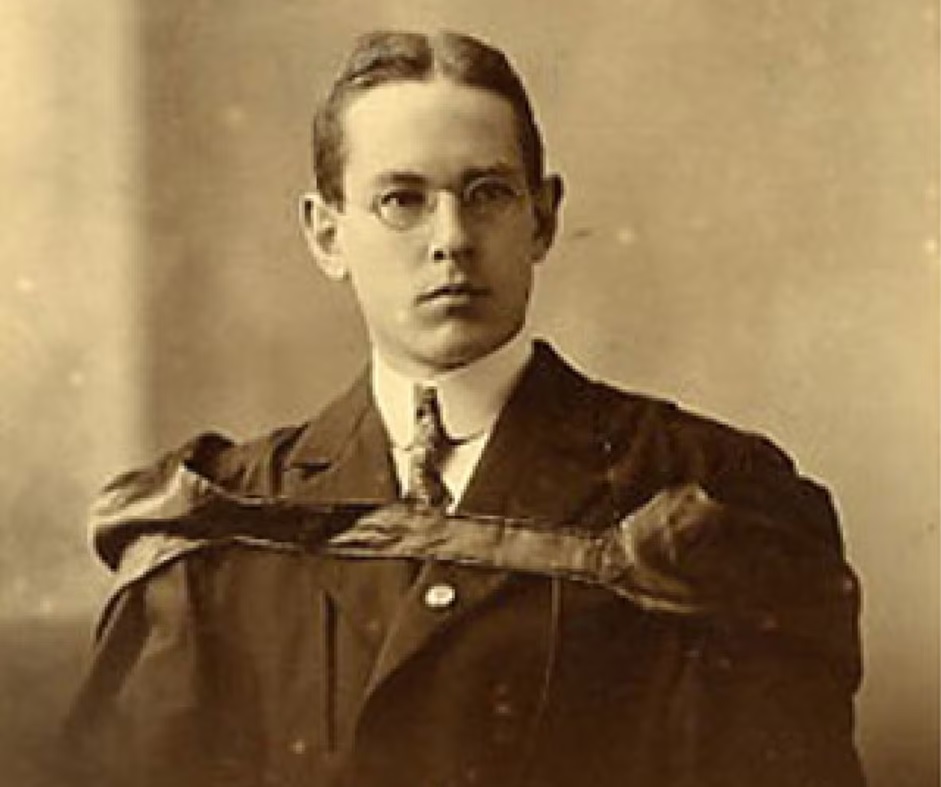
Bell, an associate professor of philosophy at the University of New Brunswick, drew this conclusion after researching his biography of Winthrop Pickard Bell (no relation). The Halifax-born academic, who died in 1965, spied for MI6 in Germany immediately after the First World War.
Jason Bell will speak about his research into the Canadian known as Agent A12 on Thursday (February 27) at the Cherie Smith JCC Jewish Book Festival.
“We tend to think that the evil of the Holocaust was centred around this single charismatic man: Adolf Hitler,” Jason Bell tells Pancouver by phone. “What Winthrop Bell’s story shows is that this was coordinated at a high level—political, military, industrial—and that Hitler was swept into the movement. I think that’s a powerful lesson about how things just get done in the world.”
The University of New Brunswick professor combed through Winthrop Bell’s papers. Housed at Mount Allison University in New Brunswick, these papers were only declassified in 2012. In his book, Jason Bell reveals that Winthrop Bell worked in Germany as a Reuters reporter after the First World War.
The future head of MI6, Stewart Menzies, negotiated this arrangement with the then head of Reuters.
“It appears that Canada supplied a line of funding that covered Bell’s salary through the Bank of Montreal,” Jason Bell writes. “MI6 covered his travelling expenses and the cost of his top-secret telegraphs. And Reuters covered the cost of his journalistic telegraphs.”

Winthrop Bell discloses roots of Holocaust
In 1919, Winthrop Bell warned that National Socialists in Germany were planning a second world war. This was before anyone had ever heard of Adolf Hitler.
According to Jason Bell’s research, the seeds of the Holocaust were planted in the First World War. In Cracking the Nazi Code, the author highlights Winthrop Bell’s discovery that the Anti-Semitic League in Germany was planning a wholesale slaughter as early as 1915. An unnamed general, believed to be Gen. Erich Ludendorff, was part of the conspiracy.
Winthrop Bell revealed how Ludendorff became the de facto dictator of Germany, telling Kaiser Wilhelm II what to do. After the war, Ludendorff promoted the false notion that Germany had been stabbed in the back by the Jews, causing the country’s defeat. The general also participated in the failed 1920 Kapp Putsch and the failed 1923 Beer Hall Putsch.
“He hated Jews; he hated other races,” Jason Bell says. “And he had a lot of organizations within Germany that he had created and reported to him. So, he was able not just to create this ideology but to have the funds and the organization to support it.
“Adolf Hitler was a cog in that machine,” the author adds. “This is not to minimize what Hitler did—morally speaking.”
Jason Bell’s book points out that Ludendorff was inspired by a conspiratorial and fabricated text, The Protocols of the Elders of Zion, which was first serialized in Russia in 1903. Many Russians ended up blaming Jews for their nation’s military loss to Japan in 1905.
Links to genocide
Moreover, Ludendorff’s right-hand man, Col. Max Bauer, conducted a survey of troops in October 1916 in search of evidence that Jews were shirking their duties to avoid the front lines in the First World War. Jason Bell writes that the purpose was to imply that Jews were the cause of Germany’s military troubles and that racist generals needed to blame someone to justify a second world war.
Genocide was already in the air in the First World War. Cracking the Nazi Code shows how Winthrop Bell uncovered links between German intelligence officials and Ottoman Empire leader Talaat Bey, a.k.a. Talaat Pasha.
“He was the world’s most prolific serial killer, having ordered the murders of over a million Armenians, Greeks, and Jews during the war,” Jason Bell writes.
A few months after Winthrop Bell interviewed Talaat in Germany, a young intelligence officer named Adolf Hitler “signed a death warrant on the Jewish people called the Gemlich letter”.
“Hitler knew his argument would find an audience among his superiors,” Jason Bell states in his book. “Top intel figures like [Hans] Humann, a friend of the Turkish génocidaires, had supported racial killing years before Hitler put it into words. At first glance, rich Talaat and Humann shared little in common with poor Hitler. But as salesmen of genocide, these three men enjoyed lucrative career prospects.”
Furthermore, more than 100,000 Jews were murdered in 1918 and 1919 in Ukraine. White Russian general Anton Ivanovich Denikin, a veteran of the Russo-Japanese War, drove this mass slaughter.
“Bell’s secret intelligence reports, filed later in the year, revealed concrete links between the German plotters and the Russian antisemites pillaging Ukraine and murdering Jews,” Jason Bell writes.
Germany imprisons Winthrop Bell
Winthrop Bell actually never set out to be a spy. Born into a wealthy Halifax family, he had a keen interest in philosophy. After graduating from Mount Allison University, he enrolled at Harvard before moving on to Cambridge University in England. Cracking the Nazi Code discloses Winthrop Bell’s early fascination with phenomenology. This led him to the University of Göttingen in Germany where he could study for his PhD under the tutelage of Edmund Husserl.
But the First World War intervened and the German government imprisoned Winthrop Bell as an enemy alien. In February 1915, the Germans transferred him to a larger camp in Berlin called Ruhleben, which housed many intellectuals.
“For Britain’s future anti-Nazi intelligence agents, Ruhleben was a four-year espionage training camp, paid for by the German government,” Jason Bell wryly notes in his book.
Here, Winthrop Bell met a central figure in British intelligence as well as key members of the Fabian Society. After the war, Winthrop Bell travelled to England and reconnected with some of them, which led him to become an intelligence agent. Because he spoke fluent German, he was able to work as a reporter, gathering information from all over the country. But in early 1920, Winthrop Bell decided to quit his job and return to North America to pursue an academic career at Harvard and the University of Toronto.
“Two decades later, in 1939, Bell published the first warning about the Nazis’ ultimate secret,” Jason Bell reveals in his book. “Years before the major newspapers began reporting on the Holocaust, Bell told intelligence agencies and the public about Adolf Hitler’s plans for racial exterminations, and how his intentions were global in scope.”
Warnings emboldened Britain
Through his careful reading of Hitler’s Mein Kampf, Winthrop Bell documented how the Nazi leader had embedded a secret “Holocaust Code” to conceal his true intentions. In 1939, the former intelligence agent wrote to an influential American friend, Francis Deák, emphasizing that Hitler aimed to destroy all non-Aryan races.
“Deák’s friendship with Bell and his trust in his information started the Americans’ process of understanding what they were up against, and likely helps explain why the US decided to arm Britain even when Congress had technically made it illegal to do so,” Jason Bell writes.
The Nazi leader’s military failures ultimately thwarted his ambitions for a 1,000-year Reich. Jason Bell maintains that Winthrop Bell’s previous intelligence work, which included briefing Winston Churchill, emboldened Britain to arm itself and warn Hitler that if he crossed a line, there would be a war.
“That was the moment when Hitler went from pretending that he was a pacifist to becoming more warlike,” the author states. “Pushing Hitler to that war footing earlier than he intended made an immense difference to the war. Hitler almost won the Battle of Britain, but not quite. He almost won Stalingrad, but not quite. If he had just a few more months to prepare, that could have made all the difference in the war.
“What would have happened if Winthrop Bell had not been there?” the author continues. “I think it’s absolutely possible that Hitler could have won the Battle of Britain and he could have defeated the Soviet forces.”
Winthrop Bell remains relevant today
One of the great lessons of Winthrop Bell’s life is the importance of considering what happens after hostilities end. As an intelligence agent, he informed his superiors that Germans were starving after the First World War. And he insisted that if the Allies didn’t address this, it would strengthen the hand of national-socialist-Jew-hating extremists and lead to more wars in the future.
“What I try to show in the book is that Winthrop Bell helped to create the Marshall Plan,” Jason Bell states. “He functionally developed it after World War I. And it sat on the shelf in the foreign office and was then dusted off again. We’ve seen that as a great historical success, yet it seems to people that it was a one-off. But really, that’s what we need to be doing after wars today.
“It’s really, really hard to do,” the professor acknowledges, “because functionally, what it means is you have to think about rehabilitating the economic life of a defeated people.”
The Cherie Smith JCC Jewish Book Festival will present Jason Bell in conversation with UBC professor Peter W. Klein. It will take place at 5 p.m. on Thursday (February 27). For tickets and more information, visit the Jewish Community Centre of Greater Vancouver website.
Follow Pancouver on X @PancouverMedia and Bluesky @pancouver.bsky.social. Also, find Pancouver on Instagram @PancouverMedia. Follow Charlie Smith on Bluesky @charliesmithvcr.bsky.social.