
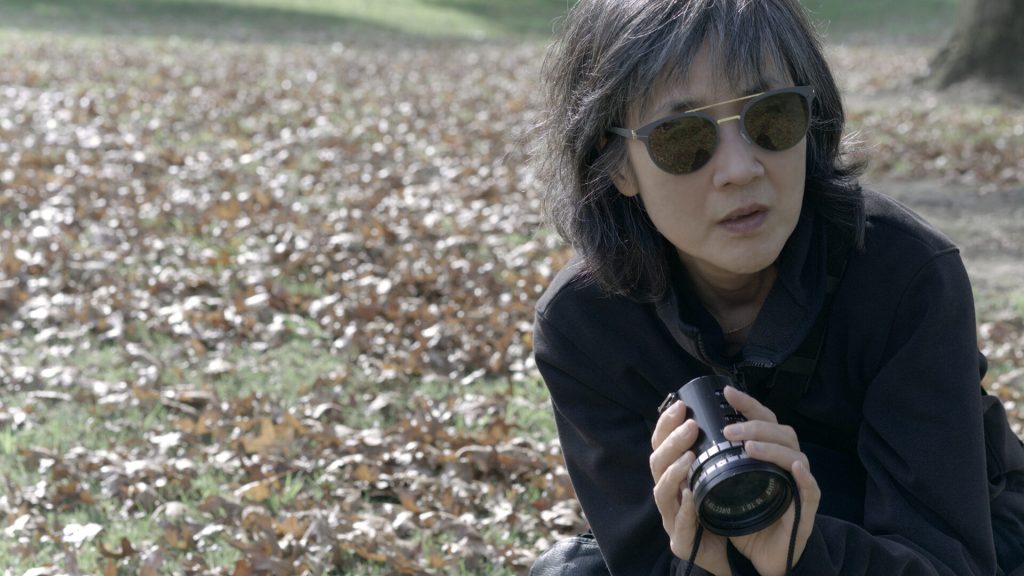
The UBC Asian Independent Cinema Showcase and the Cinematheque have teamed up on a six-part retrospective on a prominent Second Wave Hong Kong filmmaker. The Macau-born Clara Law 羅卓瑤 made her first film, They Say the Moon Is Fuller Here, as a graduation project at the National Film and Television School in the United Kingdom. Released as a 16-mm film in 1985, it won a silver plaque at the Chicago International Film Festival.
They Say the Moon Is Fuller Here addresses cultural alienation on a London university campus. Law plays a Hong Kong arts student who becomes involved with a male Chinese engineering student.
From there, Law worked in TV directing single-episode dramatic shows. She made her next feature film, The Other Half and the Other Half, in 1988. She followed that up by directing The Reincarnation of Golden Lotus in 1989 and then the highly acclaimed Farewell, China in 1990. Next came one her most famous films, Autumn Moon, in 1992.
Law has lived in Australia since the mid-1990s with her husband and frequent collaborator, Eddie Fong. She continues making independent films addressing cultural identity, migration, and diasporic issues.
The series, entitled Clara Law: Drifting Petals, Floating Lives, will open with Autumn Moon at 7 p.m. on January 16. Fong wrote this comedy-drama, which revolves around a Hong Kong high school girl’s friendship with a young Japanese man visiting the city. There will be a second screening at the Cinematheque at 8:50 p.m. on January 26.
They Say the Moon Is Fuller Here is the second film in the retrospective. It will screen at the Cinematheque at 6:30 p.m. on January 18 and 8:50 p.m. on January 27.

Series includes Clara Law films shot in Australia
The third film, Farewell, China, will be shown at 8:40 p.m. on January 18 and 6:30 p.m. on January 26. In this post-Tiananmen Square angst-filled migrant drama, Tony Leung Ka-Fai plays a Chinese teacher. He makes his way to New York in search of his missing wife.
Law directed the fourth film in the series while living in Australia. The Goddess of 1967 features a 20-year-old Rose Byrne in a road movie set in the Australian Outback. It will be screened at 6 p.m. on January 19 and 8:40 p.m. on February 5.
The fifth film, Floating Life (1996), is about a Hong Kong family moving to Australia. It was selected as Australia’s entry for Best Foreign Language Film at the Academy Awards. It will screen at 6 p.m. on January 24 and 6:30 p.m. on February 5.

The final film in the series is Drifting Petals, which was released in 2021. Shot over five years, Law and Fong self-funded this experimental film. Narrated by Law, it focuses on a classical pianist who returns to Hong Kong following major protests against the People’s Republic of China.
“His feelings of dislocation blur into the narrator’s childhood memories of Macau, where, in a parallel present, she is haunted by a boy—or spectre—resembling her vanished brother,” the Cinematheque website states.
Law’s eldest brother died when she was young.
The UBC Asian Independent Cinema Showcase and the Cinematheque curated the series in concert with Law and Fong. The couple will be available over Zoom for live question-and-answer sessions following the first screening of each film. All five older films have been newly restored for the big screen.
Event details
For more information on Clara Law: Drifting Petals, Floating Lives, visit the Cinematheque website. Follow Pancouver on X @PancouverMedia and on Instagram @PancouverMedia. Follow Charlie Smith on Bluesky @charliesmithvcr.bsky.social.


