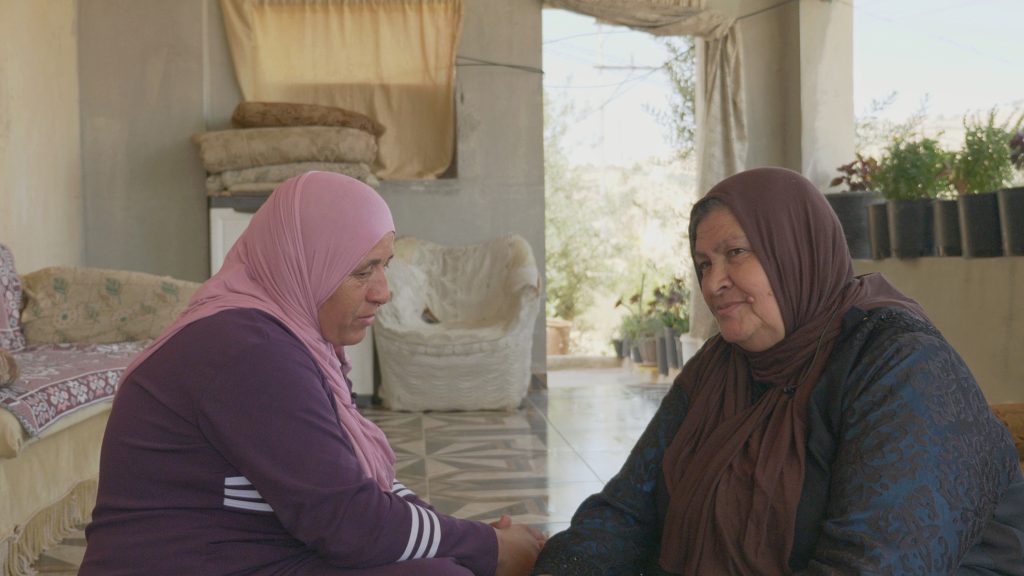
Sometimes, it takes a documentary to reveal things that go unmentioned in countless news stories about the Middle East. In Aisha’s Story, which will open the DOXA Documentary Film Festival in Vancouver, co-directors Elizabeth Vibert and Chen Wang explore the centrality of food to Palestinian identity. The film’s protagonist, Aisha Azzam, operates her family’s grain mill in Jordan. And she joyfully explains why the food products she sells are emblems of Palestinian cultural heritage.
“Talking about our food and tradition keeps us together as Palestinians,” Aisha says in the film. “Whenever we gather as a family, we talk about Palestine.”
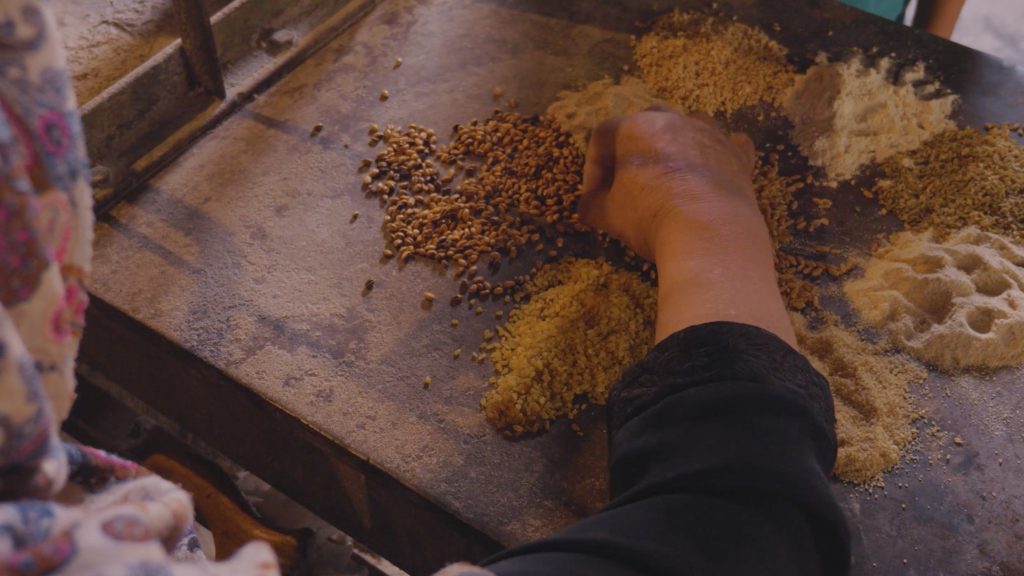
Aisha was born in Karameh, a town in west-central Jordan across the river from the Israeli-occupied West Bank. But she remains proudly Palestinian as she delights in the differences between Palestinian za’atar (thyme) and the za’atar from Jordan. Aisha also points out that mansaf is the national dish of Jordan, whereas Palestine is known for maftoul, musakhan, and other meals. According to her, wheat is at the heart of Palestinian life—and she won’t buy imported varieties grown with irrigated water, fertilizers, and chemicals.
“That’s why it has a better aroma—a fatty smell—and richer flavour than the imported ones.”
One of Aisha’s sons, Omar, wrote a university thesis about Palestinian resistance and his people’s right to self-determination. Omar insists in the film that he respects Judaism as a holy religion.
“Our struggle is against racist Zionist factions who attack Arabs and call for the deaths of Arabs,” Omar says. “Every Palestinian plays a role in resistance. My mother’s role is to protect the heritage and that’s a noble act.”
Aisha’s Story brings history to life
During the 1948 Arab-Israeli War, Aisha’s mother, Miran Dheeb ‘Abed, was forced out of her family’s Palestinian village of Bayt Mahsir.
The co-directors bring different skills to telling the family’s story. Vibert is a University of Victoria history professor (on leave) who researches food sovereignty in colonized spaces. Since 2018, she has been working on a collaborative oral history project with Aisha. Meanwhile, Chen is a cinematographer, editor, screenwriter, colourist, and UVic sessional instructor in writing.
By now, millions of Canadians are aware of the Nakba (“catastrophe” in Arabic), which describes the mass displacement of 700,000 to 800,000 Palestinians in the 1948 Arab-Israeli War. In late 1948, the United Nations General Assembly called for the return of refugees and the restitution of property. In the Six Day War of 1967, another 280,000 to 350,000 people became refugees, including many displaced for the first time in 1948.
“However, 75 years later, despite countless UN resolutions, the rights of the Palestinians continue to be denied,” the UN states on its website. “According to the UN Relief and Works Agency for Palestine Refugees (UNRWA) more than 5 million Palestine refugees are scattered throughout the Middle East.”
Aisha’s Story offers emotional resonance to the Right to Return through poignant silences, impressive cinematography, and historical rigour. By focusing on the micro narrative of one Palestinian family, co-directors Vibert and Wang give meaning to a macro story of monumental international significance.
View this post on Instagram
Event details
The DOXA Documentary Film Festival will present the B.C. premiere of Aisha’s Story at 7 p.m. on May 1 at the Vancouver Playhouse. It’s part of the festival’s opening night gala, which will be hosted by CBC broadcaster Margaret Gallagher. The festival will present a second screening at 4 p.m. on May 7 in the Djavad Mowafaghian Cinema at SFU Woodward’s. Co-directors Elizabeth Vibert and Chen Wang will take questions from the audience following both screenings. For tickets and more information, visit the DOXA festival website.
Follow Pancouver on X @PancouverMedia and Bluesky @pancouver.bsky.social. Also find Pancouver on Instagram @PancouverMedia. Follow Charlie Smith on Bluesky @charliesmithvcr.bsky.social.