Vancouver playwright Natasha Chew had an epiphany during the widely publicized Johnny Depp–Amber Heard defamation trial. It came in the midst of a monumental public backlash against Heard, who had levelled allegations of abuse against her wealthy ex-husband.
“In a horrible way, I’m fascinated by how the public truly hates women—and doesn’t realize how much they do,” Chew tells Pancouver over Zoom.
She shares this thought in a lighthearted tone, but the message is exceedingly serious. Chew has also observed how the general public expresses resentment toward famous women of colour in a different way from how they excoriate a famous white woman like Heard.
“It gives them an excuse to be racist,” Chew says.
She cites American actor Constance Wu (Crazy Rich Asians) as a well-known woman of colour who’s experienced intense racist cyberbullying. In 2019, Wu declared her unhappiness over social media about the renewal of the TV show Fresh Off the Boat.
“Everyone just assumed the worst of her and jumped down her throat,” Chew comments. “They were saying the craziest stuff, where they were, like, ‘You should die,’ and ‘How dare you? This show did so much for people. Do you not care about representing Asians?’, which is crazy to say to her.”
Wu laid low while she wrote her critically acclaimed book, Making a Scene, which was released in 2022.
“The only reason that she’s not vilified anymore is she came back with a memoir that was, like. ‘Oh, I was being assaulted the whole time by a producer,’ ” Chew says.
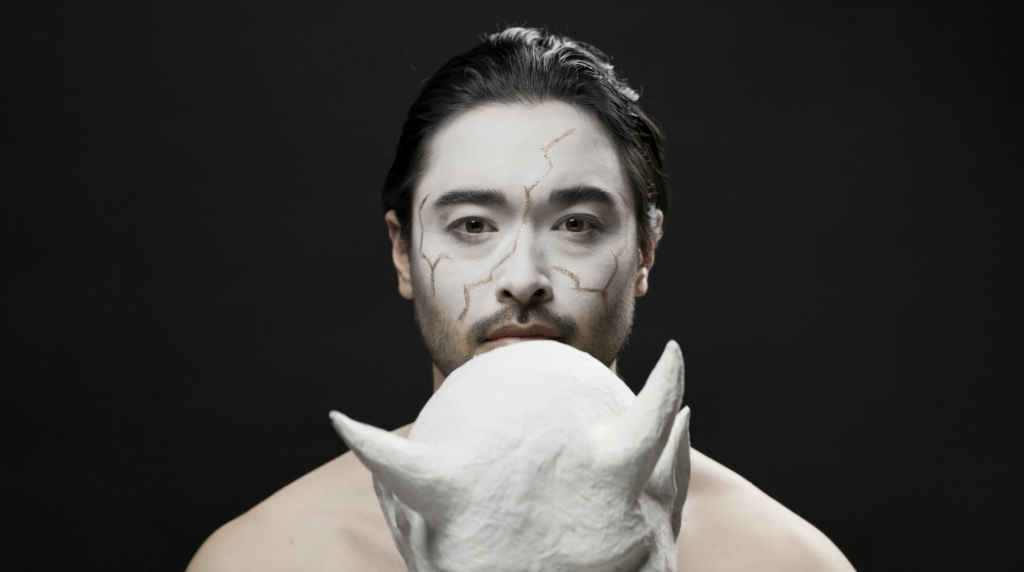
Deep-seated societal misogyny has motivated Chew to write a one-woman theatrical show A Captivating Woman. Sarah Roa will play the central character in a stage reading at the Advance Theatre Festival in Burnaby on Wednesday (February 7).
Chew, a UBC creative writing student, doesn’t want to give away plot spoilers. She prefers that people enter the venue with these words in their mind: “A woman walks into a corner store…”

Chew shares opinions on women’s anger
The origins of A Captivating Woman date back several years earlier when Chew was growing up in Singapore. She tells Pancouver that women’s anger is often not well received in an Asian environment. Therefore, she’s usually seen it expressed in one of two ways.
“You’re quiet or you’re crying or you’re simmering—and it’s very silent. Or, there is the ‘Thai woman cuts off man’s penis and feeds it to the pigs,’ ” Chew quips. “There’s no in-between…or healthy anger.
“I grew up with a lot of that mindset,” she continues. “If I’m too angry, no one will listen to me. So, if I’m to advocate for myself, I am to be very calm.”
She has had an interest in theatre dating back to her childhood. About seven years ago, Chew earned a gold award with honours at the Singapore Youth Festival. This came for a play about the Khmer Rouge, a radical Communist group that committed atrocities in Cambodia from 1975 to 1979.
“I think I was always a theatre kid,” Chew says. “I started out wanting to be an actor and wanting to be on-stage.”
Over time, this natural storyteller veered into writing.
“My mom tells me I start with one idea—and then I just keep telling that over and over,” Chew reveals. “I just slowly refine it until it becomes a story that’s a little bit further away from the truth. I’ve always enjoyed that.”
She’s enamoured with theatre because of its intimacy. According to her, there is no other medium where you can shut the door and “more or less trap an audience” for an hour without using cellphones until the intermission.
“It’s just the only time when you really have everyone’s attention,” Chew says.

From the Philippines to Vancouver
Chew is the daughter of a Chinese Canadian father and Filipina mother. When her parents retired, she moved with them from Singapore to Nueva Vizcaya in the northern Philippines. Chew was living there after the global outbreak of COVID-19. So, she had plenty of time to think about the direction of her life, leading to her move to Vancouver.
Meanwhile, the history of colonialism is rife with examples of imperial powers practising divide-and-rule tactics over the colonized.
Chew feels that a similar dynamic is undermining women’s progress in the 21st century.
“There was this interesting theory that dividing the middle class into upper and lower middle class pits them against each other,” she says. “And we keep doing that as women, because white women turn on women of colour, women of colour are turning on queer women, and queer women are turning on trans women.
“It’s just this constant,” she adds. “We let the patriarchy pit us against each other in a way that asks us to build our perfection on the backs of really imperfect women.”
Chew acknowledges that she’s been influenced by this type of thinking in the past—i.e., if she saw a woman less perfect than her, she might feel better about herself. But now, she rejects that mindset.
“The more we do that, the more we’re wading around in the muck with the scraps that we’re given.”
The Advance Theatre Festival will present a stage reading of Natasha Chew’s A Captivating Woman at 7:30 p.m. on Wednesday (February 7). Directed by Anjela Magpantay, it takes place at the Shadbolt Centre for the Arts in Burnaby. Visit the centre’s website for tickets.
Follow Pancouver on Twitter @PancouverMedia and on Instagram @PancouverMedia.