
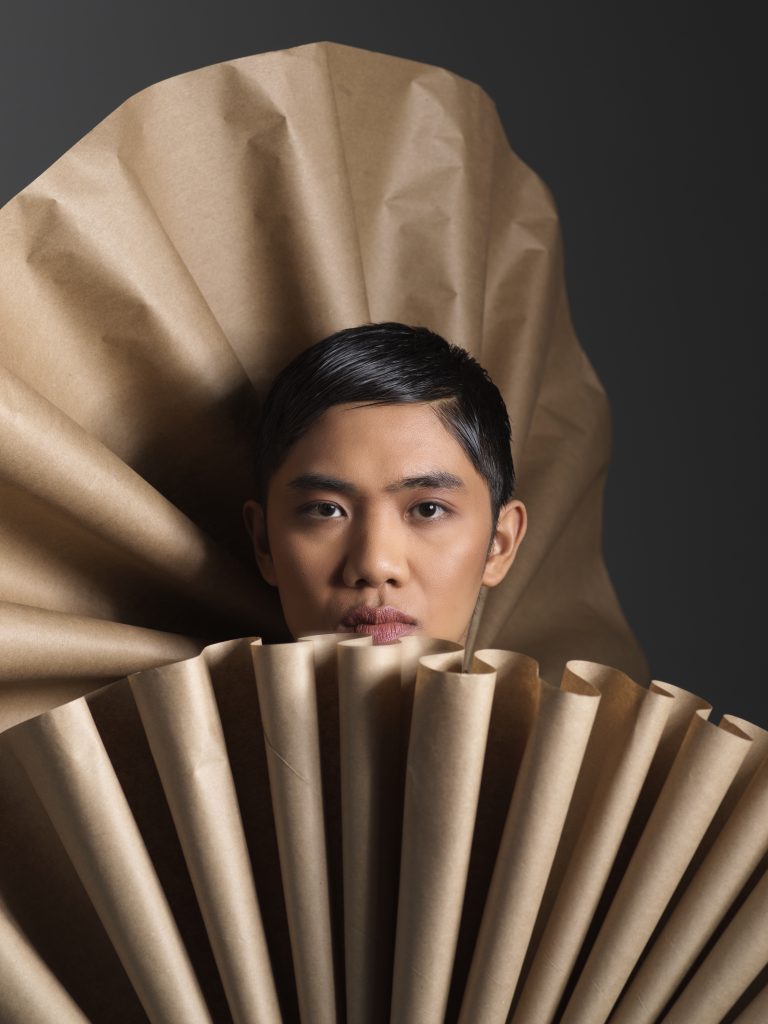
Canadian Philippine choreographer Ralph Escamillan recognizes that dance is an ephemeral art form. But its temporary nature usually isn’t reflected in the costumes, which are used again and again, depending on the production run. So, the artistic director of FakeKnot decided to create a solo, Croquis, in which his garment is as transitory as the show itself.
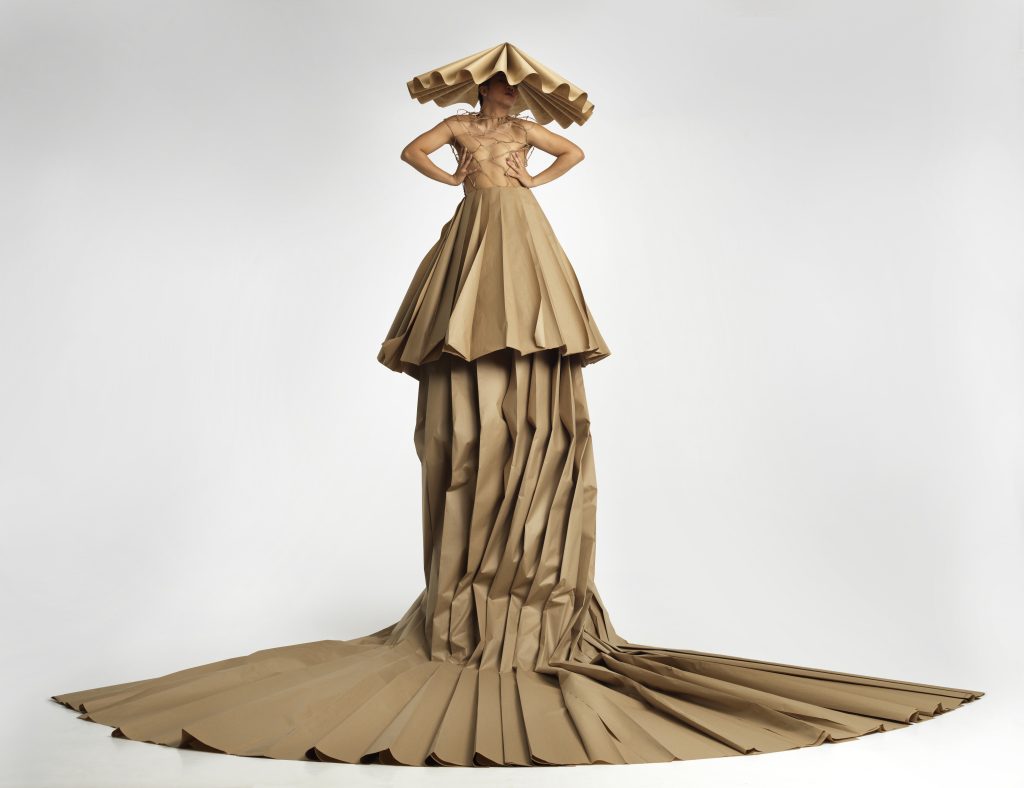
His costume in Croquis is made entirely of packing paper. As he performs in this outfit, it becomes ripped and torn. Then, he remakes it for the next show.
“There’s no glue; there’s no staples; there’s no tape,” Escamillan tells Pancouver over Zoom. “It’s all paper.”
Even the cording that holds this flowing costume together is made of packing paper. Escamillan plans to perform Croquis at Dancing on the Edge on Tuesday (June 18) and Wednesday (June 19).
“Basically, I wind paper to make thread that I sew through the garment,” he explains. “In itself, it’s a fully recyclable object.”
Escamillan draws on his varied background in street dance, contemporary dance, and flamenco in bringing Croquis to life on-stage. In effect, he parallels ephemerality of dance with the costume.
“Even how I experiment with performing in the garment kind of shifts every day,” Escamillan continues. “So, it’s more like an improvised structure.”
Croquis offers up surprises
Croquis is a French term to describe a rough draft or sketch of an article of clothing. He points out that the paper garment adds to the sonic landscape of the show.
“We all know what paper sounds like,” Escamillan says. “To have it sound for the duration of the work is also a nice little thing that has come from the research of the show.”
According to Escamillan, it adds an ASMR feel, which complements the metronome beat. In fact, he considers the garment as his dance partner because it requires so much listening on his part.
There have been a few surprises when he’s performed Croquis in the past. Escamillan recalls how he kept dancing last year in the paper garment through a heavy rainfall in Prince Edward County in Ontario. In another performance, the paper transformed into the shape of a bata de cola, which is a large flamenco skirt.
On another occasion, the wind blew the paper garment off the stage, closing the show.
“There’s this magic that happens when you live in the world of improvisation,” Escamillan states.
Croquis is an extension of Escamillan’s ongoing interest in using textiles as a central component of his artistic practice. This was on display in his highly acclaimed PIÑA, in which he featured a Philippine textile created from natural fibres from pineapple leaves. Not long after it premiered last year at SFU Woodward’s, Escamillan received the inaugural RBC Emerging Artist Award.

Fascinated by the galleon trade
Since last year, he’s been mentored in dance creation by National Arts Centre dance producer emerita Cathy Levy. She’s helping Escamillan reach his goal of supporting other underrepresented artists like him so that they, too, can perform in major venues.
“That keeps me motivated,” Escamillan says. “I would like to think I’m a pretty humble person in my life. I think what keeps me humble and grounded is actually my ballroom community.”
Escamillan emphasizes that Philippine culture places a premium on esthetic value. So, it shouldn’t come as a huge surprise that Vancouver choreographers of Philippine ancestry, such as him and Alvin Tolentino, have played a leading role in making costuming a big part of their artistic practice.
The FakeKnot artistic director is already thinking about doing a piece in the future riffing off kusikas, which is a Philippine weaving practice. He’s also trying to learn Spanish as he advances in the world of flamenco dancing.

Escamillan acknowledges that he feels a strong connection to Mexico because of the galleon trade. In colonial times from the 16th to 19th centuries, Spanish trading ships criss-crossed the Pacific Ocean from the Philippines to Mexico, bringing Asian goods in exchange for silver from Spanish-occupied North America.
As he delved into this subject, Escamillan learned that the pañuelo—a Philippine embroidered neck scarf—actually inspired the triangular manton. It’s the Spanish shawl used in flamenco dancing.
“There’s this whole connection—this literal triangle—of the Philippines, Mexico, and Spain through the galleon trade,” Escamillan says.
Dancing on the Edge will present FakeKnot’s Croquis at the Firehall Arts Centre Courtyard on Tuesday (June 18) and Wednesday (June 19). For tickets and more information, visit the Dancing on the Edge website. Follow Pancouver on Twitter @PancouverMedia and on Instagram @PancouverMedia.




