

With her new project Seeing Double, anti-disciplinary artist Ghinwa Yassine initially intended to adapt a previous live performance. The multimedia creator based her earlier work, How Far Can a Marked Body Go?, on women’s protests in Lebanon in 2019. Four years later at VIVO Media Arts, the Lebanese-born Yassine included animation, streaming, and archival footage to highlight these women’s embodied agency in response to wars and patriarchy.
But the recent war in Lebanon led Yassine to transform Seeing Double into something else. In her promotional material, she describes it as an “apocalyptic reading/storytelling performance/auditory experience that blends fact and fiction”.
“What’s urgent changed; the meaning of things changed,” Yassine tells Pancouver over Zoom. “There was a sense of absurdity in the experience that I was having and a lot of people in my community were having.”
To cope with and process what’s happened in the Middle East over the past year, she spent a great deal of time writing. In particular, the war between Israel and Hezbollah reminded Yassine of her childhood in Beirut when she lived through ferocious Israeli bombing campaigns. She describes war as “horrific, unnecessary, and traumatizing for generations and generations”.
As a result of the recent bloodshed, Yassine says that she’s now in an “interesting, uncertain place”. However, she states that it can also be very fruitful from a creative standpoint.
“What is my relationship to feminism? What is my relationship to resistance?” Yassine asks. “To begin with, especially after witnessing the atrocities of war, I feel like there’s a whole transformation when it comes to my belief systems.”
She will present Seeing Double at 7 p.m. on Saturday (December 14) at Morrow in downtown Vancouver.
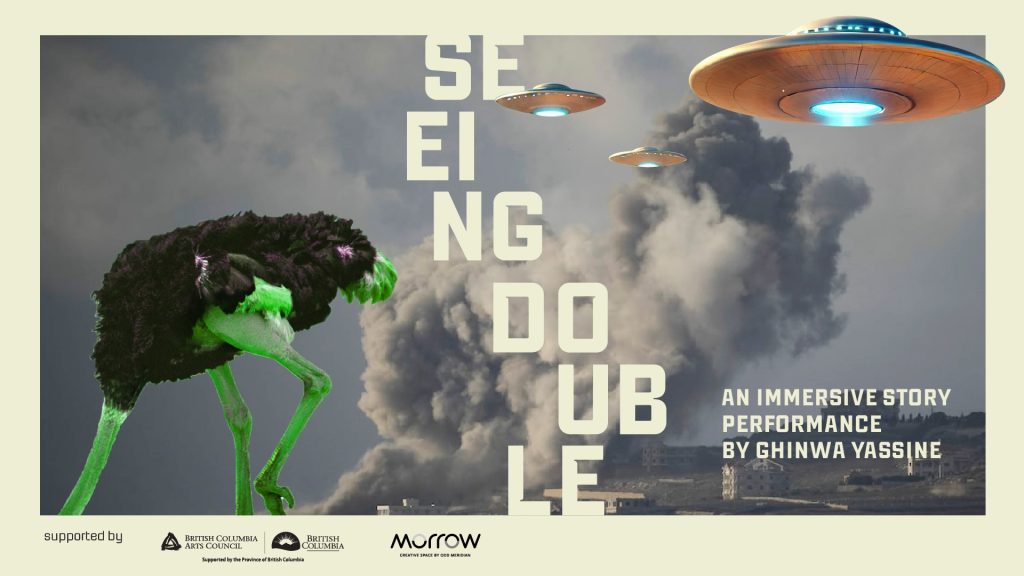
Seeing Double views Earth from outer space
Yassine promises genuine and sometimes playful storytelling in Seeing Double in an intimate setting. According to her, this journey between Vancouver, Lebanon, and outer space is also heartwarming, heartbreaking, and chaotic.
“It’s not grandiose multimedia…like my previous performance where there was projection and live streaming.”
As part of her practice, Yassine has embodied characters and alter-egos in what she calls “feminist freedom futurity”. It can incorporate everything from wearing a futuristic wig and suit to viewing the Earth from a vantage point in outer space in the next century. She couples this with a healthy dose of absurdity.
“If you look from 100 years from now towards the present, you see the present in such a different way,” Yassine explains. “Things that may look major [now] may look ridiculous, or vice versa.”
Moreover, Yassine sees immense potential in dreaming of the future in a very speculative way. She maintains that even if these visions are unrealistic, they can still help people transcend or fix problems in the present.
“I believe in fiction as a way towards the future,” Yassine adds. “I think it might come from my trauma history in war—this escape to fiction that made me almost believe in fiction more than reality.”
Researching radical pleasure
Yassine conceived and directs Seeing Double. Meanwhile, Vancouver theatre artist and filmmaker Aryo Khakpour is credited as the co-creator. Yassine brought him on as the dramaturg and rehearsal director because she wanted to imbue her performance with lighter elements. He also helped tighten up the story.
“That was really helpful for my creative process to work with someone who has this experience of physical theatre to try things that I haven’t tried before,” Yassine relates. “His perspective is always really helpful.”
Yassine began making art as a young child in Beirut. She wrote her first story around the age of 11 or 12. She also does sound design and believes that it can combine with words to create a rich storytelling experience.
“I’m wondering if I’ll have the courage one day to just create an audio story and put it out in the world,” Yassine says with a smile.
Her artistic practice has traditionally engaged with the body as a site of resistance or collective memory. The recent conflict in Lebanon reminds her of how her younger self witnessed women taking care of the kids and men going off to fight in previous wars. She’s given a great deal of thought to the relationship between women’s acts of care and resistance during wartime.
“But I’m also starting to include research about pleasure—radical pleasure, sexuality,” Yassine notes. “And I think these new avenues are going to transform what I’ve been working with in the past.”
Explaining anti-disciplinary art
Last year, Yassine spoke to Pancouver about why she calls herself an anti-disciplinary artist. She initially worked in design and didn’t go to art school until she sought her second master’s degree.
“But even when I studied design, I graduated with a video installation,” Yassine points out. “And I feel like I have the privilege of not having gone through a training that’s specific to one discipline.”
That’s because she can embrace the freedom of allowing the work to develop. Then, she decides which medium it will take. Furthermore, Yassine views strict definitions of art forms as oppressive, carrying connotations relating to mastery, privilege, and colonialism. She, on the other hand, is a strong proponent of breaking down silos between disciplines so she can create new things in the spaces in between.
“There is a definitely a link between patriarchy and mastery and the history of a lot of disciplines being led by males who are very either discriminating or oppressive or misogynistic in the way they work, especially in the dance field,” Yassine declares. “Discipline is a little bit the opposite of fluidity.”
Ghinwa Yassine will present Seeing Double at 7 p.m. on Saturday (December 14) at Morrow (910 Richards Street, Suite 204). For tickets and more information, visit Eventbrite. Learn more about Ghinwa Yassine on her website. Follow Pancouver on X @PancouverMedia and on Instagram @PancouverMedia. Follow Charlie Smith on Bluesky @charliesmithvcr.bsky.social.




