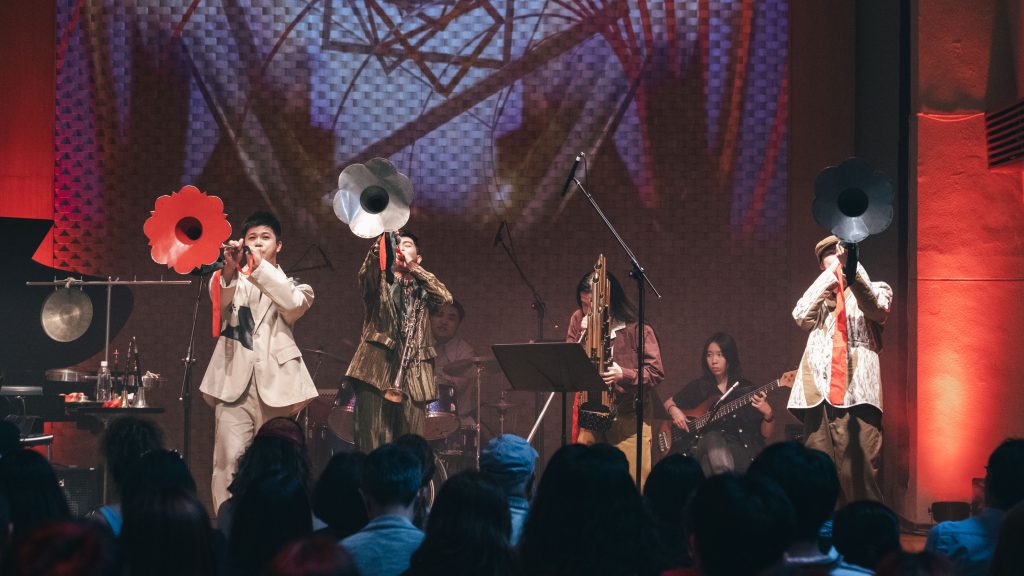
Early next month, a troupe of Taiwanese musicians will roam around Granville Island playing a double-reeded, high-pitched wind instrument. The suona is usually associated with funeral processions and other traditional ceremonies in Taiwan. But the upbeat and somewhat mischievous Suona Gang is re-imagining this conical instrument for contemporary audiences.
“We hope to convince people to actually stop, listen, and experience the suona—and this music—in a new way,” Suona Group co-founder Wu Po-Kuan tells Pancouver in Mandarin over Zoom. (Pancouver associate editor becky tu translated Wu’s comments.)
As Taiwan’s first crossover suona band, they integrate this traditional sound into lively pop-, jazz-, and folk-infused performances. The suona sounds a bit like a trumpet, piercing through the air at volumes that cannot be ignored.
The Suona Gang will perform live at 7 p.m. on January 27 at a LunarFest Vancouver concert at the Orpheum Theatre. Tickets are $8 to $18 and are available at Showpass.com.
“We will be bringing three different kinds of music to the performance,” Wu says. “We will play original songs, which will not sound traditional at all. The Suona Gang will perform some very traditional songs—the ones you hear on the streets of Taiwan during the New Year. And then, we will bring some songs that are traditional but re-arranged in a contemporary way.”
At the LunarFest Vancouver concert, Wu says that the band will perform other traditional instruments, including one that he puts inside his mouth and sounds somewhat like a whistle. That will be followed by free workshops on Granville Island on February 8 and 9 as part of LunarFest Vancouver.
“We will be sharing stories from Taiwan about the music and how to play the instruments,” Wu states.
The Suona Gang performs “My Girl”.
Suona sounds won over Wu
For Wu, it’s been a long journey mastering the suona. Born in the southern Taiwanese city of Tainan, he began studying the dizi (an Asian flute) at the age of 11. Two years later, his school group needed a suona player for an ensemble.
“No one wanted to play it because there are a lot of stereotypes to this instrument,” Wu recalls with a chuckle. “So, what we did was we drew sticks. I happened to draw the short end, so I had to play the suona.”
Much to Wu’s surprise, he discovered the instrument’s charm. And he began feeling that the suona’s negative connotations were unfair. At the age of 13, he embraced the traditional suona as his main instrument, furthering his education in music classes at Xin Chuang high school in Kaohsiung and later in the Department of Chinese Music at National Taiwan University of Arts in Taipei.
In university, Wu learned modernized suonas with mechanical keys, which came on the market about 80 years ago. As a result, he plays the keyed alto, keyed bass, and keyed tenor suonas.
Wu was about 20 years old when he started learning Beiguan suona. Beiguan is a traditional form of music, melody, and theatrical performance popular in Taiwan from the 17th to 20th centuries. It’s now out of fashion, but he wanted to master this because Beiguan is often a source for newer Chinese compositions.
However, Wu didn’t feel that he was connecting with audiences when he performed the Beiguan suona. So, as a university student, Wu would take a two-and-a-half-hour bus trip each week to Chiayi to study under a famous Beiguan master, Li Chun-Yuan.

Changing public perceptions
Wu points out that the Beiguan suona is taught orally.
“The melody, which is the essence and secret of each Beiguan school, was closely guarded, especially during times of intense competition among the schools,” Wu explains in his biography. “These ‘secrets’ were treated like the signature martial arts techniques of each family, passed down only within their schools.
“Moreover, Beiguan places great emphasis on improvisation and personal expression, akin to jazz,” he adds. “Therefore, using skeletal notation became the best solution. Beiguan suona is traditionally learned by first mastering percussion instruments before advancing to the melodies of the instrument itself.”
Later, Wu trained with the Shengde Traditional Arts Troupe, which wanted to merge Beiguan music with folk arts. He rose to the position of musical director and performed in religious processions and folk events. That’s when he started thinking about forming a popular band to change people’s perceptions about the suona.
Wu co-founded the Suona Gang in his early 20s, first calling the band “Crazy Suona”. They rooted the band in traditional local culture while embracing cross-disciplinary approaches to promote Taiwanese stories.
“Our only rule was: ‘No matter what, we will persist for one year and give our best effort; after one year, we will decide whether to continue,’ ” Wu reveals.
Initially, members of Wu’s group only played suonas. They added piano, electric bass, and vocals in 2022 to enrich their sound. At the end of that year, they also added the sheng.
The video above shows highlights from Suona Gang performances.
Suona not easy to master
According to Wu the band changed the name to “Suona Gang” in 2023 because the words crazy and lockdown sound very similar in Mandarin. As part of his creative process, Wu drew inspiration from popular Buddhist and Taoist folk pilgrimages known as Laojing, which are popular in Taiwan.
“Interestingly, you don’t need to bring money, because along the route, every household offers free food to participants,” Wu relates in his biography. “Whether or not you share the same belief, you are warmly welcomed by the community.
“I believe this is the most valuable and distinctive aspect of Taiwanese local culture,” he continues. “We decided to deconstruct and reorganize the various elements of Laojing, using the story of ‘humans’ and ‘gods’ to narrate Taiwan’s culture. The performance received great acclaim, and we subsequently collaborated with many different organizations.”
Each suona requires a different mouthpiece, which means players must re-adjust their breathing for different instruments. Wu has a simple answer when asked why the suona is so little-known in the West in comparison to other traditional Chinese instruments, such as the erhu and guzheng
“The difficulty to learn is very high, “Wu says. “On average, it takes about a month, probably, to even make sound from this instrument. So, people tend to give up part of the way.”
Moreover, the suona is not considered a “lucky” instrument because it’s long been associated with funerals. Plus, it’s very loud, which brings on another negative stereotype.
“If you practise at home, you may disturb your neighbours,” Wu says. “As a result, fewer and fewer people are able to play it, which I feel is a real shame.”
Wu estimates that nowadays, only about 50 musicians in Taiwan can read suona notation and play the instrument. But he sees real potential for the Suona Gang to re-ignite its popularity with the next generation. Furthermore, friends, former teachers, and fellow musicians are giving him lots of encouragement because they want suona music to survive in Taiwan.
When the musicians formed their group, they were able to borrow equipment from the schools. In 2024, the Suona Gang was invited to perform three solo concerts, including one at National Taiwan University Art Centre as part of the “潮傳統” (Trend of Tradition) series.
“Everyone is really supportive,” Wu says. “They say, ‘If you need anything, we are happy to help.’ ”
The Suona Gang performs “Mr. Zombie”.
Event details
The Suona Gang will perform at this year’s LunarFest Concert, Fluidity in Diversity, along with the Harmonia String Ensemble and the West Vancouver Youth Band. The concert will take place at the Orpheum Theatre at 7 p.m. on January 27. For tickets ($8 to $18), visit Showpass.com. As part of LunarFest Vancouver, the Suona Gang will offer free music workshops at Ocean Artworks on Granville Island. They will take place at 1:30 and 2:30 p.m. on February 8, and 11 a.m. and noon on February 9.
The Suona Gang will also perform at 7 p.m. on February 1 at the Old Church Theatre in Courtenay. Follow Pancouver on Twitter @PancouverMedia and on Instagram @PancouverMedia. Follow Charlie Smith @charliesmithvcr.bsky.social.