
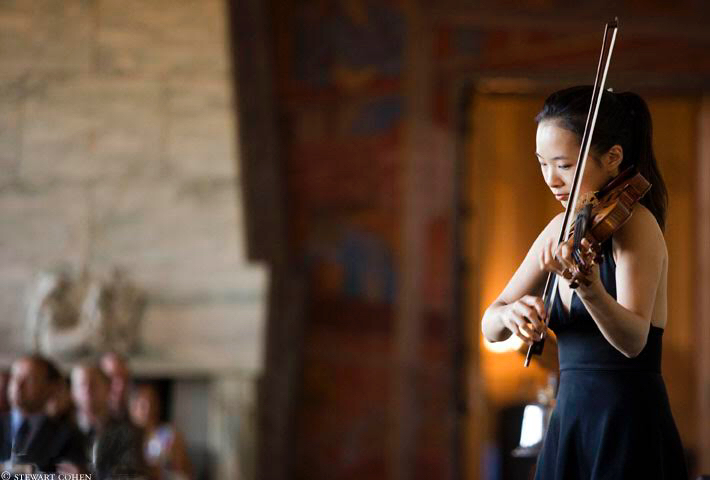
Eugenia Choi has a passion for playing 17th-century Italian violins. In a world where technology runs rampant, Choi takes pleasure drawing her horse-hair bow across 330-year-old instruments with bellies made from spruce trees grown in the Little Ice Age.
“They’re works of art,” Choi tells Pancouver over Zoom. “They’re marvels of engineering, and they’re meant to be played and enjoyed. It fascinates me that they still exist and serve a daily purpose.”
Vancouver music lovers will have a chance to hear how one of these violins sound when Choi goes on-stage at the Vancouver Playhouse on April 11. The Edmonton-born and Los Angeles-based virtuoso will perform Astor Piazzolla’s The Four Seasons of Buenos Aires as a soloist with the Vancouver Metropolitan Orchestra.
For Choi, a former UBC assistant professor of music, it will be a homecoming of sorts. Mmembers of her extended Korean Canadian family live in Vancouver. Meanwhile, former students have gone on to play for the Vancouver Symphony Orchestra and Vancouver Metropolitan Orchestra.
“It will give me such joy to see them doing what they love to do—and what I saw them training to do,” Choi says with a smile.
She recalls discussing The Four Seasons of Buenos Aires more than a decade ago with Vancouver Metropolitan Orchestra music director Ken Hsieh. At that time, she notes, this piece wasn’t commonly performed. However, violinist Gidon Kremer had recorded a version along with Antonio Vivaldi’s Four Seasons in 2004.
“I’ve always loved Vivaldi’s Four Seasons, so it just seemed like an unusual and brilliant combination of the two genres,” Choi states. “But it was hard to find even the sheet music for this, because at the time, this arrangement had not yet been published.”
Choi savours flexibility in Piazzolla music
Choi gladly accepted Hsieh’s invitation to perform Piazzolla’s work this spring, now that the music is accessible. The Argentine composer premiered his interpretation of Verano (Summer) in Buenos Aires in 1965 as music for a play, Melenita de oro. Piazzolla premiered Otoño (Autumn), Invierno (Winter), and Primavera (Spring) in 1969.
“There’s a lot of room for rubato and personal expression; I’ve never played it the same way twice,” Choi says. “The brilliance of the piece is that this flexibility is within a very clear structure—each season is a tango that takes listeners through a wild ride of emotions from passion and lust to jubilation and reflection.”
Moreover, each movement has three parts, yet they all leave a great deal of room for interpretation.
“That translates into this concerto version, too, where everyone on-stage is going to have fun,” Choi says.
She points out that even the last stand of the second violins gets its own solo, as does the principal cellist.
“The bass players are crucial to this because the contrabass was such an important part of Piazzola’s own band when he composed performed his music,” she continues. “I just hope that the audience will feel like they’re a part of the music. And that the performers will all feel like they are soloists all together on-stage. It should be really fun.”
Vivaldi composed The Four Seasons in Mantua, Italy from around 1718 to 1720. It remains one of the most adored pieces of Baroque music.
“Everyone loves it,” Choi says. “Every time I play it, I feel as if I’m reinterpreting it. It’s such a brilliant piece that despite its ubiquity, it never feels like elevator music.”
She says that The Four Seasons of Buenos Aires differs from Vivaldi’s work because the composer sonically injected the senses of Argentina’s capital into the movements.
“He does a brilliant job of giving an impression to the listener that they’ve been transported to Buenos Aires,” Choi says.
View this post on Instagram
Old instruments have a soul
For this concert, she plans to make her violin sound at times like a güiro, a percussion instrument popular in Latin America. Players make ratchet sounds by rubbing a stick against corrugated notches on the side of an open-ended hollow gourd. Plus, Choi plans to perform sultry glissando slides, harmonics, and other techniques on her violin that Vivaldi never would have considered in the 18th century.
Choi has never been one to shy away from musical challenges. A child prodigy, she performed her first solo concerto with an orchestra as a 10-year-old girl. She later attended the prestigious Juilliard School in New York, where she received a bachelor’s, master’s, and PhD. Her doctoral dissertation addressed pricing patterns of Stradivarius violins since the 18th century.
“I’ve performed on quite a few exquisite Stradivarius violins,” Choi reveals. “I can tell you that old instruments have a soul. There’s something about the wood having served a purpose—and been played, taken care of, and cherished for hundreds of years—that they respond differently. It’s almost like they’re still alive.”
As an adult, Choi has performed at Carnegie Hall, Lincoln Center, and the Nobel Prize Hall, among other famous music venues. Along the way, she has played her violin alongside spectacular classical musicians. But when Pancouver asks Choi to name a musical collaborator who stands out in her memory, she responds by citing a popular American singer and songwriter: Jon Batiste.
The five-time Grammy Award winner and former bandleader on The Late Show with Stephen Colbert was a classmate of Choi’s at the Juilliard School.
Choi recalls duet with Jon Batiste
“He was in the jazz program and we were paired together to play a concert,” Choi recalls. “And there weren’t really parameters on what we had to play.”
Batiste blew her away with his improvisations.
“I started playing Sarasate’s Carmen Fantasy and I thought, ‘Well, we’ll see what he does.’ And he suddenly was playing a New Orleans blues accompaniment to my operatic Carmen,” Choi says with a laugh.
Batiste continued responding in amazing ways to other pieces by classical musicians, including Maurice Ravel, as Choi dared him with her most virtuoso violin repertoire.
“He then would challenge me by improvising his version of what he thought might be a great duet to my showpieces,” she notes. “He’s just a phenomenal musician.”
To this day, Choi wishes that this concert with Batiste had been recorded because it was one of her most enjoyable performances.
“There were people there who said this was unreal because he was just at the beginning of his fame,” Choi says. “So, the audience didn’t know what to expect and were absolutely blown away.”
Watch Jon Batiste’s video (above) for “Freedom”.
The Vancouver Metropolitan Orchestra will perform with soloist Eugenia Choi at 7:30 p.m. on April 11 at the Vancouver Playhouse. For tickets and more information, visit the VMO website.
Follow Pancouver on X @PancouverMedia and Bluesky @pancouver.bsky.social. In addition, you can find Pancouver on Instagram @PancouverMedia. Also follow Charlie Smith on Bluesky @charliesmithvcr.bsky.social.




