
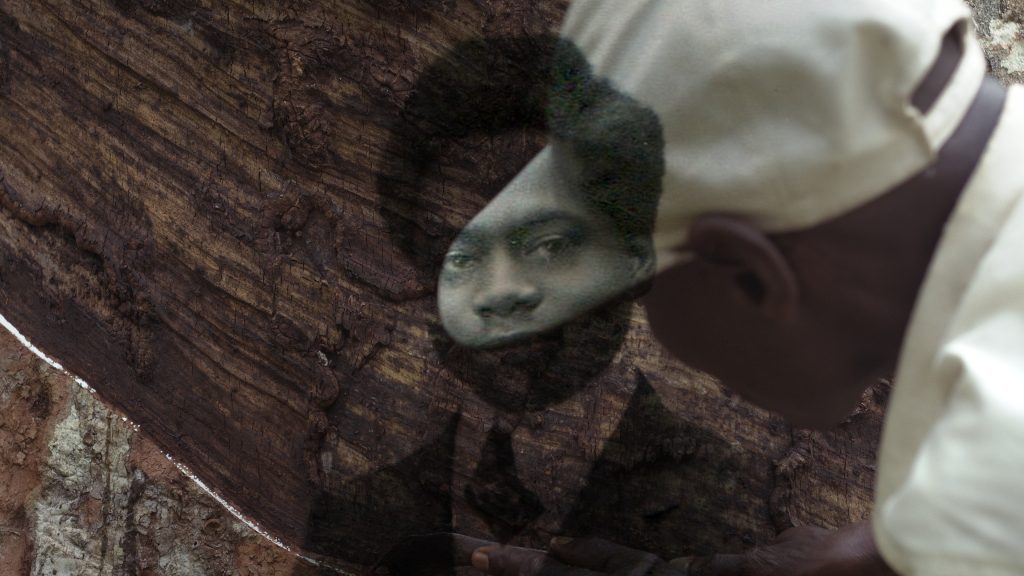
From the very first sequence to its surprising ending, The Tree of Authenticity (L’arbre de l’authenticité) is unlike any other documentary. The brainchild of Congolese multimedia artist Sammy Baloji, it offers a breathtaking exploration into his country’s colonial past under Belgian rule. This DOXA Documentary Film Festival offering relies heavily on scripted voice-overs by two 20th-century scientists: Paul Panda Farnana (voiced by Edson Anibal) and Abiron Beirnaert (voiced by Diederik Peeters). As well, The Tree of Authenticity delivers a glimpse into a terrifying future for humanity, as seen through the eyes of Nature.
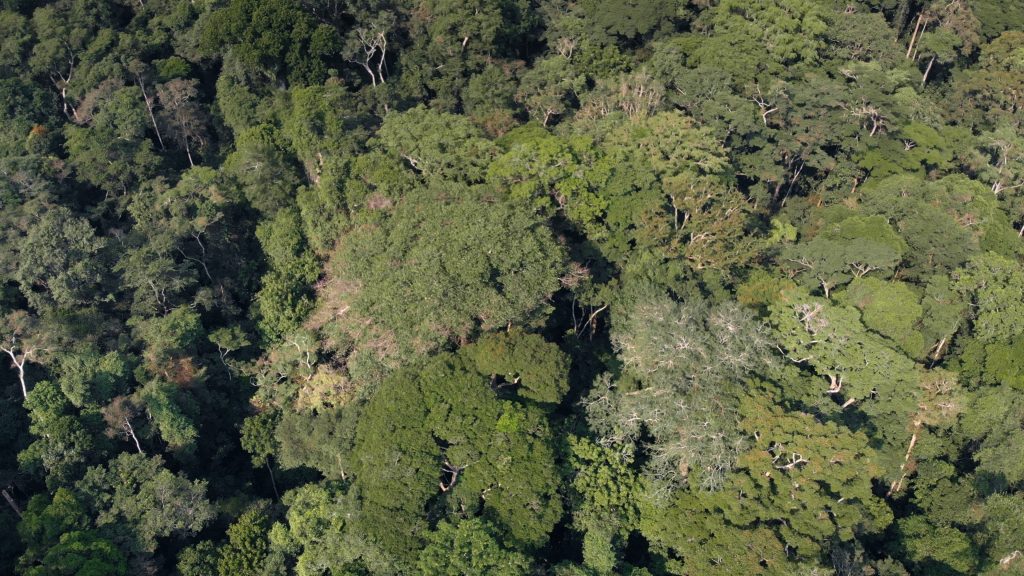
The director, Baloji, accomplishes all of this mostly by juxtaposing images of contemporary village life, office spaces, rich forests, and denuded landscapes in the Democratic Republic of Congo. He augments this with black-and-white imagery from the colonial era in Belgium. It’s an odd combination at first—voices from the past layered over 21st-century scenes. However, this approach becomes increasingly hypnotic, driven by the narrators’ voices and Baloji’s judicious use of text. In effect, he has created a film essay about the hubris of the human species, punctuated with sufficient pauses to allow viewers to absorb the complexity of the director’s message.
Baloji divides his time between Brussels and his hometown of Lubumbashi in the Katanga region. His artistic practice addresses colonial abuses, the extraction of resources, and the impact that all of this has on the environment. The Tree of Authenticity also travels down this path, albeit unlike how other directors might have contemplated. Baloji opens his film with text, showing highlights from an article in the Guardian in 2017.
The Tree of Authenticity shares researchers’ views
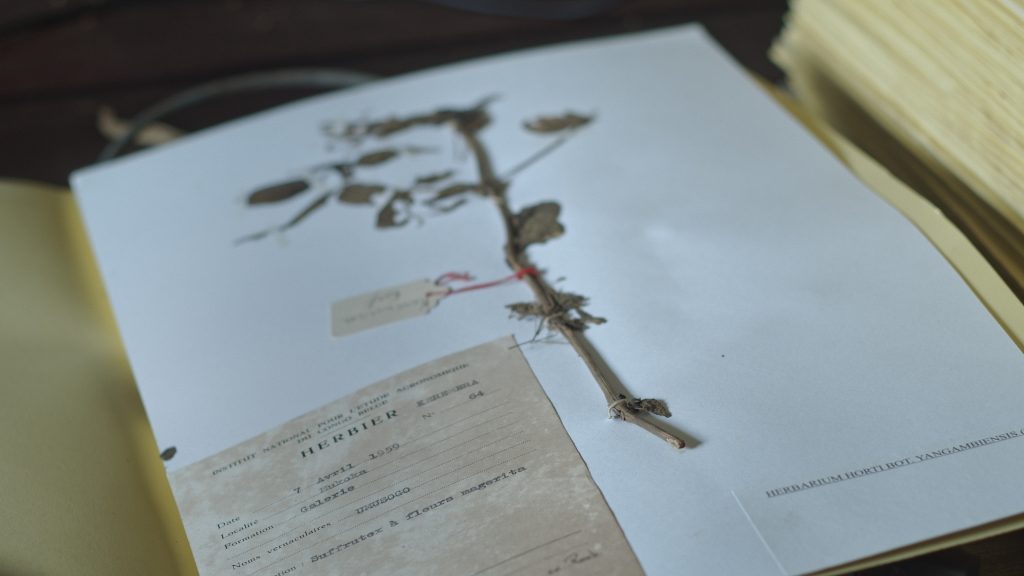
From there, a camera looks down from the sky upon a Congolese village. Then it zooms ever so slowly down to the dirt, immersing viewers in the village. Next, the director suddenly flashes back to 1909 with meteorological observations from the National Institute for Agronomic Study in Yangambi.
This remote and once highly regarded station in the north-central Belgian Congo was featured prominently in the Guardian piece by Daniel Grossman. This is where Farnana and Beirnaert conducted their research during different periods in the 20th century. The Guardian reported that now, a Belgian biologist is making use of data from the Yangambi site to assess the future health of the forest.
As the first Congolese person to graduate from Belgium’s higher-education system in 1907, Farnana offers penetrating insights into what life was like for a Black African who enlisted to serve in the First World War. Speaking French, he also vividly describes the racism that he experienced from fellow researchers while trying to conduct research in the Belgian Congo.
Beirnaert, on the other hand, looks at the Congo through a European colonial scientist’s eyes. In Dutch, he describes the importance of his research. In addition, he shares stories of his jovial interactions with an underling named Vincke.
Cruelty of colonization
To the rest of the world, Belgian colonization of the Congo is most notorious for the brutality of King Leopold II, under whom 10 million Africans died. Baloji, on the other hand, chooses to quote his successor, King Albert I, who spoke about how the “slowness and disdain for developing a healthy colonial mentality has cost many human lives in the Congo”.
“Africa needs educated men of its own race,” King Albert I declared in 1920. “This wish was expressed by a decorated chief.”
Yet, Baloji exposes the king’s hypocrisy by revealing that Belgium’s second secular Congolese university student, Thomas Kanza, was only admitted in 1952.
The Tree of Authenticity won a special jury award at this year’s International Film Festival Rotterdam. I won’t spoil the hard-hitting ending, but I suspect that it may have helped influence the jury. Let’s just say that in a world of rising greenhouse gas emissions, Nature always bats last, whether it’s in the Democratic Republic of Congo or anywhere else.
Watch the trailer (above) for The Tree of Authenticity.
The DOXA Documentary Film Festival will present the B.C. premiere of The Tree of Authenticity at 8:30 p.m. on May 8 at the Cinematheque. For tickets and more information, visit the DOXA website. The festival runs from May 1 to 11 in Vancouver. Follow Pancouver on X @PancouverMedia and Bluesky @pancouver.bsky.social. Also find Pancouver on Instagram @PancouverMedia. Follow Charlie Smith on Bluesky @charliesmithvcr.bsky.social.




