
This weekend’s Powell Street Festival celebrates how Japanese Canadians are enriching Canada’s cultural tapestry. But it’s not the only event commemorating the region’s deep Japanese Canadian roots.
There’s also an art exhibition, Part 2 of Umami: Savouring Artistic Nikkei Identity, at the Nikkei National Museum & Cultural Centre (6688 Southoaks Crescent) in Burnaby. Its Karasawa Gallery features the work of artists Molly JF Caldwell, Yoshiko Hirano, Marlene Howell, Bryan Kobayakawa and Annie Sumi, Vivien Nishi, and Reiko Pleau.
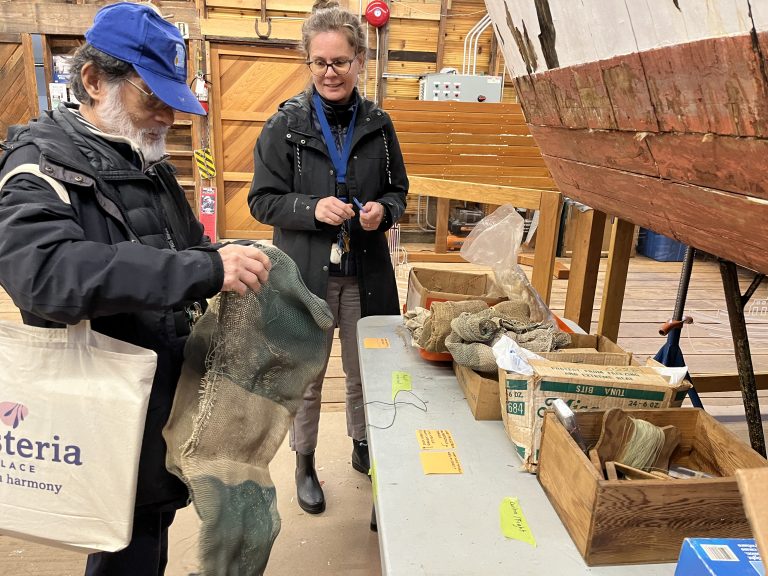
In addition, the City of Richmond invites visitors to witness the restoration of a heritage wooden fishing boat, Crystal S. M. Sakamoto Boat Works built the 37-foot Crystal S in 1963 as a combination gillnetter and troller. The restoration is taking place in the Richmond Boat Builders building at the Britannia Shipyards National Historic Site in Steveston Village.
It’s one of the attractions at this year’s Richmond Maritime Festival, which takes place on-site on August 23 and 24.
Britannia Shipyards also highlights Steveston’s thriving Japanese boat-building history and craftsmanship in the early 20th century. Two brothers, Teizo and Otomatsu Kishi, launched one of the many boat-building businesses, Kishi Boat Works, around 1912. Their nephew, Saeji, apprenticed as a carpenter in Japan before immigrating in 1917 and joining the business in 1923.
Saeji Kishi decided to launch his own boat-building business in 1929. Three years later, he and his head carpenter completed the Richmond Boat Builders building.
After Japan bombed Pearl Harbor in 1941, it all came to an end when the federal government seized the homes and businesses of 22,000 Japanese Canadians. Most were sent to internment camps in the B.C. Interior.
Some boat builders returned to Steveston
According to Roger Kishi, his paternal grandfather, Saeji, and his family were interned at Christina Lake whereas Roger’s mom’s family went to Greenwood. But Saeji continued building boats while incarcerated. That’s because he managed to take most of his tools with him.
“And my dad has shared that he can remember as a teenager going with his father into the woods around Christina Lake, and they would cut down trees and then they would go and get them milled,” Roger Kishi told University of Victoria’s Landscapes of Injustice interviewer Carolyn Nakagawa. “And my grandfather would build boats during the war while there in Christina Lake.”
The Sakamoto Brothers Boat Building yard was another Japanese Canadian–owned business in Steveston in the 1930s. However, when the federal government incarcerated Japanese Canadians, the Royal Canadian Navy seized 1,137 boats, according to the Japanese Canadian Legacies website.
“In 1949, when Japanese Canadians were able to move freely again in Canada, fishing companies sought out these skilled tradesmen, courting them back to the BC coast,” the website notes. “Many, such as the Kishi, Mukai, Asari, and Sakamoto families, returned to Steveston and successfully re-established the trade for which they were famous.”
According to StevestonHeritage.ca, M. Sakamoto Boat Works opened at the southern end of No. 2 Road in 1950. Shipwright Mamoru Sakamoto, who had been interned in the B.C. Interior in the 1940s, owned the Crystal S until his death in 2003. His son, Bud Sakamoto, generously donated the boat. He also preserved many of the original parts, including salvaged fasteners being used in the restoration.
Last June, Sakamoto talked about the restoration with host Margaret Gallagher on CBC Radio One’s North by Northwest program.
Bud Sakamoto places a Japanese kagami mochi on the Crystal S for good luck.
The Richmond Maritime Festival takes place on August 23 and 24 at the Britannia Shipyards National Historic Site. To learn more about the Crystal S restoration project, visit StevestonHeritage.ca. Follow Pancouver on Instagram @PancouverMedia and on Bluesky @pancouver.




