By Diane Huang and Sophy Chu 朱子栩
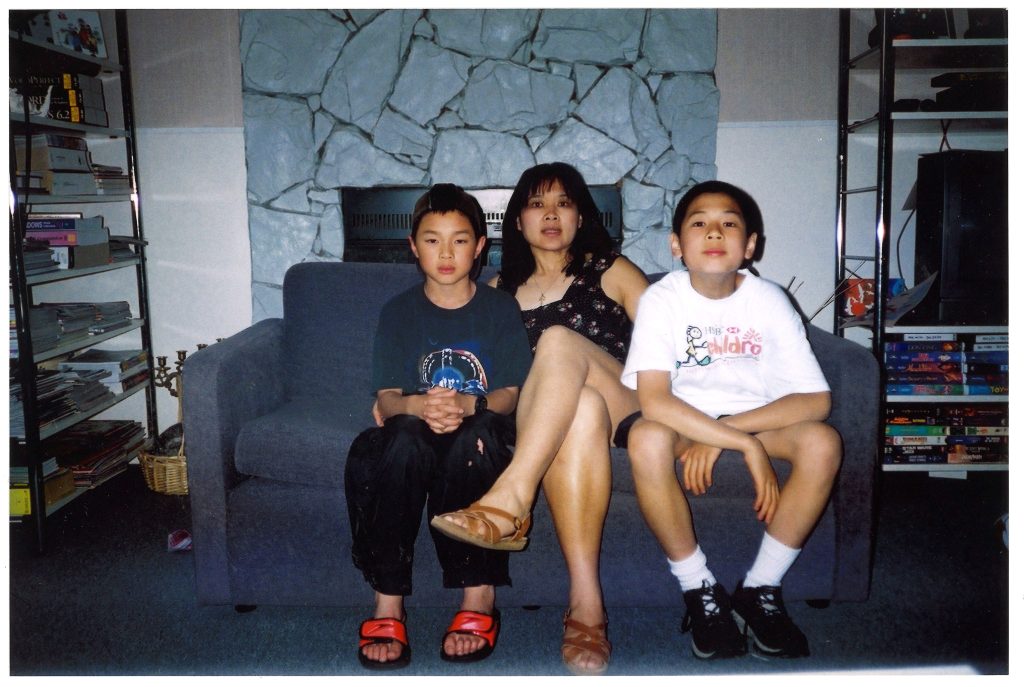
Judy Lew is a second-generation immigrant of Toishan and Cantonese descent from Guangzhou. Having been born and raised in a small town in Canada, Judy did not know many other Chinese families as she was growing up. She gradually lost her mother-tongue, Toishanese, in the English-first education system.
When Judy had her own family, she tried to incorporate Cantonese and Toishanese while speaking to her sons, Daniel and his brother Arthur. But she was met with “Mom, stop talking Chinglish!” because they couldn’t understand what she was saying.
“My tones are off. Everything was off,” Judy says. “I had created my own language and then I realized it was not a good choice, so I’d sort of backed away, thinking I’d be teaching him something that no one would understand. So I just left it to Dad to speak to them in Cantonese.”
While Judy did put Daniel in Chinese school to learn Cantonese, he eventually dropped out of classes after realizing he wasn’t enjoying it much.
Daniel says, “I didn’t really put much effort because I was feeling very isolated. When I was growing up, I felt like I didn’t have enough of the cultural background to relate to a lot of the other kids that were Chinese or Taiwanese. But as I’ve gotten older, and being part of the Jade Music Festival, it helped a lot in terms of exposing me to a whole world of music that I didn’t even know existed.”
Lew cites impact of mother’s musical tastes
Daniel reflects on his detachment from his heritage culture, and his recent efforts to reclaim it through language learning and performing Chinese songs. This was made possible through Jade Music Fest where for his first appearance his grandfather suggested he play “The Moon Represents My Heart”, a song Daniel had never heard before.
Influenced by classic rock and folk musicians that his mom liked, these sounds shaped Daniel’s early musical landscape. He credits his sense of melody and emotional songwriting to this exposure.
“My mom had direction and control over the radio and which CDs we listened to, so I remember listening to a lot of the artists that she mentioned, which helped inform my sense of melody,” Daniel explains. “There’s so many catchy songs that I remember things like that would get stuck in my head.”
In her youth, Judy trained as a figure skater for 15 years. She collected red envelope money and picked up extra shifts at work to save up and sustain her passion for the sport. Financially self-reliant and unsupported by her parents, this past informed her deep commitment to encouraging her children and providing opportunities for them to pursue their dreams in art.
“I would never say no to a child, and that if they wanted to do anything, there would be the support,” Judy encourages. “Now, when I think about giving them the freedom to do what they want to do, it’s to allow them to express themselves.”
For Daniel, he sees his musical journey as a continuation of his mother’s unfulfilled artistic path, carrying on her legacy and sacrifice through his own pursuit of music.

Mom didn’t pressure her son
“Deep down, even for myself, I always knew my mom had this longing for her figure skating life. We were always watching figure skating Olympics on TV, and when we did go out and skate together, my mom would still be doing some of her figure skating and expressing herself in that way.
“This is part of my drive to succeed and not give up on music,” he emphasizes. “It’s not that she gave up on her dream, but she chose to have a family and didn’t have the support to foster that artistic path as a figure skater, and I am aware of that. So, as my journey as an artist, I want to do what I am doing to keep that part of her spirit alive, if that makes sense.”
Judy supported Daniel’s musical development with neutrality and openness. She neither pressured him with music lessons as many Asian parents do, nor restricted him away from his natural talents and musical inclination. She described being moved by his two songs “You Do You” and “Destiny”, in which both reflect values of self-authenticity and growing into his own person.
“When he wrote this song ‘You Do You’ it really aligned with our parenting philosophy, and our hearts were just open and he was on to something,” says Judy. “He can actually sing something that really resonated with our love [for our children] to be humans and to be humans for themselves, not to be my child, my son, but whatever their own identity is as a person.”

“Destiny” touches his mother’s heart
Judy describes another favourite song, “Destiny”: “He just plays so profoundly on the piano that it just robbed my heart.”
The more she listened to the lyrics of this album title track, the more she felt a message to just be the best you can be as a person. In her view, Daniel captured in that song what she wanted him to feel.
“I don’t play an instrument but by expressing himself, that gives me such a sense of how real his music is, and makes me think that: ‘This is a good message’ for anyone listening to it, because it is really about all of us collectively.”
Judy and Daniel are planning a family trip to visit Guangzhou next year, sparked by Daniel’s interest in reconnecting with his heritage languages.
Daniel Lew performed “Destiny” at the Hollywood Theatre as part of the Jade Music Fest.
Learn more about Daniel Lew’s musical journey at danlew.ca. This is one of a series of Pancouver articles about Canadian musicians of Asian ancestry who were supported by their parents as they pursued careers as singers and songwriters. These musicians have all performed at the Jade Music Fest, which promotes underrepresented artists by offering them a platform to perform. This event also fosters intergenerational connections by celebrating Chinese-language music created by artists born in Canada and abroad. The next Jade Music Fest will be in Vancouver from November 5 to 8.
Follow Pancouver on X @PancouverMedia and on Instagram @PancouverMedia.