By Angela Chiu
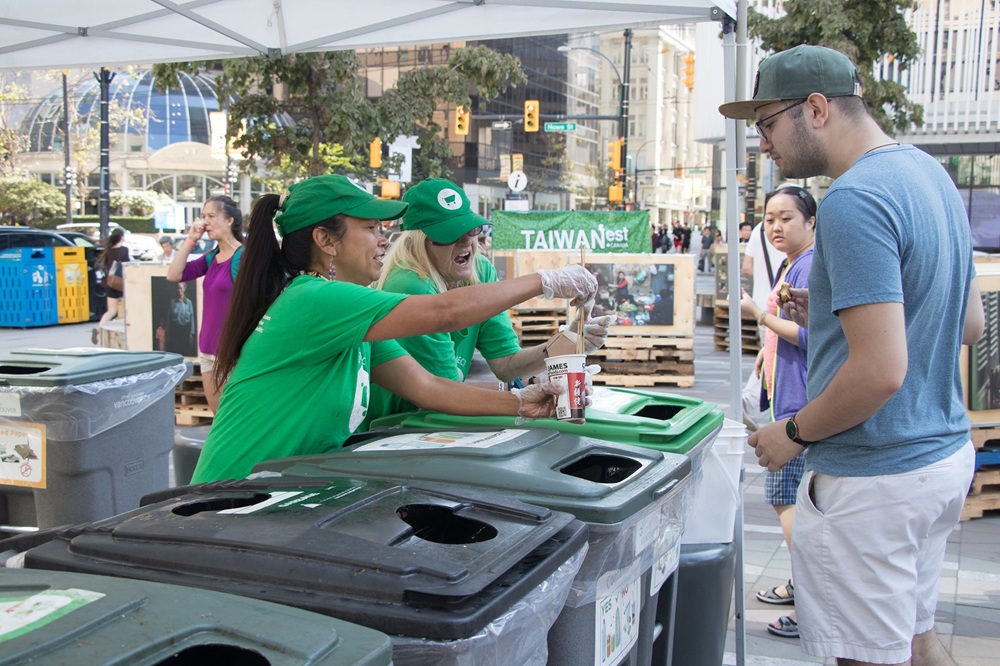
At this year’s Vancouver TAIWANfest, a social enterprise was quietly helping the festival become more sustainable. Did attendees notice various workers on-site in green T-shirts? They were all from the Binners’ Project, one of Vancouver TAIWANfest’s partnerships.
Surrounded by music, visual art, and free talks, festivalgoers might have found themselves dancing, eating, and drinking joyfully with family and friends. Yet, in those happy moments, they might not have paid attention to the garbage bin nearby. Empty in the morning, overflowing by night. That’s exactly where the Binners’ Project stepped in.
Everything begins with mutual understanding
The Binners’ Project was officially launched in 2014, originating with conversations among co-founders and binners. One of the co-founders, the late Ken Lyotier, used to be a binner and dedicated himself to promoting and legitimizing the work of other binners. These discussions gradually shaped a thriving organization that not only creates economic opportunities for binners but also builds connections with the community, schools, events, and governments.
As Sean Miles, the director of the Binners’ Project, and Nadine Leitch, the social enterprise programs manager, told Pancouver, their work is about building relationships and understanding others—even if a binner disappears for half a year and suddenly returns.
“When they choose to come back, that’s a success,” they said.
Through this project, people can access support, resources, and information on basic needs such as washrooms, housing, medical care, and mental health services. On the question of economic opportunities, Miles emphasized that participation is never forced—binners do it only if they want to.
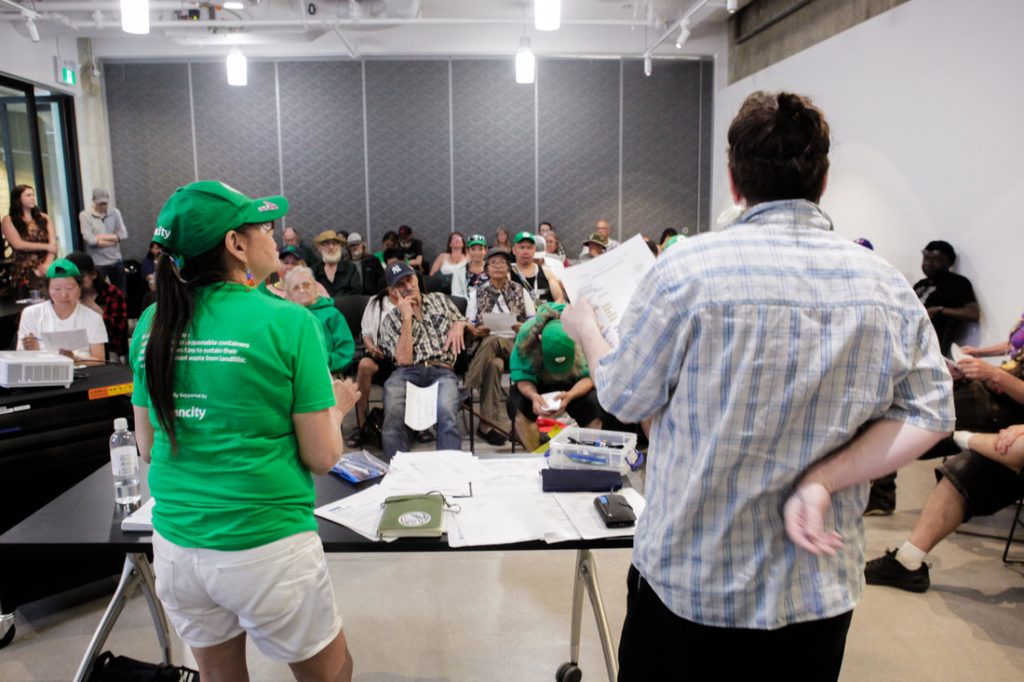
Every Tuesday at 5 p.m., the Binners’ Project hosts a weekly meeting at 312 Main Street (entrance on Cordova Street). It’s free and provides a welcoming, equal space for anyone who self-identifies as a binner. At its heart, it’s all about relationships—trust, dignity, and community.
Toward more inclusive policies
While the Binners’ Project is dedicated to building relationships and fostering a supportive community, it also aims to make a broader impact in Vancouver and beyond. For example, current policies in Vancouver remain unfriendly to binners: many public garbage bins are locked, making it difficult for them to access recyclables.
To address this, binners and other designers devised a “binners’ hook” that is attached to the large garbage can. This enables Vancouverites to leave recyclables, including bottles and cans, in a plastic bag attached to the outside of the locked bin so that they can be collected by binners.
In addition, the Binners’ Project unveiled a “universal carts“ initiative with input from more than 100 binners. These carts make it easier for binners to transport what they collect.
Yet when municipal governments encourage people to bring their own reusable cups for coffee, it doesn’t really take binners and other marginalized groups into account. For someone with stable housing and a steady job, buying and reusing a cup may seem normal. In contrast, for those facing instability, it’s difficult to wash and reuse the cup. That’s why policies need to be more inclusive.
For me, as a newcomer in Vancouver, I’m not familiar with the waste-sorting system. Sometimes I even worry about throwing garbage into the wrong bin. When I saw the binners at Vancouver TAIWANfest, they were always kind and patient, helping participants with recycling and sorting. And beyond that, they are just like us. They work, they make decisions in their lives, and they live here. The only difference is that they have a different job—nothing more—as important community recyclers.
Angela Chiu is a Taiwanese graduate student who researches social enterprises. For more information on the Binners’ Project, visit the website. Follow Pancouver on X @PancouverMedia and Bluesky @pancouver.bsky.social. Pancouver is also on Instagram @PancouverMedia.