In the fall of 2024, “Morî”, directed by Yakup Tekintangaç, was featured at VIFF in the Short Film section. This remarkable film will be screened again at both Seattle Turkish Film Festival and Vancouver Turkish Film Festival, just one week apart in November.
The film takes place in a remote snow-crusted village in the mountainous Kurdish lands of Türkiye and tells the story of a 10-year-old girl Morî, who lost her father when she was very young. All the girl has is an audio recording of her father to remember him by. She listens intently savouring the voice of her father narrating a tale for her.
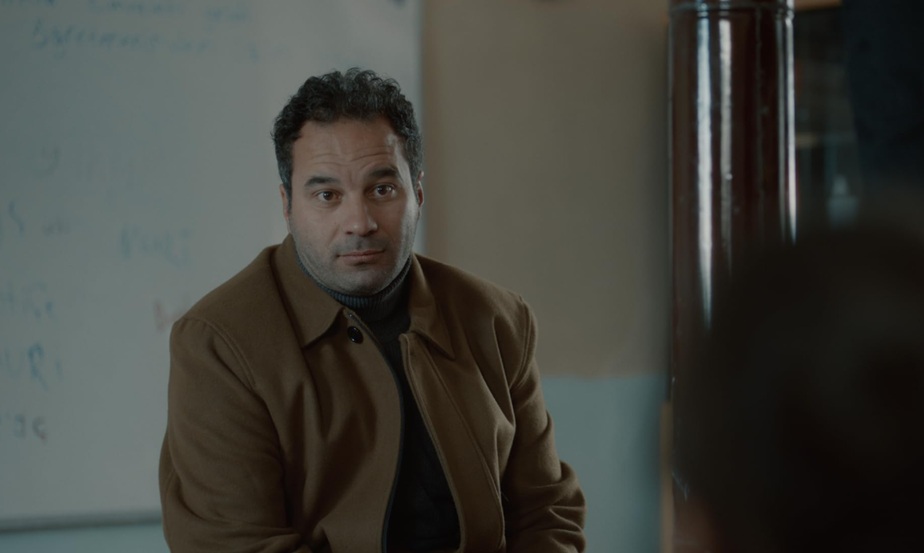
The opening scene, with its winding snowy narrow mountain road leading to a school yard is reminiscent of Nuri Bilge Ceylan’s films. In the school yard, we witness the principal scolding the children who turn the globe into a football. When a newly appointed teacher appears on the school yard, Morî runs and hugs him, mistaking him for her long-gone father. The new teacher appears and Morî’s impulsive embrace marks the beginning of an affectionate bond between them.
The film captures the harshness and challenges of life and schooling for children in this remote village. The father’s whereabouts or his destiny remains ambiguous on purpose, but those who know the history and politics of the Kurdish regions may be able to surmise. We see a woodstove centrally located in a classroom, which acts like a reminder of the harsh weather outside. At recess, it is charming to see a short snippet of kids in class doing line-dancing totally unprompted—something they would have picked up from their parents and the community.
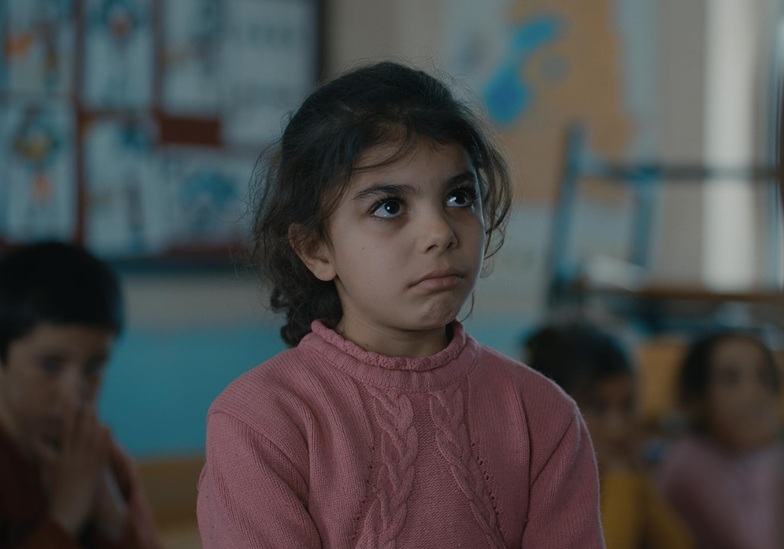
“Mori” child actors lend authenticity
We see children speaking Kurdish (Kurmanci dialect) and trying to navigate a new school language, Turkish. It is heart-warming to see how the kids guide each other and care and advocate for one another, especially with teachers who don’t speak their language. But the new Turkish teacher is different and makes and effort to learn Kurdish, which means a great deal for Mori, who refuses to speak Turkish. This deepens the affection she has for him.
“Morî” is an exceptional short film that proves that powerful storytelling doesn’t depend on big budgets and optimum conditions. Shot with a limited budget and in a challenging environment, it delivers a remarkable level of craftmanship, particularly in cinematography and acting. The director said it was hard for the film crew to travel far and work in unpredictable winter weather. However, the outcome made it all worthwhile. The cinematography by Emre Pekçakır is a visual delight, capturing sweeping, rugged, and stark landscapes in snow.
Aside from the two leads, Ozan Çelik and Emrah Özdemir, everybody in the cast is made up of non-professional actors whose performances look remarkably effortless. Bringing a nonprofessional child cast lends authenticity to the Kurdish communication and the school setting. One can see the tenderness in Yakup’s work. He was a teacher for 20 years before he became a filmmaker. This fact clearly informs the choice of setting and how he handles school scenes and interactions between staff and students.
The director travelled from village to village to find the main child actor. He went from school to school, attended classes, and conducted auditions. After an extensive search, he finally discovered Hayrünisa Akbas in one of the villages featured in the film.
A small production with a big impact
The film is hard to watch as it delves into a lonely childhood and the subdued ache of losing and longing for someone you love. The director told me that he worked very hard on the script, which is partly drawn from a painful chapter in his own childhood. When the director lost his father at a young age, he explored the possibilities of where people went after they died. Mr. Tekintangaç said, “I lost my father at a young age. I wanted to tell the emotion that a loss creates in a child, an emotion that dominates you.”
The film was well recognized in Türkiye, with Best Short Film at the Ankara Film Festival and Best Screenplay at the Izmir Short Film Festival.
Despite its modest scale, “Mori” has found an audience far beyond Türkiye. It is a small production with a big impact. The film was honoured at several festivals including the Seattle Turkish Film Festival with the Grand Jury Award. It received the Best Short Film at the 14th Kurdish Film Festival in Berlin. It received multiple awards at the Tochigi International Film Festival in Japan, including Best Cinematography (Emre Pekçakır), Best Actress (Hayrünisa Akbaş), and Best Supporting Actor (Ozan Çelik). The film also received the Jury Special Award at ZINEBI (Bilbao International Festival of Documentary and Short Films) in Spain.
“Mori” will be screened at 12:30 p.m. on November 22 at SIFF Cinema Uptown in Seattle as part of the Seattle Turkish Film Festival. It will also be shown at 10 a.m. on November 29 at the SFU Goldcorp Center for the Arts in Vancouver as part of the Vancouver Turkish Film Festival. Visit the preceding links for tickets and more information. Nural Sümbültepe is a B.C. teacher. Follow Pancouver on X @PancouverMedia, Bluesky @pancouver.bsky.social, and Instagram @PancouverMedia.