
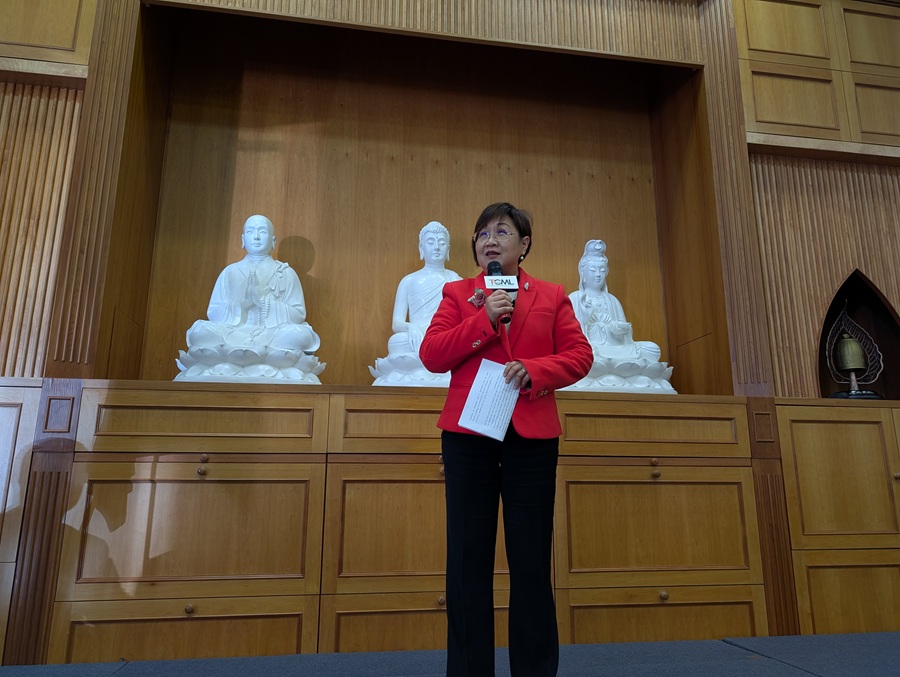
It’s not every day that a Taiwanese cabinet minister shows up in Vancouver. But on February 14—just in advance of Lunar New Year—Hsu Chia-ching attended two remarkable events.
One was the launch of LunarFest Vancouver on Granville Island. As the Minister of the Overseas Community Affairs Council, Hsu also joined other dignitaries in unveiling a plaque to launch a new TCML-Tzu Chi Academy in South Vancouver. Located in the foundation’s western headquarters at 8850 Osler Street, it’s the third Taiwan Center for Mandarin Learning in Canada and one of 95 outside of Taiwan.
“Actually, our TCML is not only a place to teach the Mandarin language,” Hsu told Pancouver in an interview in the Tzu Chi Canada Foundation office. “It’s also a place to share cultural values or experiences.”
The Overseas Community Affairs Council has a Taiwan Center for Mandarin Learning Establishment Program. It assists overseas compatriot schools and associations in setting up Taiwan Centers for Mandarin Learning to people over 18. According to the TCML website, there are 64 such schools in the United States, 17 in Europe, four in Australia, two in Japan, and one in New Zealand.
Hsu maintained that these schools serve as a bridge for people from distinct cultures to get to know each other better. In a speech almost entirely in English in the Tzu Chi Canada Foundation’s banquet hall, the minister emphasized three advantages of attending a Taiwan Centre for Mandarin Learning.
First of all, she said, the TCMLs teach traditional Chinese characters.
“If you learn traditional characters, then you can read all classic materials,” Hsu declared. “If you just learn simple characters [as taught in the People’s Republic of China], then you must learn again because you cannot recognize those classical materials. That’s why I always say if you want to learn Mandarin or Chinese, you must learn traditional characters first.”
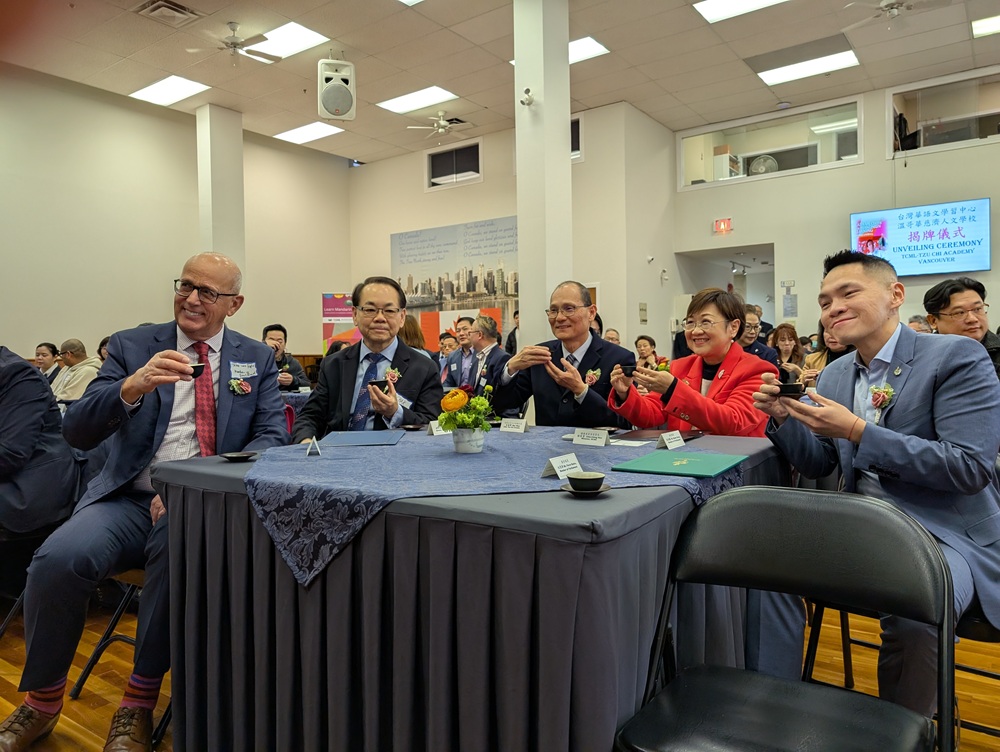
Hsu speaks about values
Secondly, Hsu said that the TCML in South Vancouver will emphasize culture and the sharing of values in addition to language education. And it’s not only about learning Taiwanese values; students will also gain insights into the cultural values of Canada and other countries.
“That’s why we established the TCML,” she insisted.
Thirdly, the minister promised that if people enroll at the TCML, it will include cultural activities, which will make language learning more fun.
Many parents of bicultural children cannot understand what their kids are saying when they speak the other parent’s mother tongue. Hsu noted that by learning Mandarin, this can enhance these parents’ communication with their children.
“I would like to express my sincere respect and gratitude to Tzu Chi Canada branch and the Tzu Chi activists who have long dedicated themselves to community education and contributed to the well-being of others,” Hsu said.
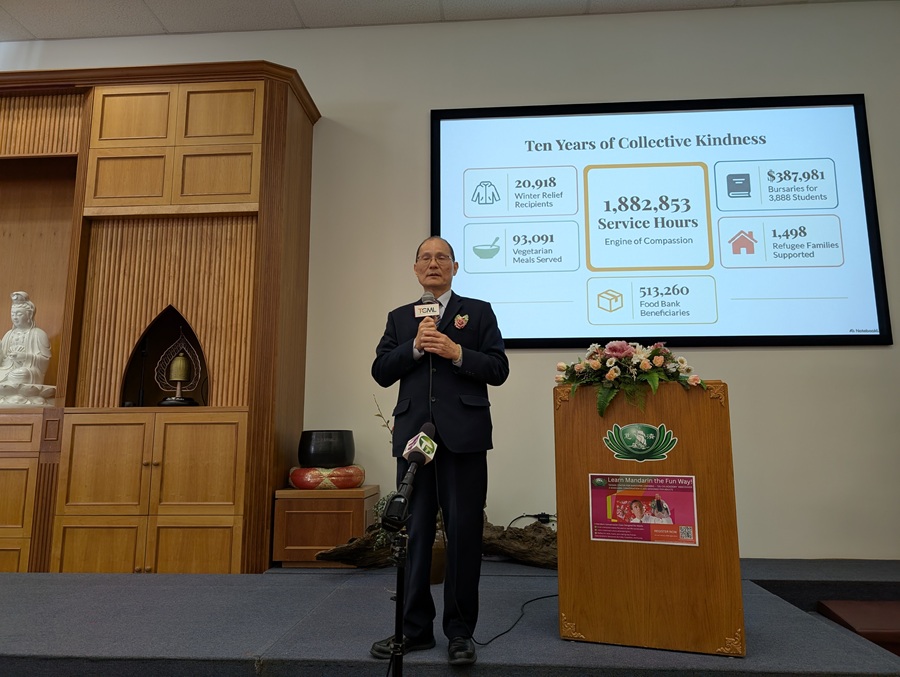
The CEO of the Tzu Chi Foundation Canada, Mac Miao, pointed out that over the past 10 years, Tzu Chi Canada Foundation volunteers have provided more than 1.8 million hours of services to local residents. The Buddhist charity has served more than a half-million people.
According to Miao, the foundation aims to be in harmony with the Earth and the world, which he said mirrors Taiwanese culture. The foundation has five pillars—charity, medicine, education, humanistic culture, and environmental protection. They’re all in support of Dharma Master Cheng Yen’s vision of “purifying minds, pacifying the society and working towards a disaster-free world”.
“That’s why we are teaching Mandarin education from kindergarten to high school,” Miao said. “Now, we have the TCML—the adult Mandarin education. We very much appreciate the sponsorship from OCAC.”
Minister draws parallels between Canada and Taiwan
Three MPs also spoke at the event: Liberal Wade Chang and Conservatives Chak Au and Tako van Popta. In addition, Conservative MLA Hon Chan and Vancouver councillors Lenny Zhou and Pete Fry said a few words from the stage.
In her interview with Pancouver, Hsu praised Canada for how it respects different languages and culture. The minister drew parallels with her own country, where more than 20 languages are spoken. They include Mandarin, Hakka, Taiwanese, and many Indigenous languages.
“In primary school and middle school, all can learn different kinds of mother-tongue languages,” Hsu stated. “Taiwan is a trading country. If we have more people with an ability to speak different languages, they can communicate with other countries.
Moreover, she pointed out that Taiwan has attracted many more immigrants over the past 20 years from Southeast Asian countries, Japan, South Korea, North America, and Europe. The minister noted that Canada and the United States are also both immigrant societies, yet they have some key differences.
“In Canada, it’s just like a salad,” Hsu quipped. “In the U.S., it’s just like pizza.”
She likes this analogy because when you make pizza, all the cheeses will mix together.
“You cannot recognize which part is what kind of cheese,” Hsu said with a smile. “But with salad, you can taste different parts—this is tomato, this is the leaves, this is the cheese. But in the dressing, it’s all mixed together.”
Follow Pancouver on X @PancouverMedia and Instagram @PancouverMedia.


