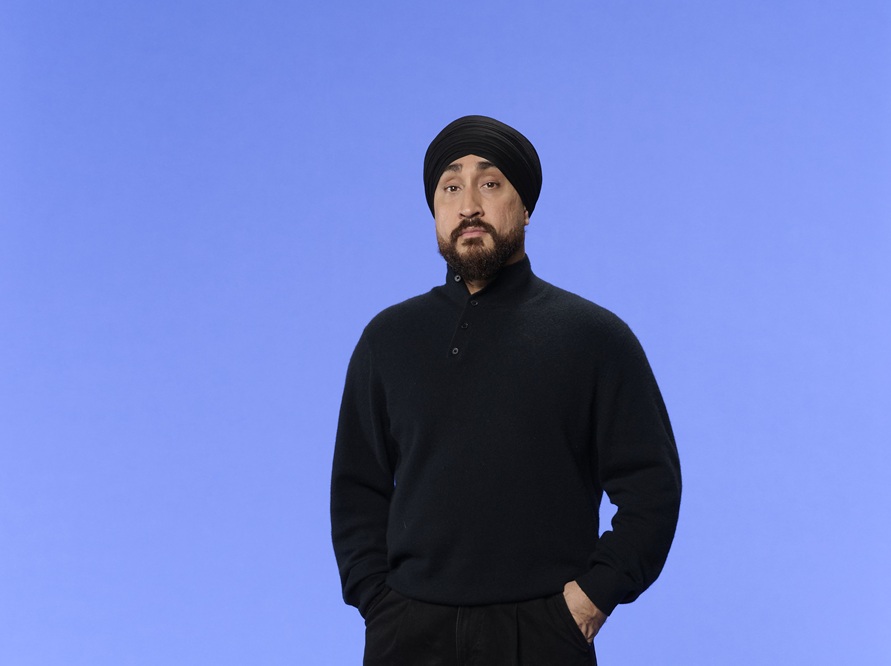
Jasmeet Raina didn’t follow a conventional route to stardom. The Canadian Screen Award-winning writer, creator, and lead character of the hit show Late Bloomer didn’t go to film or acting school. Instead, he made his mark on YouTube as the quirky and very funny Punjabi guy named JusReign.
“My parents really wanted me to head into biomed,” Raina tells Pancouver over Zoom. “In school, I just started making YouTube videos and doing sketches and skits and stuff on line.”
This hobby began in 2009 and enabled him to pay for tuition and his textbooks at the University of Guelph in his hometown. But then things started snowballing—to the point where JusReign racked up nearly a million subscribers over the next decade. Raina attributes his success to the shortage of comedy that spoke specifically to the experiences of people of Punjabi and broader South Asian heritage.
“Chappelle’s Show was a show that I really liked watching,” Raina says. “I felt like it was so unique and specific to the Black experience. I just kind of wanted to do the same thing.”
But in 2018, after climbing the mountain of YouTube success, Raina did something completely unexpected. JusReign stopped making videos and shut down his primary social media accounts. Then Raina re-emerged a few years later with the Crave series Late Bloomer, which has completed three seasons.
Watch the official trailer (above) for Season 3 of Late Bloomer.
Late Bloomer delves deeper than YouTube
Late Bloomer is about a millennial, Jasmeet Dutta (played by Raina), who balances his rising fame as an online creator with his family’s traditional Sikh culture.
“YouTube was more like comedy and slapstick-y,” Raina says. “It was satire; it was parody. It was all that. I think Late Bloomer does have a lot of those elements, but I also wanted to touch upon topics and themes and situations that were deeper than what I could really say or talk about on YouTube.
“I really wanted to head in a comedy-drama lane and be able to make something that could be funny,” he continues, “but also could be heartfelt and deep and really challenge a lot of the norms that we’re kind of used to within this community.”
On Saturday (July 25), Raina will speak about his career path at the Racial Equity Screen Office’s fourth annual East by Northwest (EXNW) Summit. In a fireside chat at the Westin Bayshore Hotel, he will reveal how he built an audience through storytelling while retaining his authenticity.
Raina enjoys exposing subjects that are often swept under the carpet within his community.
“I think I really wanted to show a South Asian family in the most honest and truthful way,” Raina explains. “I’ve seen South Asian families be depicted in TV and film before, and it just doesn’t quite hit the mark. It feels like it’s…an outsider perspective’s understanding of what like an Indian family is. And it doesn’t feel right; it feels very performative.”
As a child, his grandfather imbued him with Sikh values of seva, equality, and oneness. Raina emphasizes that these concepts are all translated into Late Bloomer. But he doesn’t always give the elders a free pass.
Jasmeet Raina breaks down a school drop-off scene in Late Bloomer.
Responding to parent propaganda films
For example, in one of the final scenes in Season 3, the father confronts the grandmother, holding her accountable for the family’s problems. The father insists that all she does is complain and complain and complain.
Raina says that he never saw a scene like this on-screen before within his culture.
“It was more of a fantasy as I wrote that,” he confesses. “I was, like, I would love to see that.”
Raina adds that in the writing room, he and his colleagues discussed how a lot of Bollywood movies are “parent propaganda”.
“I was very opposed to parent propaganda films,” he emphasizes. “Because I remember parents would use them—‘See, this is what you’re gonna do! You’re gonna not care about me, put me in an old folks’ home.’ And I’m like, ‘Bro, I’m 13. What are you talking about?’ ”
In many ways, Raina is a super-charged DIY success story. He learned how to create his early videos by watching Internet tutorials. In the earliest days, he didn’t even have a camera. He used his university MacBook—which was supposed to be only for academic work—to film various clips.
“Then, I eventually saved money to get a proper camera,” Raina recalls. “It was like a point-and-shoot. Then, I got a DSLR and so it just kind of worked its way up.”
Yet these humble beginnings yielded tremendous dividends, which are now reflected in the vibe of Late Bloomer.
“I think the authenticity I learned from my YouTube days was because I didn’t really have to answer to anybody at the time,” Raina states. “I could just make what I really wanted to make—and what felt so true and honest to me. And I was rewarded by that.”
The Racial Equity Screen Office will present the fourth annual East by Northwest (EXNW) Summit at the Westin Bayshore from Friday (July 24) to Sunday (July 26). Tickets are available on the website. Surrey writer and editor Jeevan Sangha will moderate a fireside chat with Jasmeet Raina at 10 a.m. on Saturday (July 25) on the EXNW Stage.
Follow Pancouver on X @PancouverMedia and Bluesky @pancouver.bsky.social. Also find Pancouver on Instagram @PancouverMedia.