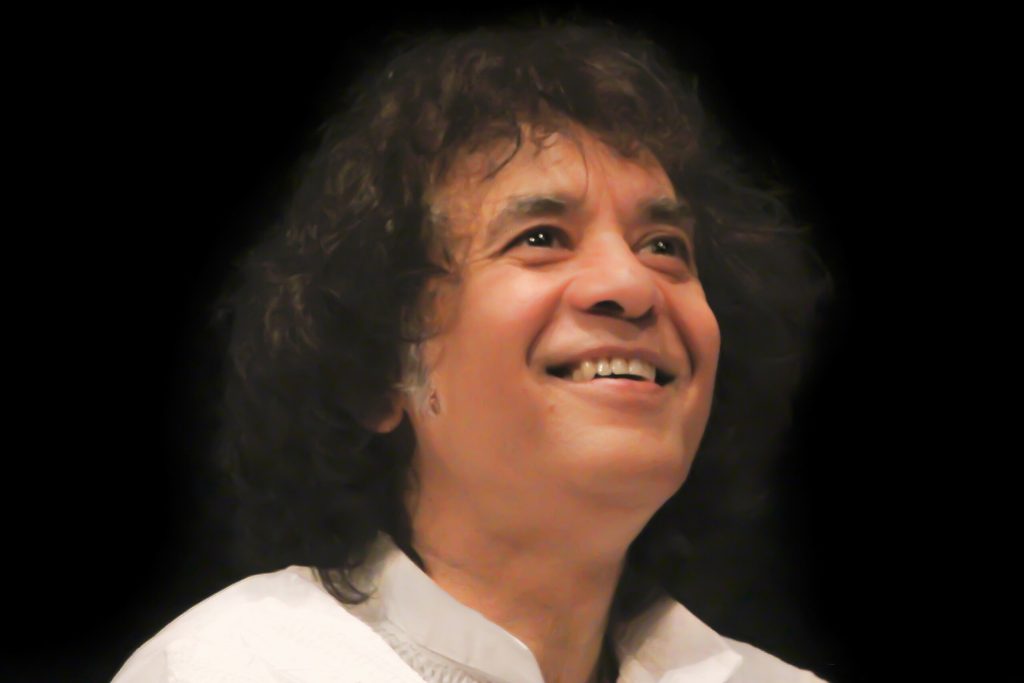
Music lovers around the world are mourning the loss of the great Indian tabla master Zakir Hussain. He died on Sunday (December 15) in San Francisco of idiopathic pulmonary fibrosis, according to his family.
I was fortunate to interview the incredibly gracious Hussain last April in advance of his final Vancouver performance. Even though he said he was suffering from a bad cough and a dry throat, he insisted on carrying on with the interview.
“I’m still trying to come to grips with it,” Hussain told me at the time. “What do you do?”
He had just come off winning three Grammy Awards in February at the age of 72. One came for Best Global Music Performance for “Pashto”. This track was on his fusion band Shakti’s album, This Moment, which won the Grammy this year for Best Global Album.
Shakti’s most recent incarnation was comprised of Hussain, longtime collaborator and 83-year-old guitarist John McLaughlin, vocalist Shankar Mahadevan, classical Indian vocalist Ganesh Rajagopalan, and percussionist Selvanganesh Vinayakram.
The band formed in the 1970s with Vinayakram’s father, Vikku, on percussion.
In addition, Hussain won a Grammy for Best Contemporary Instrumental album for As We Speak. He recorded it with banjo player Béla Fleck, double bassist Edgar Meyer, and bansuri player Rakesh Chaurasia.
“They carried me over the threshold,” Hussain said with more than a touch of modesty.
He also claimed that he was lucky to win the three awards this year.
In his interview with Pancouver, Hussain revealed that his collaboration with Fleck, Meyer, and Chaurasia didn’t begin with music. Rather, it developed socially as the musicians and their families would meet and discuss their preferences over food, drink, and reading material.
“That kind of grew into us arriving at such an in-depth comfort zone that it allows us to really—as a very natural process—play music together,” Hussain said at the time. “With our relationship at that level, and all the layers that that entails, just made it possible for us to be so conversationalist with each other—without using human words but just melodies, rhythms, and so on and so forth.”
Hussain’s father, the legendary Ustad Allah Rakha Khan, was his musical mentor as he was growing up in the mostly Muslim district of Mahim in Mumbai. As an adult, Hussain spent decades in North America.
Speaking to Pancouver, he acknowledged a contradiction between growing religious communalism in India even as Muslim performing artists are so revered in that country.
“Bismillah Khan or Ustad Amjad Ali Khan or Shahrukh Khan or Salman Khan—these guys are loved and revered, and practically worshipped by everybody in India,” Hussain said. “It doesn’t matter if they are Hindus or Muslims.”
As a result, Hussain said that it is difficult to understand what is and isn’t propaganda in connection with reports of religious communalism.
“I have no clue about that,” he added. “At the same time, I have to say that ultimately, it is up to us as a community to be able to make ourselves acceptable. We must find a way to be able to project the kind of civility, love, and affection and inclusivity amongst ourselves and the willingness to be that, so that maybe it is possible for everyone else to be able to respond thus.”
Then he quoted the Biblical phrase: “Do unto others as you would have them to unto yourself.”
Moreover, Hussian said that the some unnamed politicians who practise vote-bank politics and engaged in sabre-rattling would show up at his concerts and tell him that they were big fans. Then, they would ask for a photo with him.
As an elder, Hussain supported rising Indian classical music stars, including bansuri player Debopriya Chatterjee and sarangi player Sabir Khan. They were on tour with him in British Columbia as members of his trio called Tisra.
“When I grew up learning Indian music, it was more ‘blinkers on’—and [it was] not until I got to the Mumbai studios and then subsequently to America and Europe that I actually got to interact and open my panorama to learn more,” says Hussain. “But these young musicians grow up from the get-go, learning music as a more planetary thing—more global.”
Follow Pancouver on Twitter @PancouverMedia and on Instagram @PancouverMedia. Follow Charlie Smith on Bluesky @charliesmithvcr.bsky.social.