The Toronto Reel Asian International Film Festival has released a video tribute to filmmaker Ali Kazimi. It comes in the wake of the festival awarding Kazimi with its annual Fire Horse Award in recognition of his distinguished career as a documentary maker and academic.
Kazimi’s body of work includes Beyond Extinction: A Sinixt Resurgence, Continuous Journey, and Shooting Indians: A Journey with Jeffrey Thomas, among other films. As a professor of cinema and media arts at York University, Kazimi has also mentored many students over the years, some of whom emerged as outstanding filmmakers.
In the tribute film, jury member and Vancouver artist Paul Wong declares that Kazimi “has been really active decolonizing the lens, decolonizing the form, decolonizing the self”.
“He is energetic, passionate, obsessive, determined, and ambitious,” Wong states.
Nominator Karen Tisch highlights the impact of Continuous Journey, which was released in 2004.
“It brought to light the submerged history of one of the most infamous human rights violations in Canadian history, which was the barring of entry of Indian-British subjects who were held captive right off the shore of Vancouver on their ship, the Komagata Maru,” she says. “For two months. This was as a result of a hidden ‘Whites Only’ immigration policy.”
Kazimi’s landmark 2022 film, Beyond Extinction, exposed how a B.C. First Nation was declared extinct in 1956. This occurred even though the Sinixt people continue to live in the Arrow Lakes region of B.C., which was flooded as part of the massive U.S.-Canada Columbia River dam project. Kazimi has described the extinction declaration as “ethnic cleansing by legislation”.
Nobu Adilman produced and directed the tribute to Kazimi. Byron Wong and ZeroIIZero oversaw the editing and post-production.
Watch the short tribute film to Ali Kazimi.
Kazimi reflects on his career
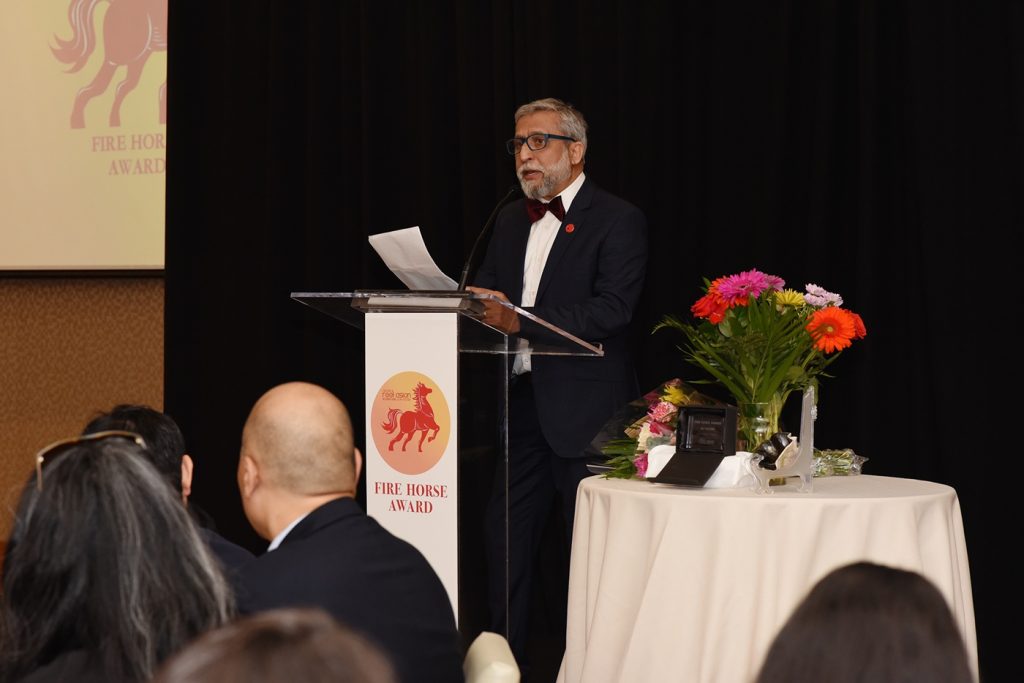
Toronto Reel Asian International Film Festival also posted Kazimi’s May 26 acceptance speech on YouTube.
“When I came to Canada in 1983 to study film at York, I was one of the few students of colour in the program,” Kazimi told the audience. “Our stories then weren’t considered part of Canadian culture. We were outside the frame, literally.
“In the Canadian arts community, our diversity was not being reflected,” he continued. “And thanks to activism, the Canada Council, led by Joyce Zemans—who I’m thrilled to know is here today—took the brave step of being the first institution to start looking at diversity and equity.”
He revealed that he found community in the late 1980s through volunteering.
“I chose documentary because I felt it could make a difference—and I still do,” Kazimi stated. “It has not been an easy path. There have been moments when I have indeed doubted my choices. But then there have been moments of affirmation.”
He revealed that one of those came when Phil Fontaine, a former grand chief of the Assembly of First Nations, once said that he watched Kazimi’s film Shooting Indians during a dark period in his life and that it helped him. Fontaine then thanked Kazimi.
“Moments like these, small and unexpected, have kept me going,” the filmmaker said.
Kazimi thanked his many collaborators and supporters, including Vancouver lawyer and Rungh editor Zool Suleman. As well, Kazimi expressed appreciation to his documentary participants who trusted him to tell their story. He singled out two in particular: Iroquois Onondaga photographer Jeff Thomas and Sinixt matriarch Marilyn James.
“Their courage continues to light the way for me,” Kazimi said. “And of course, I could not be here without my partner, Heidi McKenzie, whose long journey as a ceramic artist continues to inspire me every day. Your love and belief in me have carried me through more than you’ll ever know.”
The final part of his speech addressed public issues. Kazimi mentioned that he has always believes that citizenship isn’t only about rights. It’s also about one’s responsibility to be informed and engaged.
“Dissent, I believe, is not only essential, but I believe that it is what sustains democracy.”
Watch Ali Kazimi’s acceptance speech.
Speaking up for Gaza
He went on to express his deep disappointment to Mayor Olivia Chow, who was in the room, regarding city bylaws that create bubble zones to prevent protests genocide in Gaza.
“These are thinly veiled attempts to suppress protest and silence pro-Palestinian voices. I see this as a dangerous erosion of our democratic rights,” Kazimi said. “I want to pay tribute to the students across Canadian campuses who are standing up for Palestine. Your clarity and moral courage moves me deeply. You, the students, are the conscience of this moment.”
To add poignancy to his message, Kazimi spoke about his friendship with Ahmed Abu Shaban, former dean of the faculty of agriculture and veterinary medicine at Al-Azhar University – Gaza. This institution was “among a slew of universities in Gaza that was systematically blown up by Israeli forces”, Kazimi noted in his speech.
Remarkably, Kazimi added, students and faculty refused to let their university die even though the buildings had been demolished. Professors continued offering their courses online, sometimes travelling for two hours to reach Internet hot spots despite Israeli bombing and sniper fire. And 10,000 students continued their studies.
This gives Kazimi hope for the future. Then he closed with a comment about Canada.
“The Great White North is no longer white. It never was,” Kazimi said. “It’s a multi-hued, multi-voiced ever-evolving place. And Reel Asian has been a real part of this transformation.”
To learn more about Ali Kazimi, visit his website. Follow Charlie Smith on Bluesky @charliesmithvcr.bsky.social. Follow Pancouver on Instagram @PancouverMedia and on X @PancouverMedia. In addition, find Pancouver on Bluesky @pancouver.bsky.social.