Nigerian Canadian filmmaker Omorose Osagie says that she began working on her short film, “Lost Wax”, after hearing a crude generalization.
“My family is from the Edo tribe in Nigeria, and the stereotype was that Edo women are considered to be promiscuous,” Osagie tells Pancouver over Zoom. “That was because of the large amount of women who are sex-trafficked to Italy. People promised them job opportunities.”
She knew that these lost girls were in Europe because criminals had tricked them. That, in turn, led the UBC film production graduate to consider the fate of lost artworks from the Kingdom of Benin (c. 900 to 1897). It was home to the Edo people.
The Gender Equity in Media Society will present “Lost Wax” on Saturday (March 7) at the VIFF Centre. It’s part of the Acts of Visions: Shorts program at GEMFest 2026.
But first, some history. In response to an 1897 attack on a British trade mission, British colonial armed forces launched a deadly assault on the kingdom’s capital, Benin City. In the ensuing massacre, the Brits ransacked the palace and carted away thousands of works of art, including many prized Benin Bronzes. Hundreds of these sculptures ended up in the British Museum, stolen as the spoils of war.
“I wanted to compare the lost girls to the lost artwork—and focus on the grief we feel for strangers, through the eyes of an artist,” Osagie says of her film.
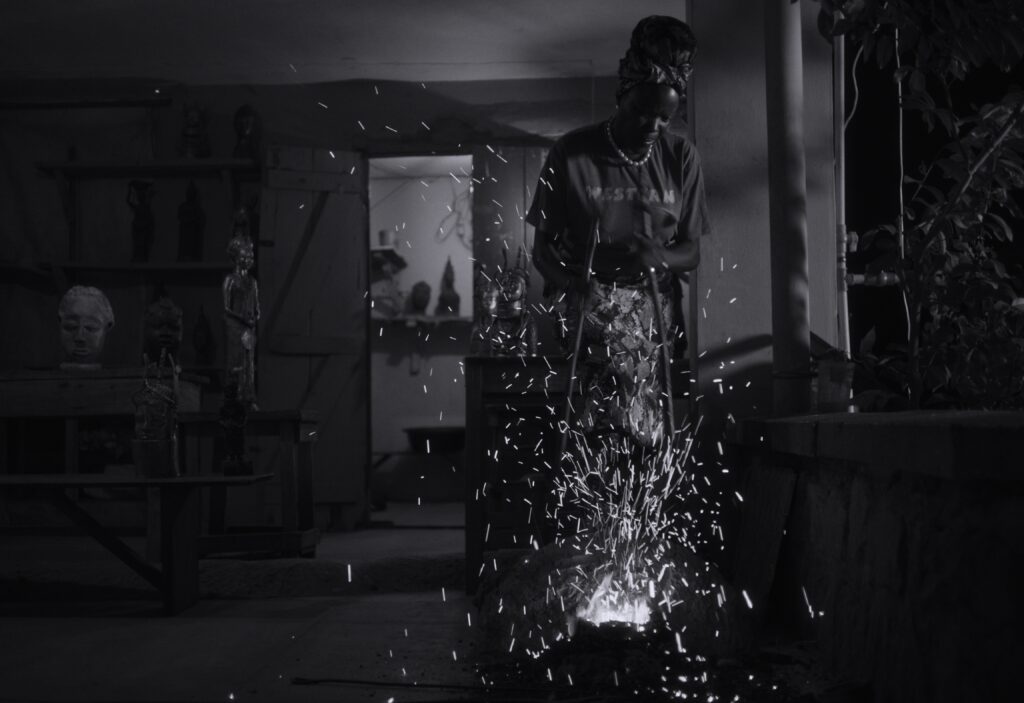
Osagie films “Lost Wax” in Nigeria
“Lost Wax” opens with five Nigerian girls in a field, clapping and chanting numbers as they play a children’s game. One girl, Mercy (Diana Egwatu), is sent to the sidelines after she is eliminated. But by the time the girls go inside the building, Mercy has vanished.
Two of them pass Mercy’s mother (Wumi Tuase) on the stairs. They shout from above that they want to leave Nigeria.
“Who told you about Italy?” the mother demands.
Director of photography Antonia Ramirez helps craft a dreamy feel to “Lost Wax”, which was filmed in Nigeria in black and white. As Mercy’s mother embarks on a frantic search for her daughter, a childless bronze caster named Osas (Eyiyemi Olivia Robbinyin) is lurking nearby, eliciting suspicion.
“Because she is an older woman who does artwork, people in her community would view her as a bit strange,” Osagie says. “She is an outsider.”
Osagie makes judicious use of animation to introduce elements of speculative fiction.
“The reason I wanted to integrate it into this film is because it allowed me to break into a more surreal space,” she says.

Filmmaker grounds story in reality
Osagie likens “Lost Wax” to “slow cinema”, which is reinforced by Nyla Smith’s elegant piano music. The filmmaker maintains that it is also more poetic than her previous shorts, such as the animated “Glass Doll” and the tech-oriented “The Wolf That Chased the Sun”.
“I would say that’s the biggest difference,” Osagie continues. “And then also the fact that it felt more grounded in reality than any of the other films I’ve made.”
As a writer and director, Osagie has been inspired by Nigerian arthouse films, including Akinola Davies Jr.’s My Father’s Shadow. She also praises a 2005 Nollywood film called Eagle’s Bride, which remains with her to this day.
“It has such an intense storyline,” Osagie emphasizes.
When it came time to shoot “Lost Wax”, Osagie also felt the influence of Fritz Lang’s 1931 film M.
“After a young girl disappears and the mom is calling out her name, he shows empty spaces as well,” Osagie relates. “So, that was an inspiration for the film.”
The Gender Equity in Media Society will present Omorose Osagie’s “Lost Wax” in its Acts of Visions: Shorts. The program begins at noon on Saturday (March 7). For tickets and more information, visit the GEMFest website. GEMFest runs from March 5 to 8. It is the only one western Canadian film festival dedicated to women and gender-diverse people. Follow Pancouver on Bluesky @pancouver.bsky.social.