Some of the most memorable historical novels revolve around families living in tumultuous times. Min Jin Lee’s Pachinko, John Steinbeck’s East of Eden, and Isabel Allende’s The House of Spirits are just three examples. But rarely has a true-life family saga served up as many historical twists and turns as Huang Yin-Yu’s 2016 documentary, After Spring, the Tamaki Family… 紀錄片: 海的彼端.
The film revolves around the Tamaki family’s preparations for the 88th birthday of their matriarch, Tamayo. She was born in central Taiwan and moved to Okinawa as a young woman. Her grandson, Shingo, is a Tokyo-based J-pop and heavy-metal musician on a voyage of discovery about his complicated family history.
The Vancouver Public Library and LNY Splash are teaming up to present a free screening of After Spring, the Tamaki Family… 紀錄片: 海的彼端 at 2:30 p.m. on Tuesday (February 10). It’s part of LNY Splash’s annual series of films from Asia, which are screened in Vancouver and Courtenay over the Lunar New Year period.
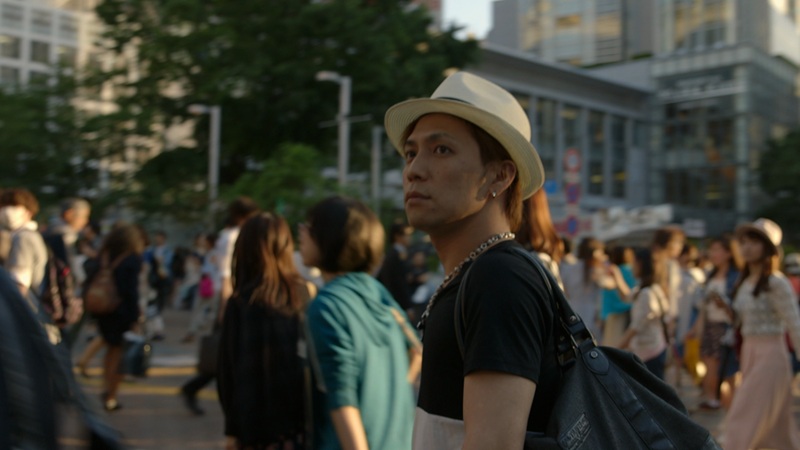
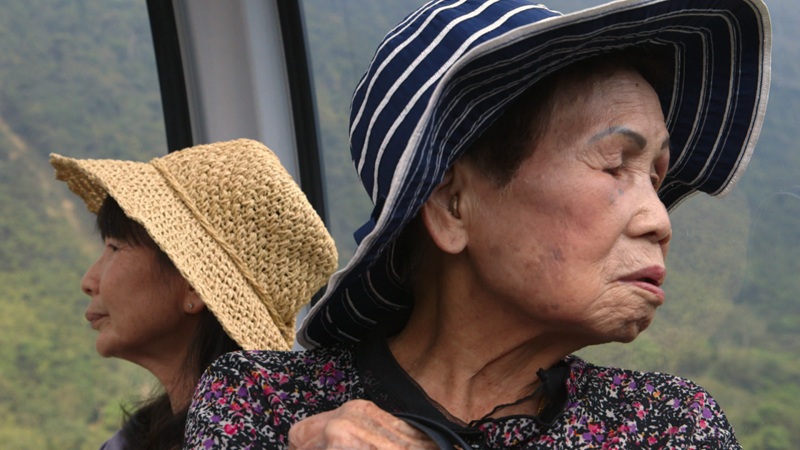
After Spring, the Tamaki Family… 紀錄片: 海的彼端 opens with a few people visiting an older woman on a very rainy day in Puli, Taiwan. The dogs are barking in the background, koi are swimming in a containment tank, and the yard is a bit of a mess. Shingo seems strangely out of place with his stylish rock-star haircut, sapphire blue jacket, and studded metal and leather bracelets. Inside the dishevelled home, his grandmother speaks Taiwanese with the other old lady in what appears to be a reunion.
Things become even more confusing as Shingo and an older man trade cigarettes. The older man describes Shingo’s Japanese-made cigarette as “icy” and ill-tasting in Mandarin, which Shingo doesn’t understand. Shingo, on the other hand, approves of the Chinese cigarette, noting that it’s longer than those made in Japan.
This sets the stage for an odyssey through modern Asian history to explain how these two men and two women came to spend time together.
Tamaki film highlights Taiwan’s link to Japan
A few minutes into the documentary, Shingo is in Tokyo revealing how he ended up in a touring band. In one live performance, he asks the raucous crowd if they’re having fun. Then, he proudly declares to screaming fans: “I am from Ishigaki Island, Okinawa, and I’m half-Taiwanese!”
Shingo didn’t give a lot of thought to his Taiwanese ancestry until he read a book about Taiwanese immigrants to Ishigaki Island. He was surprised to discover his family name in it.
Media coverage often reminds westerners of Taiwan’s fraught relationship with the People’s Republic of China. But from 1895 to 1945, Taiwan was a colony of Japan as a result of the first Sino-Japanese War—and Japan’s links to the island nation receive far less attention.
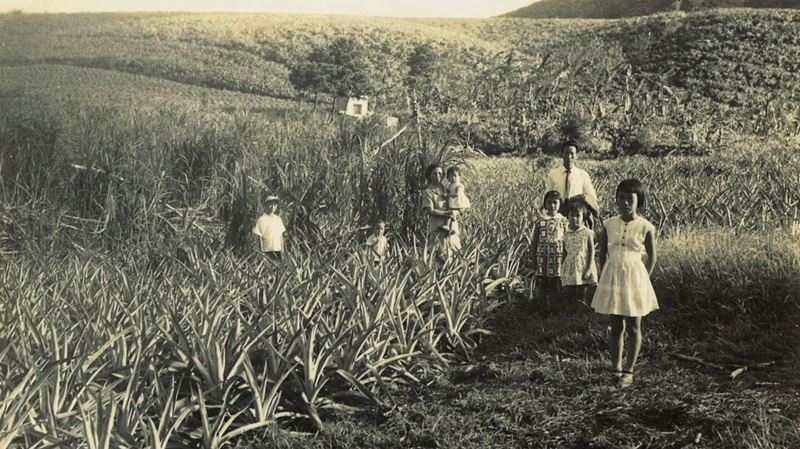
Director Huang dug up fascinating archival video footage showing life in Taiwan under Japanese rule. In those days, Taiwan became a hub for tropical fruits, especially pineapple. But in 1935, Japan nationalized the entire pineapple industry, creating havoc for independent producers.
According to the film, an entrepreneur named Fa Lin recruited 60 families and 300 pineapple farmers to move from Taiwan to Okinawa, where he founded a factory.
“My grandpa, Mu-Yung Wang, was recruited through Japan’s new agricultural policy during the 1930s to move to Ishigaki Island from colonial Taiwan,” Shingo reveals in the film.
Taiwanese immigrants created a village in a malaria-infested area largely avoided by Okinawans. Later, Wang returned to Taiwan and married Tamayo before taking her back to Ishigaki Island, where they had a large family.
Stateless residents of Okinawa
But that didn’t settle things. After the Second World War ended, the Chinese nationalist government under Chiang Kai-shek imposed dictatorial rule over Taiwan. He declared martial law and massacred thousands of Taiwanese in the notorious 228 incident in 1947. Chiang moved his government to Taipei two years later after losing the Chinese Civil War.
However, Okinawa was not part of Taiwan. Following the Second World War, it became a U.S. territory, which was formalized in the Treaty of Peace negotiated with Japan in 1951. Relations remained tense between Okinawans and Japanese, who mistrusted their proximity to the Americans.
As a result, Shingo’s grandparents were stateless for decades. They weren’t residents of Taiwan and didn’t want to return there. Chiang was forcing everyone to speak Mandarin in public life as he brutally repressed dissent. Yet the grandparents also couldn’t be citizens of Japan under the treaty, even though the Tokyo government retained “residual sovereignty”.
Director Huang does a remarkable job in telling the story of how the U.S. eventually transferred Okinawa to Japan and how the Taiwanese immigrants campaigned to became Japanese citizens.
Shingo’s father prospered during the Japanese economic golden era of the 1980s, but things turned sour when the bubble burst. Along the way, Huang explains why Taiwanese immigrants to Okinawa lost contact with their homeland. Tamayo’s grandchildren don’t speak Taiwanese and Shingo has moved on from Ishigaki Island.
“Everyone tells me to move back,” Shingo says at one moment in the film. “It’s a tough call. If I were to come back, I would have to leave behind all the progress that I have made in Tokyo.”
Historical documentaries often focus on world leaders, famous athletes, and monumental military campaigns. But the waves of history also crash over families. And it can take decades for some to adjust and find their bearings.
This gentle and intriguing film looks at the fallout from history through the eyes of one family. The resilient, cheerful 88-year-old and her introspective 32-year-old grandson serve as ideal foils in this remarkable journey of Asian reconciliation.
The Vancouver Public Library and LNY Splash will present a free screening of After Spring, the Tamaki Family… 紀錄片: 海的彼端 at 2:30 p.m. on Tuesday (February 10). The film will be shown in the Montalbano Family Theatre, Level 8 of the Central Branch. Multilingual marketing strategist and dialogue facilitator Iris Chen will lead a post-screening discussion about After Spring, the Tamaki Family… 紀錄片: 海的彼端.
There will be a second screening on Friday (February 13) at the Courtenay Evergreen Club. For more information, visit the LNY Splash website. Follow Pancouver on Bluesky @pancouver.bsky.social and Instagram @PancouverMedia.