
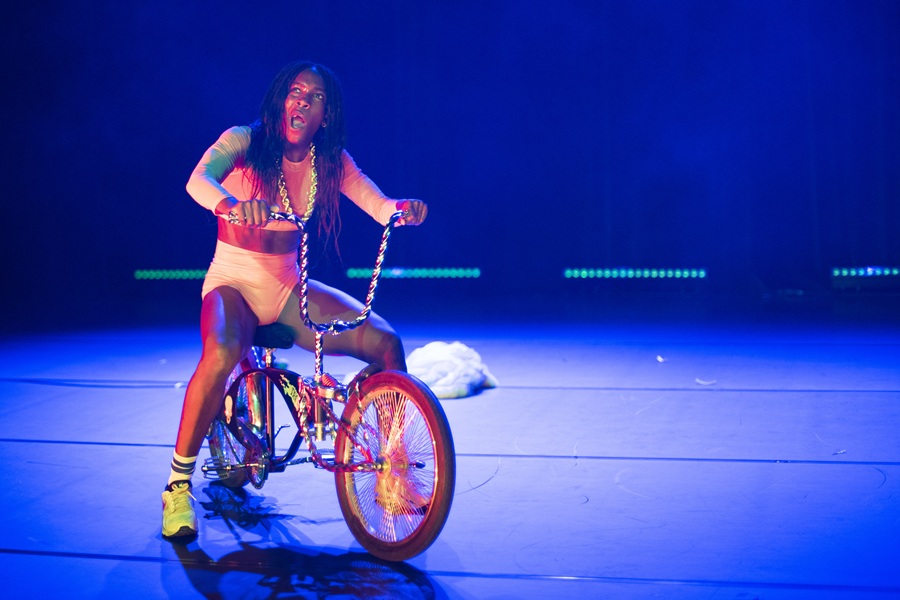
In her solo show Jezebel, choreographer and dancer Cherish Menzo questions the representation of Black women’s bodies in visual culture.
“That immediately draws me to a specific time in my youth—my teenage years—where I watched a lot of MTV and other music channels,” the Amsterdam-based Menzo told Pancouver in a 2024 interview.
The hypersexualization of Black women’s bodies in visual culture in the late ’90s and early 2000s prompted her to question how her body was being represented within the black-box theatre. Moreover, she also interrogated the information that she had gained before entering the institutional culture of arts.
“I feel that I had pushed these things to the back because I wanted to be seen as a technically schooled dancer [in] classical ballet, modern dance,” Menzo stated at the time. “So funny enough, looking more into this specific representation—and what my references were—brought me into this specific representation.”
Menzo made these comments about Jezebel in a wide-ranging interview about one of her other shows, DARKMATTER, which was featured at the 2024 PuSh International Performing Arts Festival in Vancouver. Jezebel and DARKMATTER are the first two parts of her trilogy, which also includes FRANK.
In all three dance performances, Menzo distorts reality through chopped-and-screwed sound, video imagery, lighting, and movement. Through this approach, she encourages audiences to think more deeply about Blackness, the African body, and the African diaspora.
This month as part of the PuSh festival, Menzo is returning to Vancouver to perform Jezebel at the Scotiabank Dance Centre on January 22 and 23. The festival runs from January 22 until February 8.
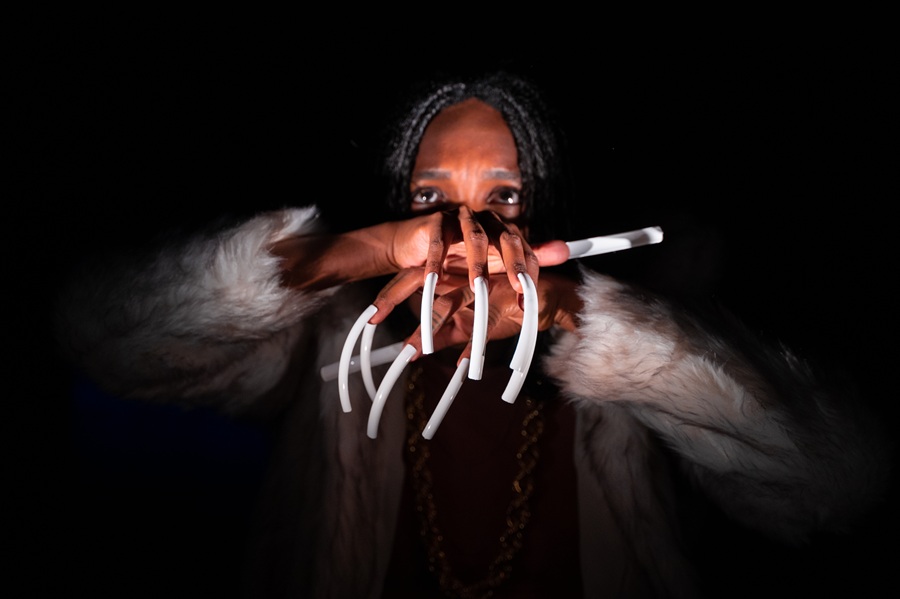
Jezebel creator cares about audiences
Even though Menzo was born and raised in Amsterdam and her family ancestry goes back to Suriname, she acknowledges that Black American visual culture had a big impact on her as a teenager. In a recent PuSh festival podcast, Menzo spoke about her show with the festival’s in-dialogue coordinator and curatorial assistant, Chipo Chipawaza. According to Menzo, in the initial stages of her research, she gave a great deal of thought to the representation of Black female rappers such as Nicki Minaj, Cardi B, and Megan Stallion.
“The audience is very important in my practice,” Menzo told Chipawaza. “I feel that with Jezebel, it was the first spark of wanting to bring that importance of the dialogue—the dissonance, the negotiations…that come about in relation to when audience members and the performers meet each other in a specific context.”
In the same podcast, she quipped: “I could not bring a low-rider car, so I brought a low-rider bike.”
Back in 2024, Menzo emphasized to Pancouver that the title of her show refers to the Black Jezebel, not the Biblical Jezebel.
“I looked at three archetypes, which are more caricatures,” Menzo explained. “But they have their origins in the colonial times where the Jezebel was perceived as the hypersexual and also manipulative female within the African descendants. This idea of Jezebel is still very present in those hip-hop or rap clips.”
Watch the trailer (above) for Jezebel.
The PuSh International Performing Arts Festival will co-present Jezebel on January 22 and 23 with New Works Dance at the Scotiabank Dance Centre. It’s produced by Cherish Menzo / Frascati Producties in conjunction with GRIP. For tickets and more information, visit the PuSh festival website.
Follow Pancouver on X @PancouverMedia and Bluesky @pancouver.bsky.social. The publication is also on Instagram @PancouverMedia.


