By Xianda Huang, University of California, Los Angeles
Several years ago, an employee at Universal Music came across a cassette tape in a Tokyo warehouse while sorting through archival materials. On it was a recording by the late Taiwanese pop star Teresa Teng that had never been released; the pop ballad, likely recorded in the mid-1980s while Teng was living and performing in Japan, was a collaboration between composer Takashi Miki and lyricist Toyohisa Araki.
Now, to the delight of her millions of fans, the track titled “Love Songs Are Best in the Foggy Night” will appear on an album set to be released on June 25, 2025.
Teng died 30 years ago. Most Americans know little about her life and her body of work. Yet the ballads of Teng, who could sing in Mandarin, Cantonese, Japanese, and Indonesian, continue to echo through karaoke rooms, on Spotify playlists, at tribute concerts, and at family gatherings across Asia and beyond.
I study how pop music has served as a tool of soft power, and I’ve spent the past several years researching Teng’s music and its legacy. I’ve found that Teng’s influence endures not just because of her voice, but also because her music transcends Asia’s political fault lines.

From local star to Asian icon
Born in 1953 in Yunlin, Taiwan, Teresa Teng grew up in one of the many villages that were built to house soldiers and their families who had fled mainland China in 1949 after the Communists claimed victory in the Chinese Civil War. Her early exposure to traditional Chinese music and opera laid the foundation for her singing career. By age six, she was taking voice lessons. She soon began winning local singing competitions.
“It wasn’t adults who wanted me to sing,” Teng wrote in her memoir. “I wanted to sing. As long as I could sing, I was happy.”
At 14, Teng dropped out of high school to focus entirely on music, signing with the local label Yeu Jow Records. Soon thereafter, she released her first album, “Fengyang Flower Drum.” In the 1970s, she toured and recorded across Taiwan, Hong Kong, Japan, and Southeast Asia, becoming one of Asia’s first truly transnational pop stars.
Teng’s career flourished in the late 1970s and 1980s. She released some of her most iconic tracks, such as her covers of Chinese singer Zhou Xuan’s 1937 hit “When Will You Return?” and Taiwanese singer Chen Fen-lan’s “The Moon Represents My Heart,” and toured widely across Asia, sparking what came to be known as “Teresa Teng Fever”.
In the early 1990s, Teng was forced to stop performing for health reasons. She died suddenly of an asthma attack on May 8, 1995, while on vacation in Chiang Mai, Thailand, at the age of 42.
Teresa Teng performs “Fly Me to the Moon” in Taipei in 1984.
China catches Teng Fever
Perhaps the most remarkable aspect of Teng’s story is that Teng Fever peaked in China.
Teng was ethnically Chinese, with ancestral roots in China’s Shandong province. But the political divide between China and Taiwan following the Chinese Civil War had led to decades of hostility, with each side refusing to recognize the legitimacy of the other.
During the late 1970s and 1980s, however, China began to relax its political control under Deng Xiaoping’s Reform and Opening Up policy. This sweeping initiative shifted China toward a market-oriented economy, encouraged foreign trade and investment, and cautiously reintroduced global cultural influences after decades of isolation.
Pop music from other parts of the world began trickling in, including Teng’s tender ballads. Her songs could be heard in coastal provinces such as Guangdong and Shanghai, inland cities such as Beijing and Tianjin, and even remote regions such as Tibet. Shanghai’s propaganda department wrote an internal memo in 1980 noting that her music had spread to the city’s public parks, restaurants, nursing homes, and wedding halls.
Teng’s immense popularity in China was no accident; it reflected a time in the country’s history when its people were particularly eager for emotionally resonant art after decades of cultural propaganda and censorship.
For a society that had been awash in rote, revolutionary songs like “The East is Red” and “Union is Strength”, Teng’s music offered something entirely different. It was personal, tender, and deeply human. Her gentle, approachable style—often described as “angelic” or like that of “a girl next door”—provided solace and a sense of intimacy that had long been absent from public life.
Teng’s music was also admired for her ability to bridge eras. Her 1983 album, Light Exquisite Feeling, fused classical Chinese poetry with contemporary Western pop melodies, showcasing her gift for blending the traditional and the modern. It cemented her reputation not just as a pop star but as a cultural innovator.
It’s no secret why audiences across China and Asia were so deeply drawn to her and her music. She was fluent in multiple languages; she was elegant but humble, polite and relatable; she was involved in various charities; and she spoke out in support of democratic values.
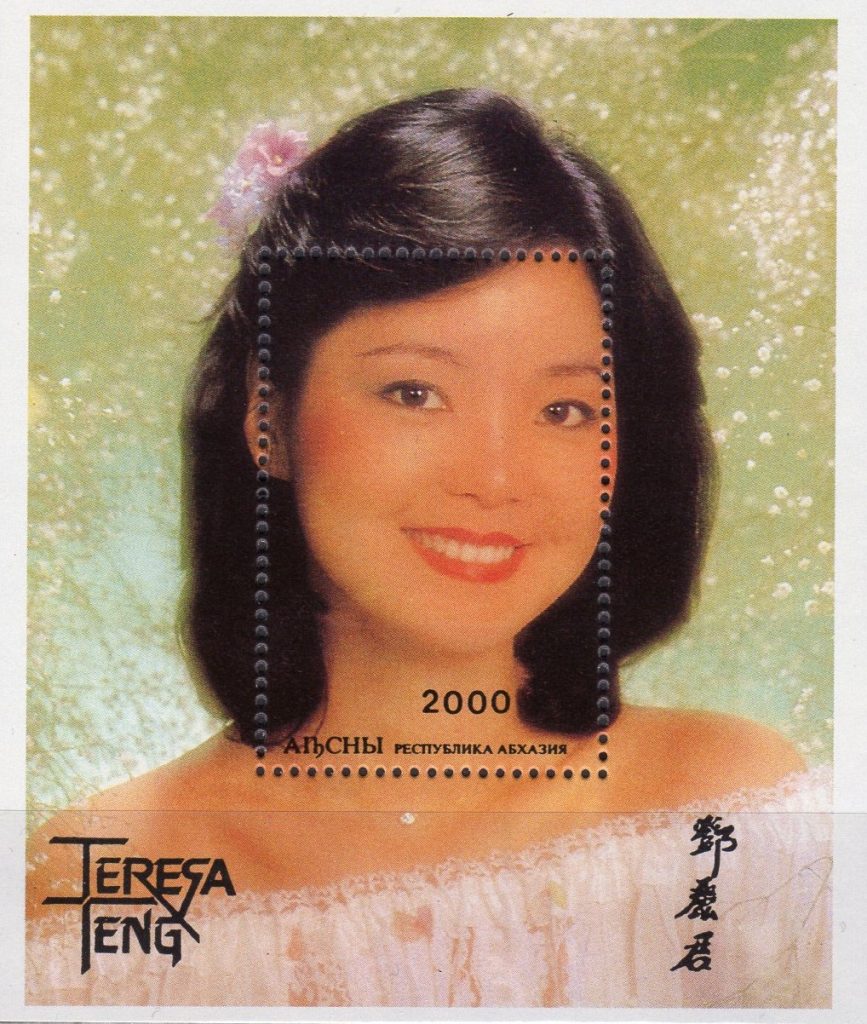
A sound of home in distant lands
Throughout the 1990s and early 2000s, the Chinese immigrant population in the United States grew to over 1.1 million. Teng’s music has also deeply embedded itself within Chinese diasporic communities across the country. In cities such as Los Angeles, San Francisco, and New York, Chinese immigrants played her music at family gatherings, during holidays and at community events. Walk through any Chinatown during Lunar New Year and you’re bound to hear her voice wafting through the streets.
For younger Chinese Americans and even non-Chinese audiences, Teng’s music has become a window into Chinese culture.
When I was studying in the U.S., I often met Asian American students who belted out her songs at karaoke nights or during cultural festivals. Many had grown up hearing her music through their parents’ playlists or local community celebrations.
The release of her recently discovered song is a reminder that some voices do not fade—they evolve, migrate and live on in the hearts of people scattered across the world.
Teresa Teng’s music is still celebrated in Asian communities across North America.
In an age when global politics drive different cultures apart, Teng’s enduring appeal reminds us of something quieter yet more lasting: the power of voice to transmit emotion across time and space, the way a melody can build a bridge between continents and generations.
I recently rewatched the YouTube video for Teng’s iconic 1977 ballad “The Moon Represents My Heart.” As I read the comments section, one perfectly encapsulated what I had discovered about Teresa Teng in my own research: “Teng’s music opened a window to a culture I never knew I needed.”

Xianda Huang is a PhD student in Asian Languages and Cultures at the University of California, Los Angeles. This article is republished from The Conversation under a Creative Commons licence. Read the original article.
Follow Pancouver on Instagram @PancouverMedia and on Bluesky @pancouver.