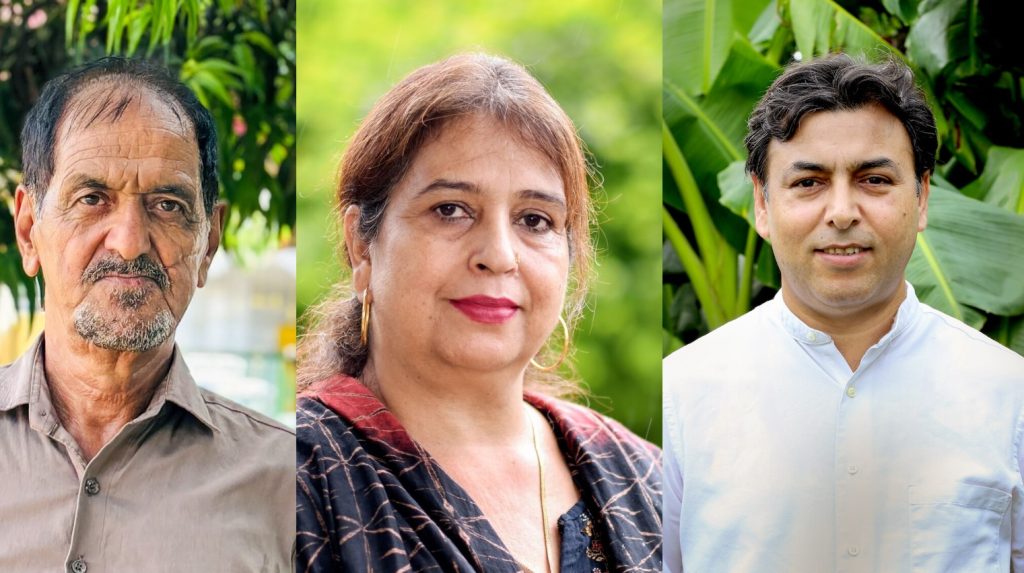
Lahore author Shahzad Aslam feels that writing is the key to seek truth, discover himself, and understand others.
“Writing in one’s mother language is the surest way to discovery and liberation,” Aslam declares. “In today’s unstable world, fiction is my only refuge.”
These words are all the more remarkable considering that Aslam is a Pakistani court judge raised by illiterate parents.
Vancouver businessman Barj Dhahan quoted Aslam last month in a speech announcing the finalists for the most lucrative Punjabi literary award in the world. That’s because Aslam’s collection of short stories, Jungle Rakhey Jag De, is one of three finalists for the Dhahan Prize for Punjabi Literature. Aslam wrote it in the Shahmukhi script.
Sometimes referred to as the “Punjabi Giller”, Dhahan launched the prize in 2013 with his wife Rita through the Canada India Education Society. They did this in partnership with the University of British Columbia’s Department of Asian Studies. Other friends and family members of the Dhahans also help finance the award.
This year’s winner will receive $25,000 and each of the two runners-up will collect $10,000. In addition, the funders will spend another $6,000 translating the books into Gurmukhi or Shahmukhi script.

Taboo and Safety Kit also Dhahan finalists
Kashmir-based writer Surinder Neer is another finalist for Taboo, a collection of short stories in Gurmukhi.
“Neer says her mother used to narrate folk tales with a lot of interest when she was young,” Dhahan said at the unveiling of the finalists at Simon Fraser University’s Surrey campus. “That experience instilled in her the urge to write stories. She was also inspired by her maternal uncle, a writer and a poet.”
The title story is about a mother-daughter relationship. The mother disapproves of her daughter living with her boyfriend outside of a traditional marriage. But then, the daughter overhears her mother speaking to man on the phone, who says “Hi dear.”
According to Dhahan, there is no equivalent to the word taboo in Punjabi.
The third finalist, Jinder, lives in Jalandhar city in the Indian state of Punjab. A retired Punjab State Transport Department employee, he’s a finalist for Safety Kit. This collection of short stories in Gurmukhi was written from several perspectives, according to UBC Department of Asian Studies lecturer Gurinder Mann, who spoke at the event.
Mann said that one of Jinder’s stories revolves around a young woman named Jaspreet, who embraces the freedom that comes from moving abroad. Then she meets a friend who was a rape victim.
In another story, Mann revealed, a young woman makes a gut-wrenching decision to become a sex worker to meet the challenge of supporting her family back in Punjab.
Dhahan said that there were juries for both scripts of Punjabi as well as a central jury, whose members can read Gurmukhi and Shahmukhi. In total, there were 11 jurors.
“Every one of them is a scholar, writer, or recognized person in the Punjabi literary or Punjabi studies field,” Dhahan stated.
Watch the news conference announcing the finalists.
Youth award inspires secondary students
The 2024 Dhahan Prize Ceremonies Banquet will be held on November 14 at the Northview Golf and Country Club (6857 168 Street, Surrey). It includes a sit-down buffet-style dinner and a musical performance by Sunny Matharu (tabla), Pafittar Singh (dilruba esraj), and Saajh Jaura (vocalist). Tickets are available through the Dhahan Prize website.
Royal Bank of Canada’s Community Involvement is once again the presenting partner of the Dhahan Prize. Sponsors include G.L. Smith Planning and Design, Adrian Keenan Personal Real Estate Corporation, and SFU’s Vancity Office of Community Engagement, among others.
In addition, Coast Capital sponsors the Dhahan Prize Youth Award. One of this year’s winners, L.A. Matheson Secondary School student Harman Singh Atwal, attended the event in Surrey and spoke briefly at the podium.
Gurpreet Bains, a Punjabi language teacher at LA Matheson Secondary School, emphasized that this award is instilling a love of the language among youths in her school and four other secondary schools in Surrey, as well as one in Abbotsford.
“As an award facilitator, I can attest that with time this opportunity is inspiring our youth in writing short stories on the topics that they care about and bring a positive change in our community,” Bains stated. “Students in our classrooms are going above and beyond to write about issues they care about and creating literature for their peers.”
The students’ stories appear in a publication called Lofty Heights. This year, there were 56 submissions, setting a record.
“This is a testament to the growth of this award and how popular it is with the youth,” Bains said.
For more information on the Dhahan Prize for Punjabi Literature, visit the website. Follow Pancouver on X (formerly Twitter) @PancouverMedia and on Instagram @PancouverMedia.