

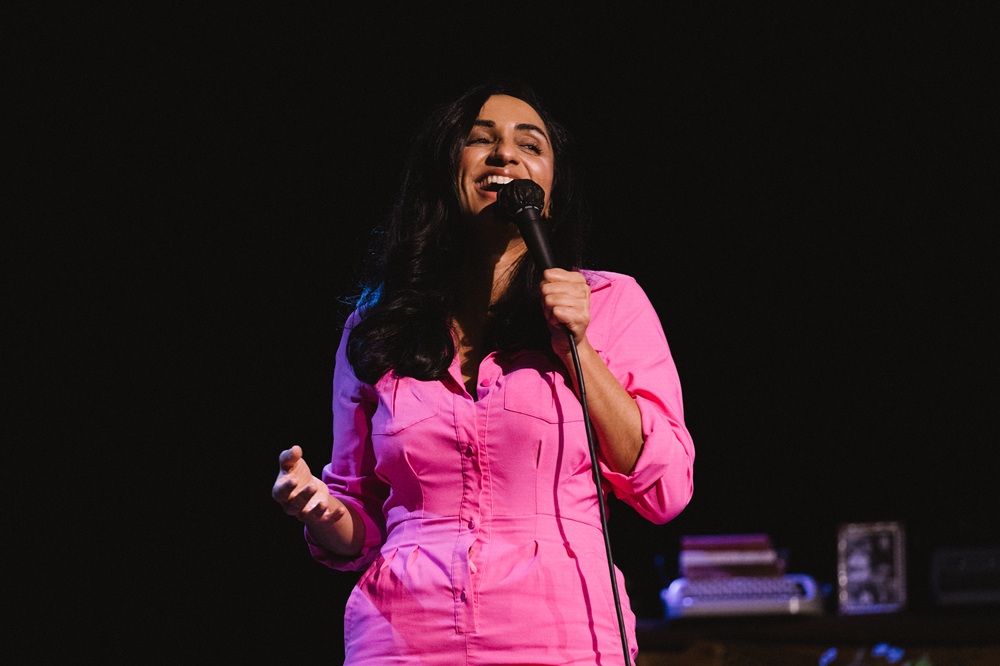
Like other standup comedians, Kiran Deol enjoys eliciting guffaws in a crowded theatre. But she emphasizes that she is also a storyteller who loves sharing personal experiences. The Los Angeles resident describes her standup as “a real conversation” with the audience, who become part of the event.
“I feel like we spend less time in rooms together than we ever have in history, just because of technology,” Deol tells Pancouver over Zoom. “It’s one of the remaining mediums where people actually physically get together and do something. And you know, there’s nothing like a feeling when the whole room is laughing.”
She will be in a large room—the Vancouver Playhouse—for A Raucous Evening with Kiran Deol on Tuesday (July 8) as part of the Indian Summer Festival. The U.K.-born comedian has Punjabi ancestry, and she knows that people from the Indian subcontinent have been immigrating to Metro Vancouver for well over a century.
“This isn’t just a first-generation crowd,” Deol notes. “This isn’t just a second-generation crowd. This is going to be a mixed crowd, and I feel that makes people really open to you just being a good comedian.”
When she is in the U.K., she is regarded as “Asian”—a common term for people with family roots in India, Pakistan, and Bangladesh. But in America, “Asian” is more often applied to people of East Asian ancestry.
“I had a joke in a gala saying, ‘I’m the other kind of Asian.’ It would never work in England,” Deol quips.
Deol survives ayahuasca
The Harvard-educated entertainer is also an award-winning filmmaker (Woman Rebel, I Would Never) and TV actor (Sunnyside). She points out that documentaries and other films take time to produce, yet they can live forever. Comedy, on the other hand, is deeply present but often fleeting.
“What I love about documentary film and what I love about standup is that they’re both versions of storytelling—and I find that so exciting,” Deol says.
This year, her debut comedy special, Joysuck, was released on Amazon Prime. The title reflects how things that made her angry or sad can be transformed into something funny on-stage. They become “joysucks”.
“It’s stuff like equal pay or it’s stuff like politics or it’s stuff like getting malaria,” Deol says. “Then you find a way to reframe it and make it funny. So we just made that the theme of the show.”
Comedy Dynamics posted one funny excerpt on Deol’s adventures with ayahuasca, which is reputedly beneficial for brain health and psychological well-being. Made from plants, this hallucinogenic brew has traditionally been consumed for medicinal and spiritual reasons in parts of the Amazon and Orinoco basins. Deol heard about the beverage’s healing properties from a comedian friend. Then, she learned more from the observations of Vancouver physician and author Dr. Gabor Maté.
Initially, Deol had to convince a shaman that she was spiritually ready.
“I ended up being fine,” the comedian relates, “and then some other woman ended up jumping into the jungle. She ran off and got all busted up by the branches.”
Weaving a comedic tapestry
Deol is part of a national touring standup show called Facial Recognition Comedy, which is comprised of female-identifying performers of Middle Eastern, North African, and South Asian descent. According to the website, it was created “as a response to tokenism and underrepresentation in entertainment, and to let everyone know that we are NOT the same person!”
“We’re all brown women who do comedy,” Deol says, “and we get mistaken for each other all the time.”
At the Indian Summer Festival, Deol will weave a comedic tapestry on-stage that will feel familiar to people who look like her. But she also plans to present this in a cool and funny way.
“Some of that incorporates culture and race and identity,” she states. “And some of that incorporates how you are as a person and your personal experience.”
For example, in Vancouver she plans to tell a true story of being assaulted outside a 7-Eleven store a few years ago. A man struck her in the face with a bottle. Naturally, this raised questions whether this was ethnically or racially motivated or whether the man was mentally ill. Despite the grim subject matter, Deol promises that her tale has many funny moments.
Moreover, this incident has made her think about how she chooses to metabolize someone else’s actions toward her. It sounds, in a way, like the ultimate joysuck.
https://youtu.be/fgm-HS5zCCA?feature=shared
Indian Summer Festival will present A Raucous Evening with Kiran Deol at 7 p.m. on Tuesday (July 8) at the Vancouver Playhouse. For tickets and more information, visit the festival website. Follow Pancouver on Instagram @PancouverMedia and on Bluesky @pancouver.




