
By Sophy Chu 朱子栩
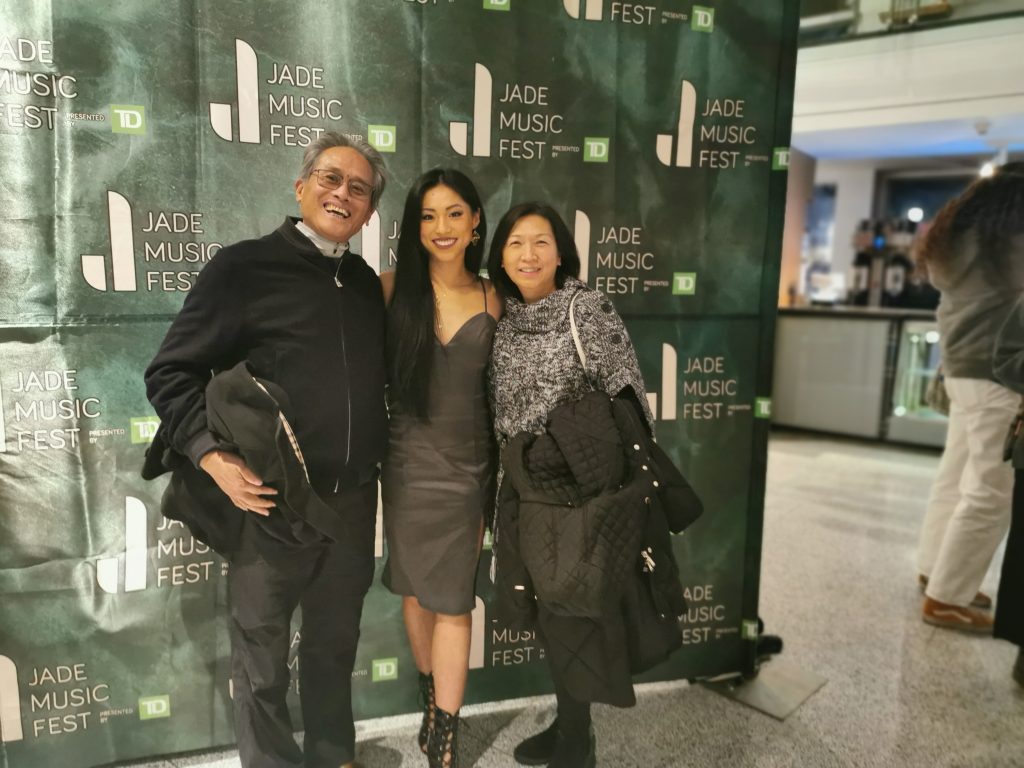
Vanessa Yuen’s journey to becoming an artist known as Van Lefan is a migration story, shaped by her parents’ bold decisions and values. From her parents’ migration gamble to their open-ended encouragement of her creative interests, Vanessa’s artistry is built on a foundation of choice, both her own and those her parents made for her.
Vanessa’s father, Joseph, had built a solid career in accounting and finance in Taiwan and China. Immigration to Canada wasn’t part of a long-term plan; it began almost by accident when an old colleague introduced the idea and an immigration consultant to him.
“We’d never been to Vancouver before,” Joseph laughs. “But within four years, we got the visa approval, and within three days of landing, we bought a car, and within six days, we bought a house.”
This was a great leap of faith, driven partly by their dissatisfaction with Taiwan’s rigid education system. Vanessa’s mother, Daisy, chimes in, “Our parenting style was always freer, we let the kids explore. When Vanessa’s older brother was about to enter junior high, I knew I couldn’t accept the 7-to-9, test-heavy school days. I didn’t want my children in that system.”

Father loves classical music
In the Canadian education system, there was more time and space for Vanessa and her older brother to explore various interests. The parents also avoided pushing their children towards specific hobbies or even careers, and instead, encouraged them to experiment—dance, art, guitar, long flute, etc.—without the weight of expectations. However, there was one exception: singing.
“The voice is the most natural instrument,” Joseph says. “I tricked Vanessa into trying a children’s choir once. I told her, ‘Just go a couple of times.’ After that, every Wednesday, she’d call me to hurry from work so I could drop her off at the choir.”
Joseph brought a different musical sensibility into the home: classical music. Growing up in 1950s Taiwan with no television, he fell in love with orchestral works broadcast over the radio. This influence meant that alongside pop CDs the family stereo also carried symphonies.
“For me, classical music meant bedtime,” Vanessa teases. “He’d play it when we were going to sleep, so I always associated it with feeling drowsy.”

Parents gave their children freedom
The family’s playlists evolved with the decades—Taiwanese folk songs to 1980s pop—always with CDs stacked near the car stereo. By the time Vanessa started writing her own songs, English was her dominant language for creative expression, with snippets of Mandarin and Taiwanese overheard at home lingering in her memories.
“I didn’t feel the need to write in Chinese at first,” she admits, “most of the music I listened to and felt inspired to write were mostly English. But later when I was recording, I wanted some Chinese lyrics in my work.”
Her second album, written with collaborators who encouraged her to embrace her heritage languages, incorporated more Mandarin and some Taiwanese. The process was challenging—as her Mandarin literacy was limited to Grade 5 level, and her Taiwanese was only conversational—but deeply rewarding. “Some concepts felt truer in Chinese,” she says. “I can’t always translate them to English”.
Joseph’s insistence on cultivating habits that encouraged enjoyment of arts and Daisy’s child-rearing preference for exploration over prescription were pivotal in Vanessa’s upbringing. The family’s bilingual and bicultural environment have helped shape Vanessa’s career, as well as the way she thinks about identity and her relationship to music.
“My parents gave me freedom,” Vanessa reflects. “They gave me music as something joyful and fun, not something I had to do. I think that is why I am still doing it now”.

Daisy and Joseph reveal their own dreams
Joseph echoes, “From the beginning, I recognized that they were my children, but they did not belong to me. I can give them paint, brushes, and canvases for them to paint their own life. I grew up in an era where we didn’t have the luxury to dream. I have a lot of dreams that I wanted to pursue, but that is now for the younger generation. So, I encourage them to pursue their dreams, to do whatever they feel passionate about.”
On the topic of dreams, Vanessa asked her parents, “If you could live in an environment like I am now and afford to pursue your dreams, what would you want to do?”
Without hesitation, Daisy said that she would want to become a Chinese opera singer. For Joseph, it was to become a journalist or writer.
Daisy added, “Life is short, the time you have to chase your dreams is limited. Of course, life changes drastically and it might not be possible to realize all your dreams, but no matter what, there will always be a home to return to.”
Van Lefan recorded her official music video for “The Lesson” in Taitung, Taiwan.
This is one of a series of Pancouver articles about Canadian musicians of Asian ancestry who were supported by their parents as they pursued careers as singers and songwriters. These musicians have all performed at the Jade Music Fest, which promotes underrepresented artists by offering them a platform to perform. This event also fosters intergenerational connections by celebrating Chinese-language music created by artists born in Canada and abroad. The next Jade Music Fest will be in Vancouver from November 5 to 8.
Follow Pancouver on X @PancouverMedia and on Instagram @PancouverMedia.




