
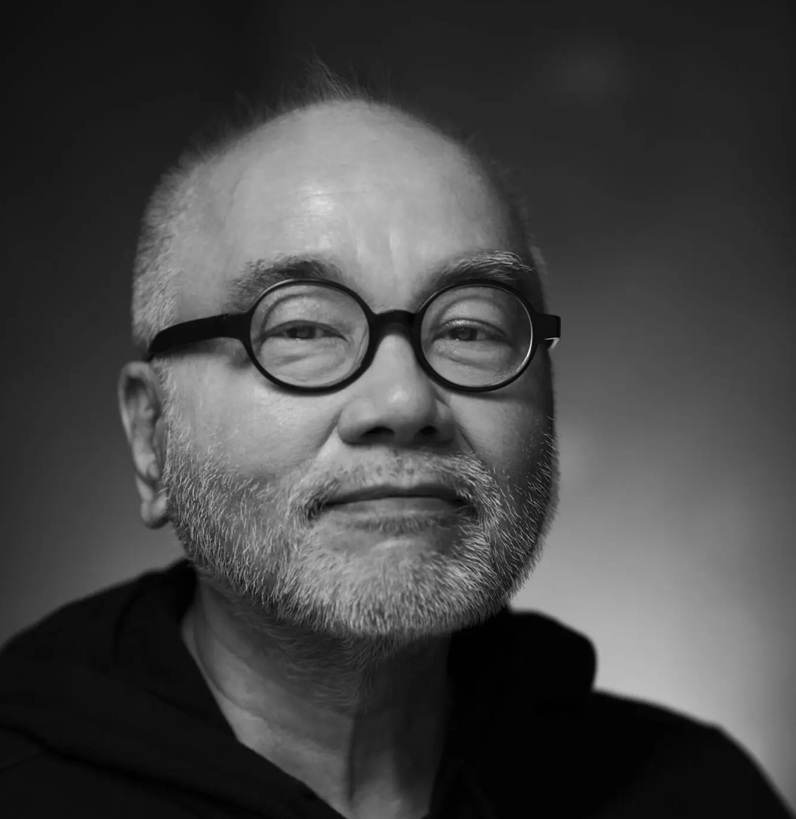
A pioneering experimental artist from Hong Kong will speak in Vancouver about his cultural odyssey. Danny Yung 荣念曾 is program director of the Hong Kong Institute for Contemporary Culture. He is also co-artistic director of Hong Kong–based Zuni Icosahedron, which blazed a trail in experimental theatre dating back to the early 1980s.
Yung’s artist talk, Borderless Stage, is at the Vancouver Art Gallery at 2 p.m. on Thursday (July 17).
“A highly influential cultural figure in Asia, Yung’s work spans theatre, installation, curatorial practice and cultural policy,” the Vancouver Art Gallery states on its website. “Over the past five decades, he has initiated groundbreaking cross-disciplinary platforms such as One Table Two Chairs Cross-Cultural Exchange Platform, City-to-City Conference and Asia Arts Net, fostering dialogue between traditional and contemporary art forms across Asia and beyond.”
Yung, 81, was born in Shanghai and moved to Hong Kong with his family during the Chinese Civil War. He spent nearly two decades in the United States, majoring in mathematics at Pacific University while studying dance under Lila Hitchcock. He went on to bachelor’s degree in architecture at the University of California, Berkeley. Yung also earned a master’s degree in urban design and urban planning at Columbia University.
In a 2008 interview with Suzanne Carbonneau for the Pew Center for Arts & Heritage, Yung said that he gave up architecture because he was fed up with dealing with clients.
“I was in Hong Kong in the late 1970s,” Yung stated. “I was doing pretty much nothing. Actually, not quite nothing: I was observing people and documenting what I observed through comics. Doing comics is economically feasible because all you need is a pen and some paper.”
Danny Yung 荣念曾 recorded this message after winning a Fukuoka Prize in 2014.
Yung transitioned from comics to performing arts
His first exhibition was in the Hong Kong Art Centre in 1979.
“They kept asking me if I wanted to do something more than just comics,” Yung recalled. “I said sure, for opening night I would do something experimental. So I invited all my friends and gave them rules and regulations to follow. It became a happening.”
In this way, he launched his first performing arts piece, The Broken Record.
“It’s called The Broken Record because I used a ‘broken record’ recording that kept repeating,” he revealed.
Yung followed that up with his Journey to the East series. THe two characters, Marco Polo and Antonioni, discuss how the West views the East, and vice-versa. That led to the founding of Zuni Icosahedron in 1982.
The name Zuni Icosahedron reflected Yung’s desire for colour (zuni) and form (icosahedron). “Zuni” represents a colour between green and blue, whereas “Icosahedron” is a 20-sided object as well as an infectious virus. Its first work as a collective was an adaptation of Colombian author Gabriel José García Márquez’s One Hundred Years of Solitude. According to Yung, Zuni Icosahedron focused on the spirit of the story rather than the text.
The last British governor of Hong Kong, Chris Patten, asked for Yung’s help in creating the Hong Kong Arts Development Council to counter censorship. Several years later, the Ford Foundation invited him to a meeting in New York to discuss the creation of the World Cultural Forum.
“There were 60 people present, from all over the world, yet I was the only Asian,” Yung recalled in his interview with the Pew Center for Arts & Heritage. “I thought I should share with them the way we did networking, how we share with each other, in Asia. I talked with them about the importance of sustainability, of empowerment. Finally, the World Cultural Forum focus sort of evolved from my suggestions.”
The Vancouver Art Gallery will present Danny Yung’s artist talk in Room 4East from 2 to 3 p.m. on Thursday (July 17). For tickets and more information, visit the VAG website. Follow Charlie Smith on Bluesky @charliesmithvcr.bsky.social. Also, follow Pancouver on Instagram @PancouverMedia and on Bluesky @pancouver.




