
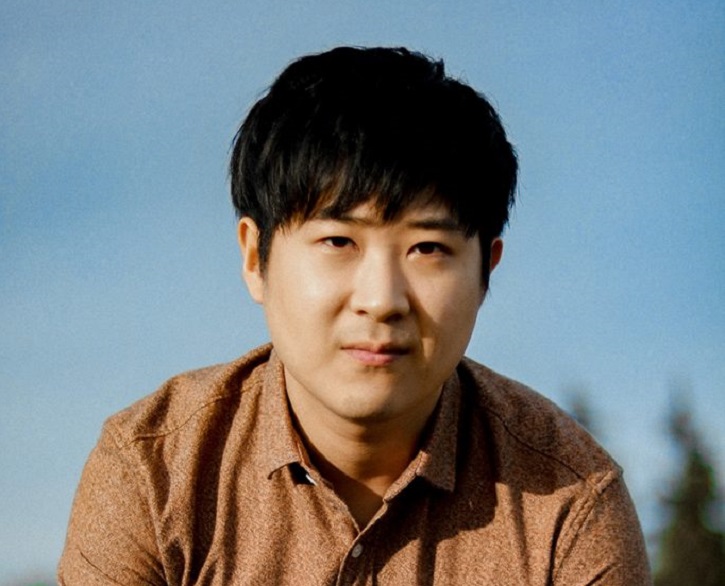
Vancouver filmmaker Jerome Yoo has enjoyed folk tales since childhood. He tells Pancouver that he even embedded these cultural influences in his debut feature film Mongrels, which is nominated for two Canadian Screen Awards.
“There is one big symbolic reference to the ‘Pied Piper of Hamelin’,” Yoo says over Zoom. “But there are also cultural folk tales specific to Korea that’s underlined in the film.”
Mongrels is about a Korean widower, his sensitive teenage son, and young daughter adjusting to their new life in Canada in 1991. The father, Sonny (Jae-Hyun Kim), finds work eradicating feral dogs that are creating havoc and fear in their small town. At home, he has a difficult relationship with his son Hajoon (Da-Nu Nam). Meanwhile, his daughter, Hana (Sein Jin), remains grief-stricken over the loss of her mom.
Yoo says that in Sonny, he aimed “to create a shell of a character that’s really struggling in all facets of his life—isolation, connection to his children, and the loss of his partner”.
“I wanted to see what that would look like from a perspective of someone that’s really just starting from rock bottom,” the writer-director says. “I wanted him to be animalistic, almost.”
Yoo drew inspiration from a famous mythological Korean story. In this tale, the king of the dark world of Gamangnara dispatches his two most ferocious fire dogs to fetch the light of the sun and then the light of the moon.
“The idea is that the king of darkness is isolated in his kingdom and wanted to bring light into his world,” Yoo explains. “The isolated king in this instance would be the father—isolated and wanting to have light. And the children are representative of the dogs that want to, in some way, bring light back into the family.”

Yoo stuck to his roots for debut feature
In Mongrels, Yoo linked all of this with canines, which symbolize outsiders who are often misunderstood. In effect, the dogs reflect the family’s journey. It’s a fictional story, but Yoo’s film is informed by the experiences of his family, who are Korean immigrants, and others in the community.
“Thinking about my first feature film, I’ve always felt that I had to express something from the heart—that’s very personal,” Yoo says. “I wanted to stick to my roots.”
He created the film in three chapters, each presenting the perspective of a major character. In this regard, Yoo was inspired by Barry Jenkins’s film Moonlight, which told one character’s story at three different points in their life.
“I felt some sort of confidence that a structure like this could work.”
Yoo won the Directors Guild of Canada Horizon Award for an emerging Canadian director for Mongrels at the Vancouver International Film Festival. At the Canadian Screen Awards, Mongrels is a nominee for original screenplay and the John Dunning Best First Feature Film Award. These honours will be presented from May 30 to June 1. In the meantime, the Rio Theatre will show Mongrels at 2 p.m. on Sunday (May 25), followed by a question-and-answer session with Yoo.
This comes in the wake of last month’s screening at the Beijing International Film Festival and its Korean premiere at this month’s Jeonju International Film Festival.
Mongrels was an official selection of the Beijing fest’s “Forward Future Section”, with famed Hungarian auteur Béla Tarr heading the jury that evaluated these films.
Jae-Hyun Kim sees Mongrels for first time
Meanwhile, Yoo appreciated the festival’s translation of his film’s title into the Simplified Chinese characters 野狗・异人, which means “Wild Dog and Alien”.
“It was my first time visiting China, and I have to say the festival is extremely well run there,” Yoo comments. “The audiences were the most passionate that I had, especially in the Q&A.”
Yoo was also thrilled to see Mongrels screened in Jeonju. It’s just over 200 kilometres south of Seoul, where he was born before moving to Canada as a baby. He was pleased by the Korean audience’s warm reaction, describing it as a “such a memorable moment”.
It marked the first time that Jae-Hyun Kim, the Korean actor who played Sonny, was able to see the film. That’s because Yoo had resolved that leading cast members would see it first in a theatre—and Mongrels had never been shown before in Korea, where Kim lives.
“Working with Jae-Hyun really opened my eyes to what a diligent actor—that really throws himself at a part—can look like,” Yoo says. “I wish, looking back, I could have been more prepared because I had a lot to learn from him.”
At the screening, Yoo worried what Kim might think of their film. So, how did this high-profile Korean actor respond to the final cut of Mongrels?
“He bawled his eyes out once in every chapter,” Yoo replies.
In other words, the actor liked it.
Watch the trailer (above) for Mongrels.
Yoo is part of Vancouver wave
Yoo knows that he’s among a growing number of Vancouver directors of Asian ancestry who are making a mark by telling their stories on the big screen. He studied acting under one of them, Anthony Shim, the Korean Canadian writer-director of the multiple award-winning Riceboy Sleeps. Yoo also acted opposite Japanese-born and Vancouver-based director Mayumi Yoshida in her 2018 short film “Tokyo Lovers”.
“She excels at working and collaborating with actors,” Yoo says. “But what I really respect about Mayumi is her diligence of really planning and knowing every shot, every camera move, and the blocking of the actors. That’s not so say that she doesn’t allow the space for her actors to experiment.”
Another up-and-coming filmmaker of Japanese ancestry is Meredith Hama-Brown. Her debut feature, Seagrass, has won several awards, including Best British Columbia Film from the Vancouver Film Critics Circle. Filipina Canadian Thea Loo has also impressed audiences. Her documentary Imay (Mama), which won the Arbutus Award for best B.C. film at the 2024 Vancouver International Film Festival.
Yoo points to Taiwanese-born Athena Han and Korean Canadian Kevin Jim Kwan Kim as two other Vancouver filmmakers of Asian ancestry who have done impressive work. Kim’s short film, “My Dad, the Rockstar”, will premiere at the upcoming Tribeca Film Festival, which was co-founded by Robert De Niro.
“I think in the past, we were not given a platform,” Yoo says. “There were less opportunities given to diverse voices…
“It’s a unique experience and perspective and lens that we have as people that grew up away from our motherland, away from where we were born,” he continues. “Or maybe we were born here but are of a different culture.”
Event details
The Rio Theatre will screen Mongrels at 2 p.m. on Sunday (May 25) as part of Asian Heritage Month, followed by a Q&A with Jerome Yoo. The Toronto premiere will be at 7 p.m. on May 31 at the Paradise Theatre, also followed by a Q&A with Yoo. Follow Pancouver on Instagram @PancouverMedia and on Bluesky @pancouver.bsky.social. Also follow Charlie Smith on Bluesky @charliesmithvcr.bsky.social.




