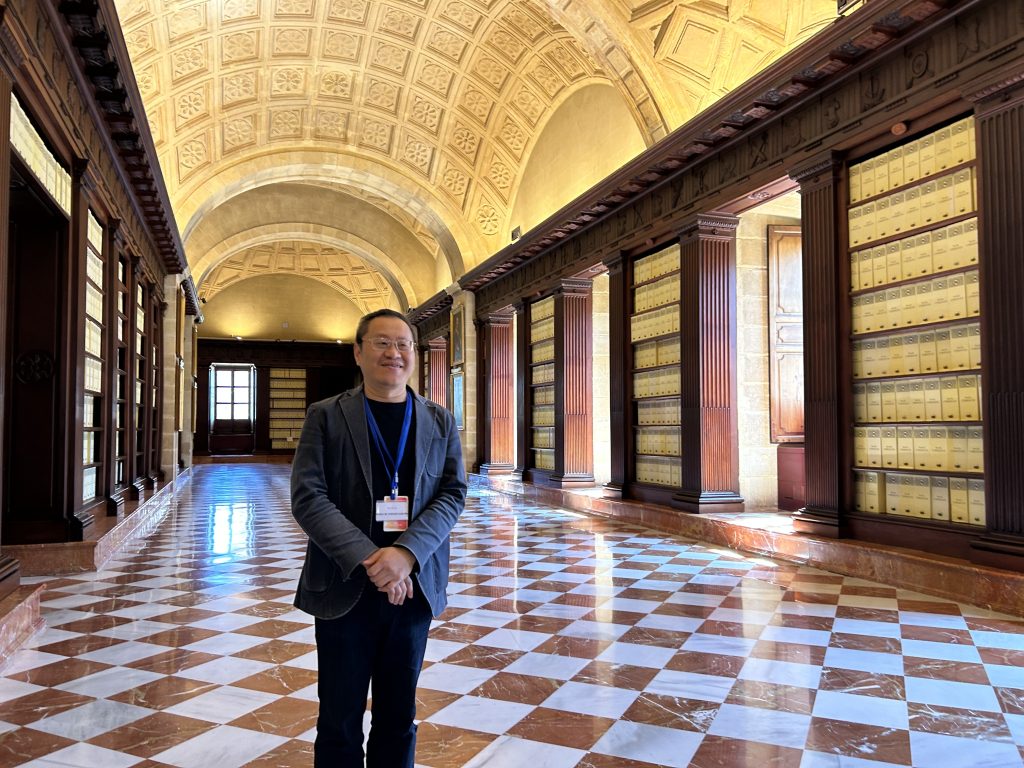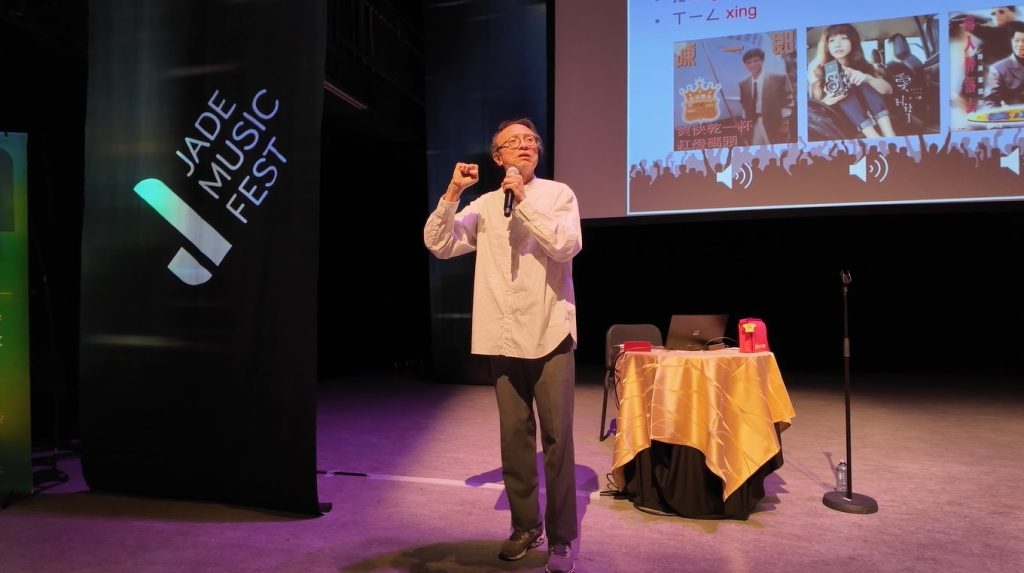
A Taiwanese musicologist has a tip for Canadian musicians of Chinese ancestry who want to bring their ethnicity to audiences in Asia. Szu-Wei Chen 陳峙維 recommends asking parents, grandparents, in-laws or neighbours to sing or play some Asian folk music for them.
He then advises musicians to take the next step of adding their own lyrics to this melody to express love, passion, or even their own identity.
“Then in the future, you show it to the audience,” Chen suggests. “You’ve got a very good story. It’s based on something.”
Chen, an independent curator, offers this guidance at a Jade Music Fest workshop in Vancouver on November 8. Entitled “Exploring Ethnicity and Identity in Your Songs: What’s so Chinese about Chinese-Language Music?”, the title reflects the Jade Music Fest’s mandate of helping musicians perform in heritage Chinese languages.
Over the course of an hour, Chen covers a wide range of topics. They include language, instrumentation, vocal style, melody, lyrics, tuning scales, meter, and rhythm. His goal is to help Canadian musicians learn how to add ethnic components to make their songs more appealing in other countries.
The former National Taiwan University adjunct professor explains why it’s acceptable to add one’s own lyrics to Chinese folk music. According to him, traditional Chinese folk songs are commonly adapted into local variations. This differs from North America, where songs are not ordinarily transformed into radically different versions for the masses, depending on their state or province.
To illustrate his point, Chen plays a southern Chinese recording of one the most famous Asian folk songs—“Jasmine Flower” (also know as “Mò Li Hūa” and “Sinfa”).
“This is the very first ‘Jasmine’ I learned from my grandma, who was actually from Shanghai,” Chen says.
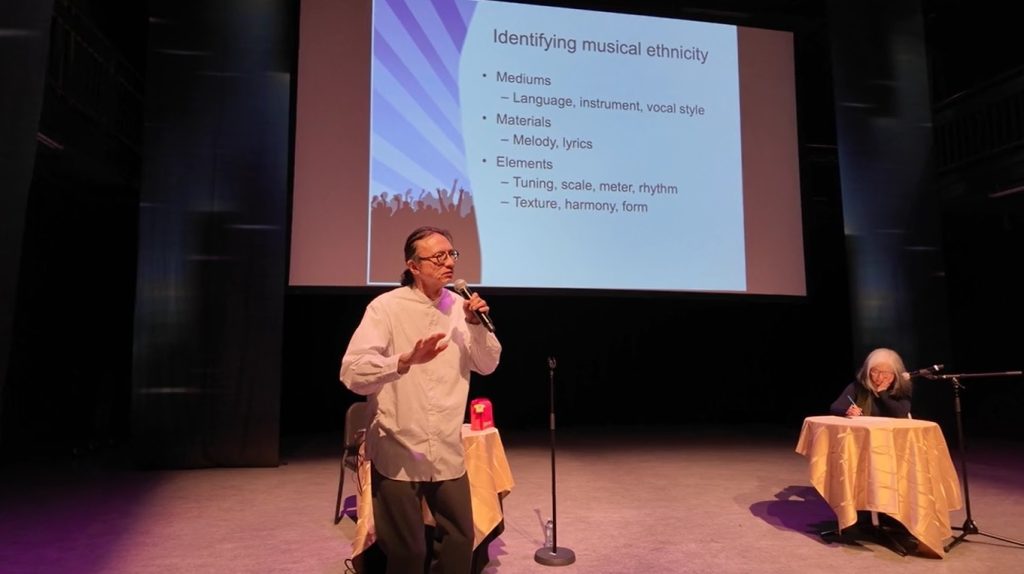
Determining ethnicity of music
He follows up by singing the northern Chinese version of “Jasmine Flower”. It has certain similarities but still sounds like a radical departure. Chen reinforces his point by playing a recorded version of the song from Beijing. Next, he plays a recording of “Jasmine Flower” from Giacomo Puccini’s Turandot opera. It sounds epic and triumphant in comparison to other more gentle versions of the song from China.
Chen explains that if villagers in one district approved a version of “Jasmine Flower”, it was then “passed down generation to generation”.
In the workshop, Chen also highlights three broad ways of determining the ethnicity of music that might sound unfamiliar. First, there are the “mediums”, which come down to language, instrument, and vocal style. Next are what he calls the “materials”—melody and lyrics.
Finally, there is a long list of “elements”. He says that they are comprised of tuning, scale, meter, rhythm, texture, harmony, and form.
If someone is singing in English, it’s likely western music. If they are playing the erhu, it’s likely Chinese music.
As for vocal style, Chen points out that in western opera, the baritone is enriched from deep in the chest, which sounds resonant. Chinese folk-music vocal styles, on the other hand, are often restricted; the sounds are shaped from higher up in the body.
In addition, Chen says, singers can adjust the melodic contour to make western music more Asian. He provides an example by singing the Scottish classic “Auld Lang Syne” in Mandarin. And it sounds distinctly Chinese.
Céline Dion sang “Jasmine Flower” in a duet (above) with Song Zuying in 2013.
Pitch and meter are also important
At the Jade Music Fest, many Canadian musicians with Asian ancestry sang songs in Chinese. While their original lyrics reflected their Chinese heritage, Chen maintains that these songs didn’t often capture the feel of their Asian identity.
“Our artists tried their best to show—to be proud—of their work,” Chen says. “But unfortunately, we didn’t hear a lot of ethnic content in their work. They showed themselves, but how are you going to express your identity in lyrics?”
From here, Chen ventures into a discussion of pitch and meter. Chen then poses a question on the overhead screen: which pitch can’t be reproduced on the piano? He also asks: which meter is difficult to march along with?
With regard to pitch, Chen plays a recording of a xylophone player performing the heptatonic scale. It has seven pitches and is used in traditional Chinese music. This differs from the highly familiar pentatonic scale, which has five notes per octave and is common in many musical traditions.
As for meter, Chen plays a Turkish march, which includes nine beats. This is very unusual. With great showmanship, he then struts across the front of the room to the beats, demonstrating how awkward it is for him to time his steps.
“The meter is not four beats or eight beats,” Chen says with a smile. “How can you march like this?”
That elicits laughter from the audience. But then, Chen puts it all in perspective.
“Just try to figure out how many elements you can use if you are trying to show your culture.”

Counterpoint and heterophony reflect ethnicity
Closer to the end of his talk, Chen discusses the differences in melody between traditional Chinese folk music and western classical music. He emphasizes that counterpoint—with independent melodies capable of standing on their own—is the basis of baroque compositions.
Chinese folk music, on the other hand, is rooted in heterophony. A single melodic line is interpreted in different ways by different instruments.
“You won’t hear it in Japanese or Korean traditional music, or Uyghur music,” Chen states. “You won’t hear it in Middle East music; you won’t hear it in Indian classical music.”
In fact, he adds, one won’t even hear it in Chinese music composed in the 1930s or 1940s or 1950s because by that time, songwriters had been influenced by the west. But in truly “traditional Oriental” songs, you will hear heterophonic melodic structures, Chen insists.
“If you’re creating new work, try heterophone,” he suggests to the musicians.
Chen closes his workshop by discussing what he calls “tone against tune”. He is referring to the multitude of tones in Chinese languages—four in Mandarin, seven or eight in Taiwanese Hokkien, nine in Cantonese, and even 10 in the countryside of Guangzhou. He acknowledges that this concept is difficult for musicians to comprehend if they don’t understand any of these languages.
“A folk tune should be open to regional interpretations,” Chen declares. “It can be modified.”
For more information on the Jade Music Fest, visit the website. Follow Pancouver on Twitter @PancouverMedia and on Instagram @PancouverMedia. Follow Charlie Smith @charliesmithvcr.bsky.social.
This article is part of “Beyond Chinese”, a joint initiative of Pancouver and the Asian-Canadian Special Events Association. Through interviews with artists and cultural workers, Beyond Chinese offers a nuanced view of people with Chinese ancestry. Pancouver and the Asian-Canadian Special Events Association gratefully acknowledge the support of Canadian Heritage.