For those with free time over the holiday season, there is still an opportunity to stroll through one of Vancouver’s more imaginative museum exhibitions of 2025. Deep-Seated Histories: Chairs from the Collection offers insights into the history of Vancouver, as well as waves of nostalgia for long-time residents. The Museum of Vancouver accomplishes this through a carefully curated selection of 150 chairs dating back to before the city’s incorporation in 1886.
“We tried to pick ones that have a strong Vancouver connection,” curatorial lead Denise Fong told Pancouver on a tour of the exhibition in June.
Moreover, Fong paid special attention to chairs that reflected the Museum of Vancouver’s four thematic pillars: reconciliation through redress and decolonization; immigration and diversity; sustainability and environment; and contemporary urban issues.
“They are meant to reflect the social history of Vancouver but also evolution of design, because we do have a cluster of chairs here that are locally made and produced,” said Fong, the museum’s curator of urban cultures. “It’s nice to be able to honour that industry in Vancouver.”
The Museum of Vancouver will continue presenting Deep-Seated Histories: Chairs from the Collection until January 4.

Chairs offers a slice of colonial history
For the most part, the chairs are arranged in chronological order, beginning with the semicircular Barkley Chair from the 18th century. Made with bamboo and wooden pegs in Malaysia, it belonged to Frances Barkley. She was the wife of ship captain and maritime trader Charles Barkley. They sailed from Hawaii to Nootka Sound in 1787 before travelling south to Juan de Fuca Strait, making her the first European woman to see the coast of what became British Columbia.
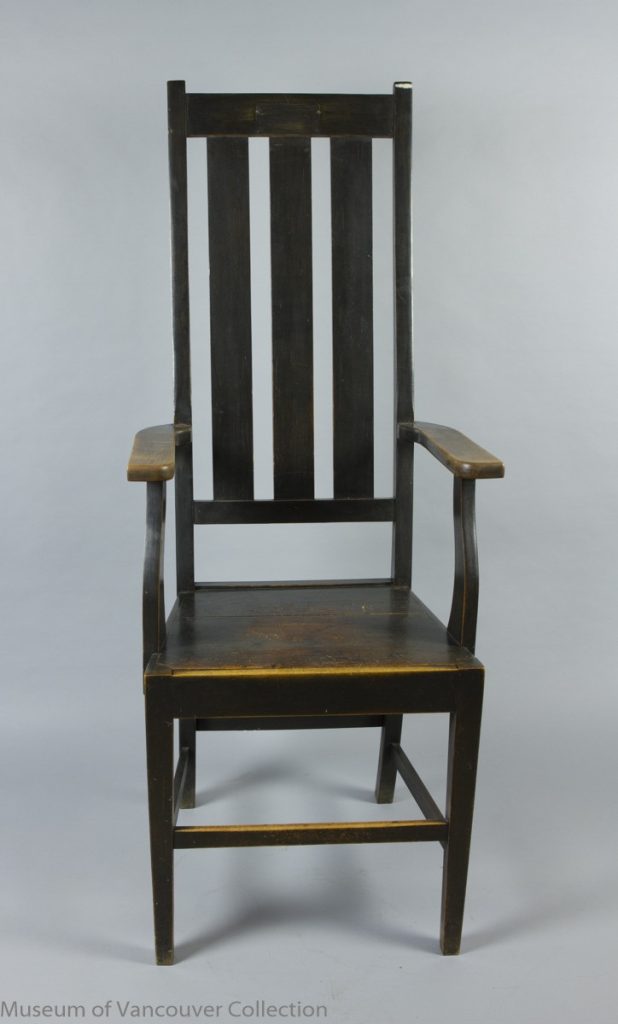
One of the more imposing and distressing objects from colonial times is a high-backed, dark stained oak chair near the entrance. It was used by Matthew Baillie Begbie, the first chief justice of the Crown Colony of British Columbia. Following a jury verdict in 1864, Begbie pronounced the death sentence on five Tsilhqot’in chiefs convicted of murder. In reality, they were resisting colonization during the Chilcotin War.
“It’s said that this chair travelled with him throughout the Fraser Canyon when he did trials,” Fong said.
Afgter his death, Begbie became known as the “Hanging Judge”. The B.C. government exonerated the Tsilhqot’in chiefs 150 years later in 2014. Begbie’s chair is fittingly place near the entrance to another Museum of Vancouver exhibition entitled The Work of Repair: Redress & Repatriation, which celebrates Tsilhqot’in culture. It continues until April of next year.
Diversity of city reflected in chairs
Other chairs summon more joyful aspects of B.C. history. One example is a Morris Chair owned by Joe Fortes, a Trinidad-born lifeguard who lived in Vancouver’s West End. According to accounts of his life, he saved more than 100 people from drowning. He also taught thousands of children how to swim.
Another chair is from the kitchen of famed Chinatown merchant Yip Sang. His home in the Wing Sang Building is now the site of the Chinese Canadian Museum.
“He had four wives,” Fong noted. “Probably lots of kids sat in it.”
Then there is metal bar stool that was in Little Sister’s Book and Art Emporium when Janine Fuller was the manager fighting for LGBTQ rights. This custom-made chair includes a gold plaque with the store’s name as the back rest. In this area, there’s a video featuring an interview with Fuller.
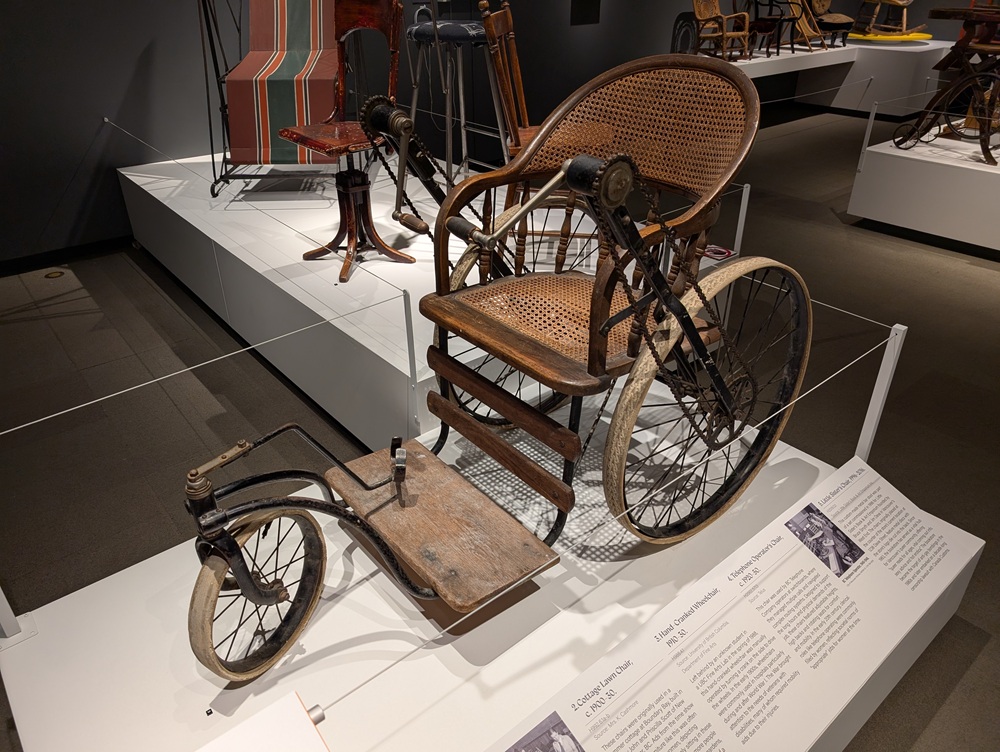
The exhibition also shows how children’s seating has evolved. Plus, there’s an early wheelchair, an old and long pew from Christ Church Cathedral, and a yellow chair from the former Vancouver Public Library central branch at Robson and Burrard.
Theatre seats bring back memories
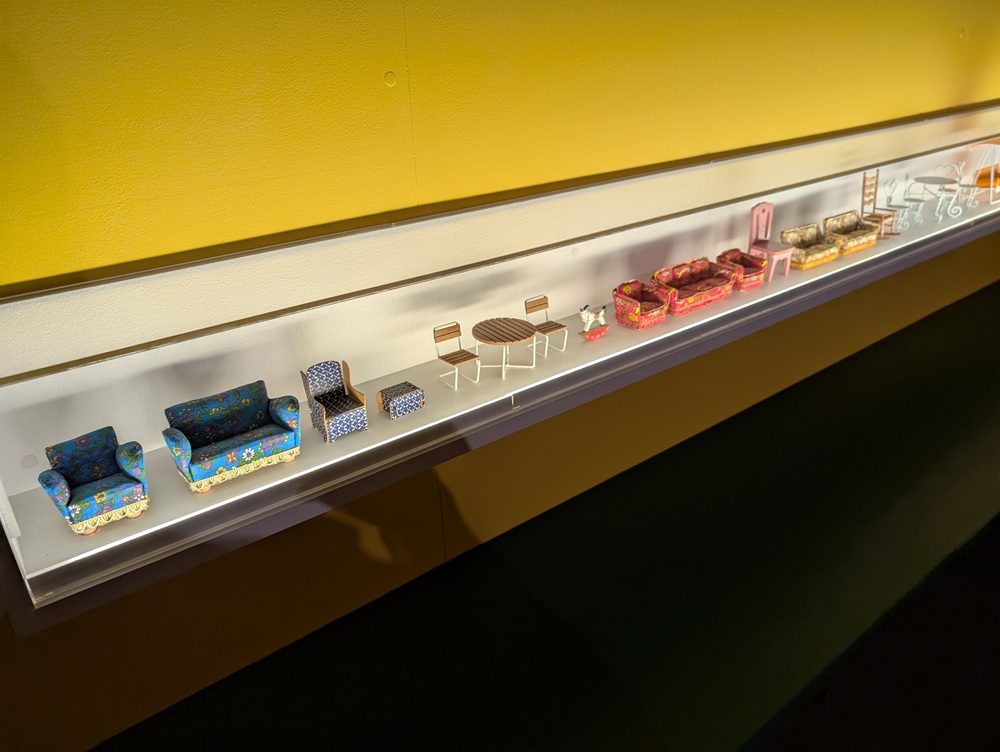
That’s not all. There are also seats from the old Pantages Theatre, Park Theatre, and Theatre Under the Stars, along with an antique Koken’s barber chair, Indigenous-designed chairs sold to tourists, and a whole bunch of miniature chairs.
What makes this exhibition so delightful is that it’s not just a collection of chairs. It’s also a collection of stories about these chairs and the owners or occupants. Celebrated collector, researcher, and curator Allan Collier contributed an essay about mid-century chairs. Civic historian and heritage consultant John Atkin wrote a piece about the Jewish community’s connection to local furniture businesses. And Vancouver photographer Mark Mushet shared his photographs of chairs sitting in back alleys.
In addition, Vancouver artist Jessie Sohpaul created stools inspired by the city’s first gurdwara in Kitsilano.
“It’s a really nice connection for us because we’re also in Kits,” Fong said. “He custom-made these stools for us as part of the Chair show theme.”
The Museum of Vancouver will present Deep-Seated Histories: Chairs from the Collection until January 4. For more information, visit the Museum of Vancouver website. Follow Pancouver on X @PancouverMedia and Instagram @PancouverMedia.