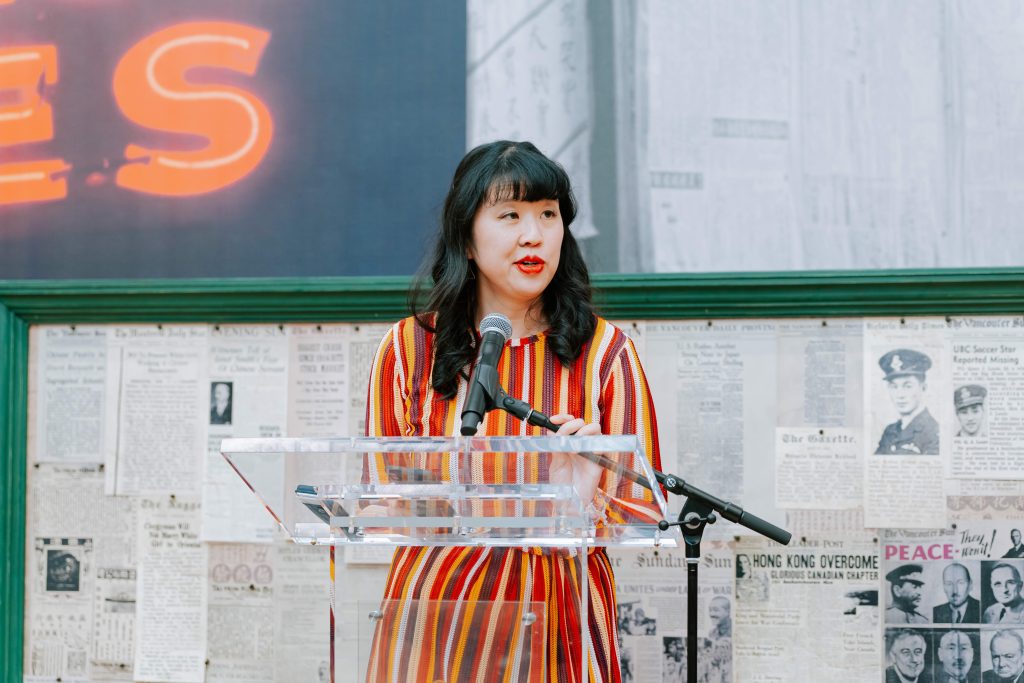
When Giselle K Liu began choreographing a duet about the healing power of matriarchal connection, it made sense to include her mother in the creative process. The impetus for Liu’s latest work, Behind Veiled Eyes, was the birth of her niece in 2021.
“I never imaged myself seeing three generations in the same room—and that was like a dream come true,” Liu tells Pancouver over Zoom.
Liu, an interdisciplinary choreographer, divides her time between Richmond and her hometown of Prince Rupert. She never knew her grandmothers, who died before she was born. Her mother, an immigrant from Hong Kong, served as costume designer on Behind Veiled Eyes because she could create a traditional Chinese outfit.
“I also work with paper for my costuming,” Liu says. “In regards to culture and tradition, I use red thread that’s pressed into the costumes.”
These aren’t the only Chinese cultural components in Behind Veiled Eyes, which will be performed at Dancing on the Edge. Liu also wanted to incorporate her mother’s first language. To accomplish this, she wrote a poem and asked her mother to translate it into Cantonese.
“What was important to me was to have a shared process with my mother,” Liu explains.
Liu’s parents’ ancestral roots go back to Shun Tak, which is in Foshan, Guangdong. Liu’s mother reads the poem in this Method Dance Society interdisciplinary production.
Behind Veiled Eyes is performed by two sisters, Caitlin and Abigael McCormick. Their duet immerses audiences in the intricacies of family relationships.
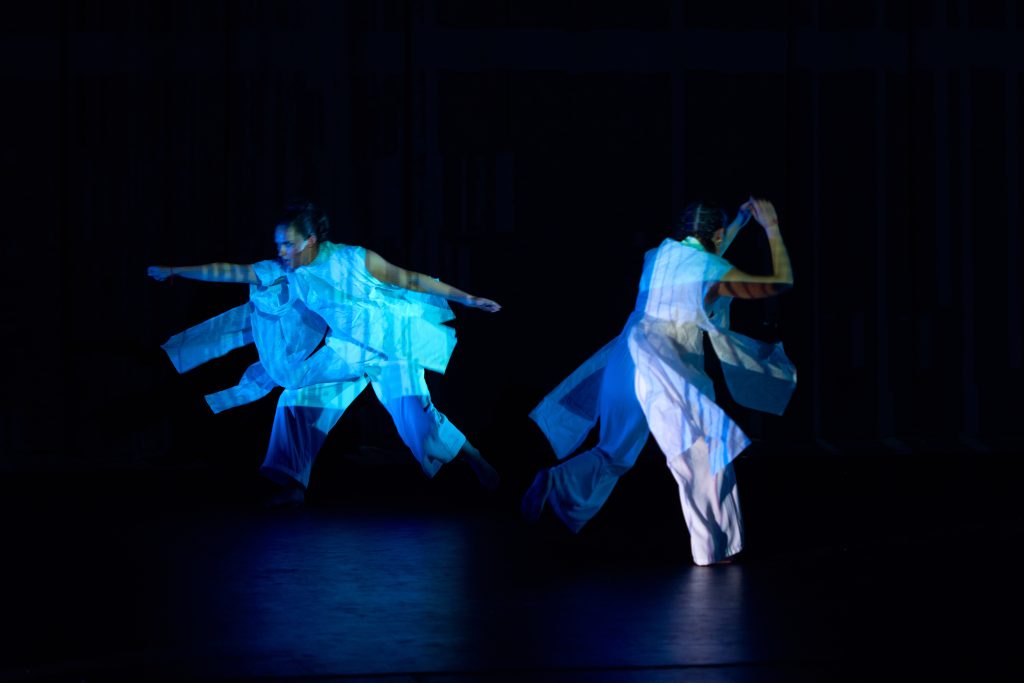
Liu says movement is her mother tongue
The title reflects Liu’s interest in what exists beyond “typical perceptibility”.
“Within the scope of my work, I’m always exploring the visibly hidden—things that are already there that we’re intricately interconnected to, but not necessarily visible to our eyes,” Liu explains.
The McCormick sisters grew up on unceded ancestral lands of the Lheidli T’enneh Nation in north-central B.C. Even though the dancers don’t speak Cantonese, they designed movements from their interpretation of Chinese script.
“We are looking at the forms and the lines and the shapes,” Liu reveals.
In effect, the choreographer invited dancers into her culture by transliterating these characters through their bodies in a highly collaborative process.
Behind Veiled Eyes also includes a soundscape, projection, and exploration through expressive art. Liu notes that she’s not an expert in those fields but makes use of them in her work. Movement, she emphasizes, is her “mother tongue”.
“I just want to be clear: I am a choreographer,” Liu declares. “Sometimes I work with bodies, sometimes I work with words, sometimes I work with sound.”
She started dancing in Prince Rupert at the tender age of three, following in the footsteps of her cousins. By the age of 10, Liu began devising her own new dance works and attending competitions. She went on to earn bachelor’s of arts in dance from the University of Calgary, followed by a master’s in fine arts in interdisciplinary arts from Simon Fraser University.
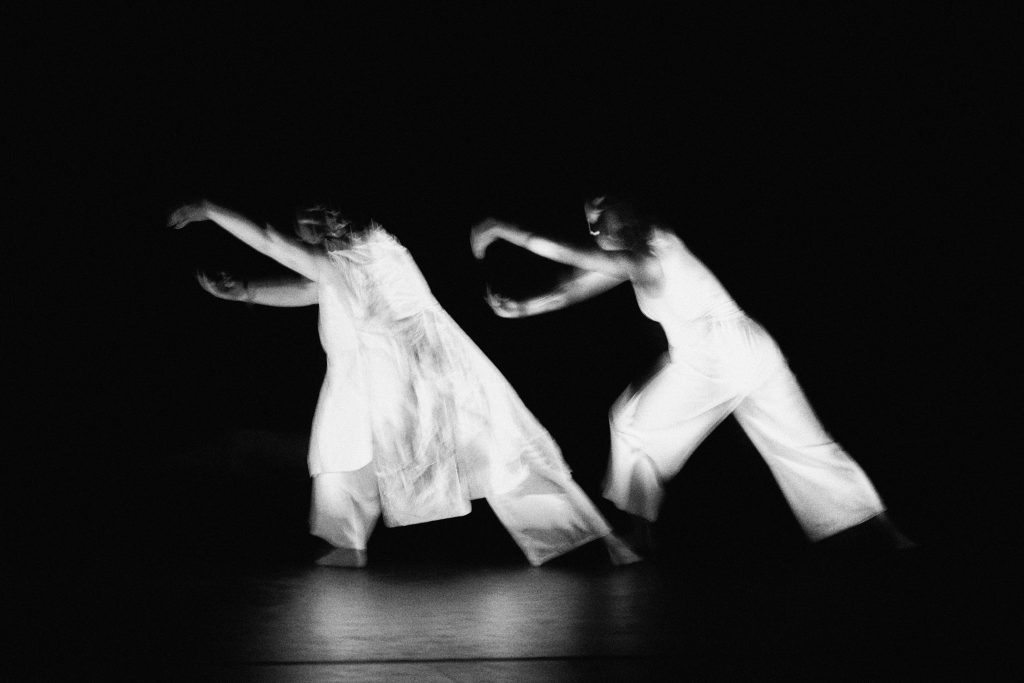
Growing up Asian on Indigenous land
Liu spent 11 years of her life in Hong Kong honing her skills as a movement artist. This included collaborating with the Hong Kong Youth Arts Foundation. There, she co-choreographed the musical Melodia, which was performed by the late Violane Corradi and Rose Winebrenner, and directed by Lindsey McAlister. It included puppetry, aerial arts, word, song, dance, and physical theatre—a veritable crash course in interdisciplinary choreography.
Even when Liu was in Hong Kong, she tried to get home frequently to share what she was learning with dancers in Prince Rupert. To this day, Prince Rupert remains a very large force in her work.
“I grew up in an Asian family on Indigenous land,” Liu says. “So, I would say that even leaning toward this piece, family has been such a grounding concept for my own life philosophy and morality—and in understanding the strength that it builds.”
She points out that this integration between family and the Indigenous character of northern B.C. is in “continuous conversation”. She manifested this in her experimental short film, “SMGAN (cedar)”. It shows Indigenous artist Tina Robinson responding to her ancestors’ call to preserve traditional weaving and the Sm’algyax language.
Liu maintains her passion for community with Method Dance Society. It aims to increase appreciation for contemporary dance in northern B.C. by presenting works from unceded Lheidli T’enneh traditional territory.
“With Method Dance, we have a philosophy,” Liu states. “We build with the community for the community.”
Event details
Dancing on the Edge presents Method Dance Society’s production of Behind Veiled Eyes on June 18 and 20 at the Firehall Arts Centre. For more information and tickets, visit the Dancing on the Edge website. Behind Veiled Eyes will also be performed on November 10 as part of Conversations in Six at the Prince George Playhouse. Follow Pancouver on X (formerly Twitter) @PancouverMedia and on Instagram @PancouverMedia.
This article is part of “Beyond Chinese”, a joint initiative of Pancouver and the Asian-Canadian Special Events Association. Through interviews with artists and cultural workers, Beyond Chinese intends to offer a more nuanced view of people with Chinese ancestry. Pancouver and the Asian-Canadian Special Events Association gratefully acknowledge the support of Canadian Heritage.