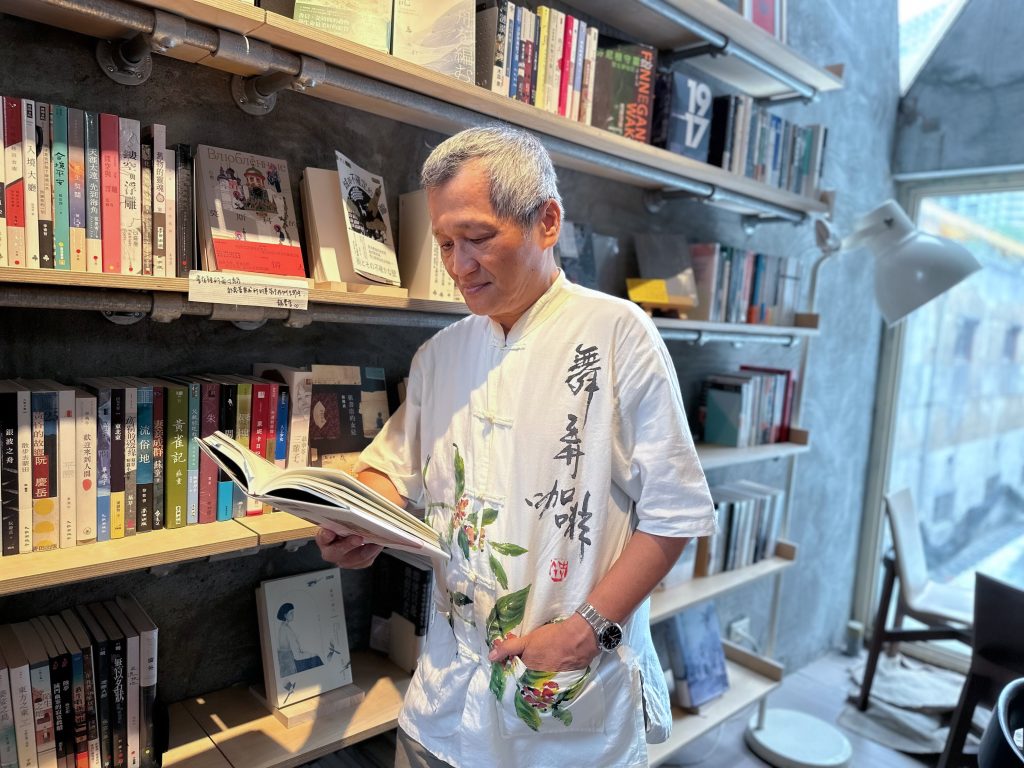
Historian Kaim Ang thinks that the world needs to consider Taiwanese history through a multi-ethnic lens. Ang, a research fellow emeritus at Academia Sinica’s Institute of Taiwan History, believes that this enables people to go beyond seeing China and Taiwan as an inseparable unit.
In an interview with Pancouver, the respected scholar points out that from the16th century onward, historical records began explicitly mentioning Taiwan and its surrounding islands.
“These sources described a diverse population that included Indigenous communities, as well as incoming fishermen, merchants, and adventurers—many of whom were pirates,” says Ang. “Notably, the infamous ‘Wako’ (倭寇) frequently referenced in Chinese historical texts as Japanese pirates were, according to most contemporary historical research, not predominantly Japanese. Instead, they were mainly seafaring people from China’s Fujian, Guangdong, and Zhejiang regions.”
In addition, the Taiwanese historian states that people from Japan (and likely Korea), Southeast Asia, Portugal, Spain, the Netherlands, and England also came in contact with Taiwan during the Age of Exploration. According to Ang, the international situation from the 16th to the 18th centuries was highly dynamic, and Taiwan was far from an isolated island.
In fact, it was already deeply connected to the outside world, in ways not unlike the present.

Ang says history can shape national identity
“Approaching this period of history enables us to move beyond a Han-centric or Sinocentric worldview, or the idea of a ‘family-state’ where Taiwan and China are one inseparable unit,” Ang emphasizes. “Instead, it opens the door to a more global, multi-shore perspective—shifting from a cross-strait narrative to a multi-strait or global view. It invites us to rethink history through a multi-ethnic lens, rather than from a single ethnic or national vantage point.”
Ang will deliver a free lecture, Taiwan’s History from the Age of Exploration Onwards 「祖國」是誰的國? 從近代初期海洋看台灣歷史, as part of Vancouver TAIWANfest. He will speak at 4 p.m. on Saturday (August 30) at the Annex (823 Seymour Street).
For more than a decade, Chinese president Xi Jinping has been making overtures to “overseas Chinese”. He talks about the “Pan-Chinese Nation”, as if everyone with some Chinese ancestry, regardless of national origin or political ideology, shares a common civilizational bond. But according to Cornell University historian Mary Yue Du, the People’s Republic of China’s efforts to recruit overseas Chinese to this fanciful idea “have only achieved limited success”.
Meanwhile, Ang maintains that actual history—contrary to traditional Chinese historiography—is not a tool for predicting or determining the future.
“Rather, it serves as a reference point for imagining possible futures,” Ang insists. “Studying Early Modern history is not about assuming that era shapes the present directly but is about uncovering the roots of contemporary tensions in Taiwan and seeking new directions for national identity and reconciliation.”
Portuguese language left a mark on Taiwan
Portugal led the way in exploring East Asia and established a de facto colony in Macau in 1557. According to Ang, Portuguese became a lingua franca across East Asia from the 16th to 18th centuries, even though it never established dominion over Taiwan.
“This influence can be seen in several transliterated Portuguese loanwords found in historical Taiwanese texts, such as capitão (‘captain’, rendered as 甲必丹), padre (‘priest’, 巴禮), alcool (‘alcohol’, 啊口), and tabaco (‘tobacco’, 淡巴菰 / thà-ba-khòu),” Ang says. “More widely known everyday terms like pão (‘bread’, 麵包/pháng) and sabão (‘soap’, 肥皂 / 雪文 / sap-bûn) also entered local usage directly from Portuguese.”
Spain and the Netherlands each colonized Taiwan in the 17th century, leaving their footprints on Taiwan in different ways. According to Ang, they were also influenced by Portugal’s early presence in the region.
“Looking more closely, during the Dutch period, prominent interpreters such as He Bin were known to use Portuguese when communicating with Dutch officials, highlighting its regional utility,” Ang states. “Prior to Japanese rule, the people of Taiwan referred to the Portuguese of Macau, their ships, and their tobacco simply as Makou-lang (媽口人), Makou-chûn (媽口船), and Makou-ian (媽口菸), respectively.
“These examples suggest that although Taiwan was never under Portuguese rule, its historical relationship with Portugal was one of indirect yet meaningful contact—’distant yet near’—and remains a rich subject for further exploration,” he notes.
Ang says that Portuguese sailors were referring to 0ne of the Ryukyu Islands, and not Taiwan when they described it as “Ilha Formosa (Beautiful Island)”. Yet the Portuguese are often falsely credited for giving the name “Formosa” to Taiwan.

Conflict kept rulers in charge
Under the Ming dynasty, migrants from China crossed the Taiwan Strait to Taiwan in the 16th and 17th centuries. Ang emphasizes that it wasn’t limited to Hakka and Minnanese (Southern Fujianese), though this is widely believed. Historical records and old place names indicate that migrants also came from Xhinghua and Fuzhou in Fujian and from parts of Zhejiang Province.
“These Han Chinese groups, due to differences in language and connections to their native regions, often settled in clustered communities based on origin, while smaller or less dominant groups were gradually assimilated,” Ang states. “This pattern gave rise to the common perception of ethnic-geographic distribution in early Taiwan: people from Quanzhou settled along the coast, Hakka communities lived in the foothills, Zhangzhou settlers occupied the plains in between, and Indigenous peoples remained in the mountains.”
He notes that the Qing dynasty (1644-1911) fomented conflicts between different ethnic groups on the island to prevent any unified challenge to their authority. “In other words, not all ethnic conflicts were inherently antagonistic—many were provoked, orchestrated, or exaggerated for political ends.”
He adds that traditionally, members of the Chinese elite travelled to the capital for imperial exams. Knowledge and power gravitated toward the emperor historically.
“This often came at the expense of local cultures and languages, especially in the borderlands of the Chinese empire such as Fujian, Taiwan, and the ethnic minority regions in the interior,” Ang states. “In my generation, very few of us are both fluent in our mother tongue or ancestral language and able to conduct academic research in it. As a result, the historical narratives we produce are inevitably flawed and disconnected from the land on which we live.”

Lessons from history
As a result, Ang argues that these narratives do not yet represent a grounded and place-based form of historical subjectivity. Furthermore, he feels that his generation’s advocacy for universal democratic ideals is often more conceptual than practical. But he believes that the younger generation’s return to a “more grounded and realistic trajectory” will lead to more concrete and contextually appropriate developments in Taiwan’s democratic system.
“For example, they may be better positioned to move beyond outdated constitutional frameworks that no longer reflect the lived realities of the people.”
So, what is the biggest lesson that Ang has learned from studying history?
“As students in a history department, we usually take a course called Introduction to Historiography, where we first encounter the academic definition of history.” He replies. “It’s there that we learn the term ‘history’ doesn’t simply mean ‘past events’. It comes from the Greek word historia (Ιστορία), which means ‘knowledge acquired through inquiry or investigation’, and even ‘scientific observation’.”
In other words, human history doesn’t merely refer to the history of humankind. Rather, it refers to the study and inquiry of all aspects of the human condition.
“It is not limited to heroic narratives, political events, or the history of a single nation-state,” Ang insists. “In short, it was through the study of historiography that I came to deeply understand the importance of constantly asking: what is history? Who am I? Who are we? And what actually happened?”
Event details
Vancouver TAIWANfest will present a free lecture by Kaim Ang called Taiwan’s History from the Age of Exploration Onwards 「祖國」是誰的國? 從近代初期海洋看台灣歷史. He will speak at 4 p.m. on Saturday (August 30) at the Annex (823 Seymour Street). Ann Cheng translated Kaim Ang’s responses into English for this article. Follow Pancouver on X @PancouverMedia and Bluesky @pancouver.bsky.social. Pancouver is also on Instagram @PancouverMedia.